
At Fondation Cartier in Paris, Ibrahim Mahama and his former mentor Dorothy Amenuke explore collective memory, community and the promise of Ghana’s independence movements in The Harvest Season. They speak to Elephant about the radical potential of everyday materials and harvesting hope from history. Words and interview by Daisy Finch.
At Fondation Cartier in Paris, Ibrahim Mahama and his former mentor Dorothy Amenuke come together for The Harvest Season, an exhibition rooted in collective memory, artistic exchange and the enduring promise of Ghana’s independence movements. The artists speak to Elephant about the importance of community, the radical potential of everyday materials and harvesting hope from the remnants of history. Words and interview by Daisy Finch.
History can often feel flat and faded, stripped back to the turn of a page. But in The Harvest Season at Foundation Cartier, it breathes. Ibrahim Mahama propagates seeds of hope dating back to the African independence movements in the middle of the 19th-century, this time nurtured by the optimistic contributions of his fellow exhibitors – including one of his mentors, artist and lecturer Dorothy Amenuke.
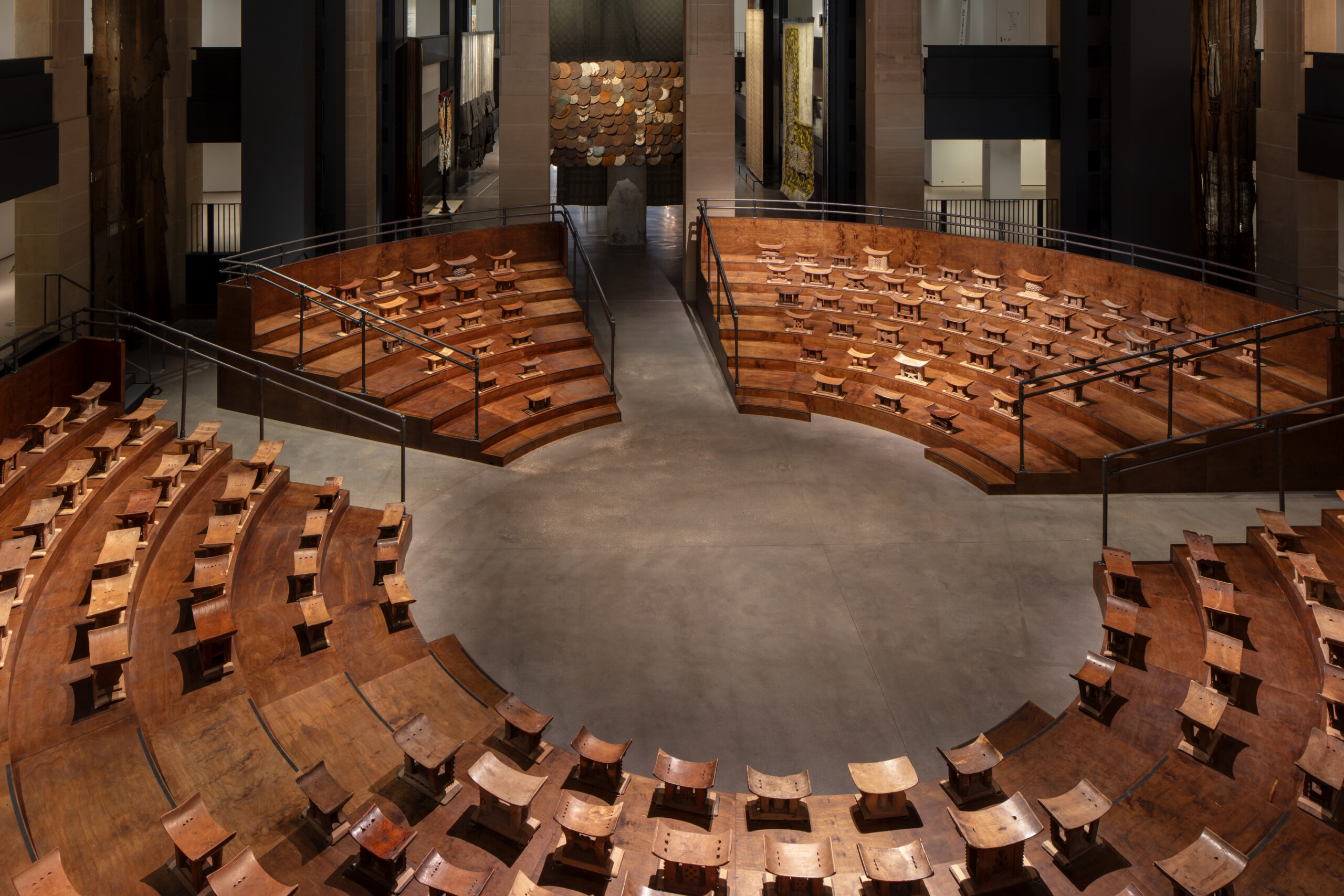
Nothing feels unreachable in the contents of Foundation Cartier’s showcase, and nothing feels static. In Parliament of Ghosts, Ibrahim explains that stools which have historically been brought to Europe as ethnographic objects are now being relocated to Paris in a wholly different context: there are gifts showing signs of repair, of use, and people are invited to sit on them. The exhibition as a whole is focussed on the exchange of ideas as a basis for growth, both between the work and visitors, and between a broader community of artists in Ghana, Paris and beyond.
From Ibrahim’s Ghanian stools to Dorothy’s scrolls woven from Pandanus plants by local craftspeople, there is nothing passive in The Harvest Season. This exhibition looks and moves forward, taking notes from a hopeful, creative past in order to realise a similarly optimistic future.
Could you both describe your artistic practice, in your own words.
Ibrahim: Let my mum start first.
Dorothy: Ahh! I think that since you have been going around the world you can.
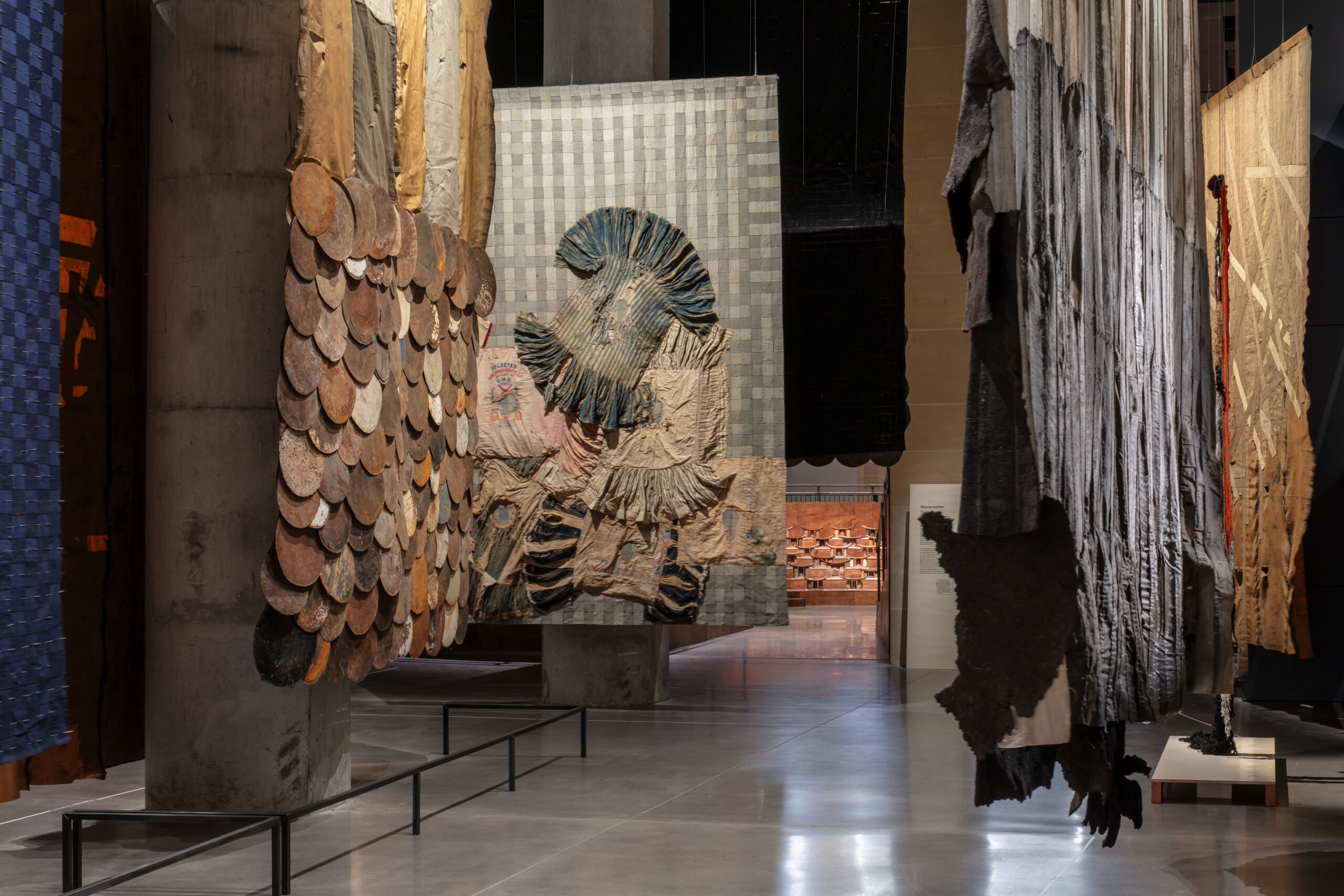
Ibrahim: This sounds like an instruction, who am I to say nothing? Simply, I studied at Kwame [Nkrumah] University from 2006 to just recently, I was in the painting and sculpting department where Dorothy is a professor. I was heavily influenced by the programme there, in terms of materiality. I think Dorothy was one of the first artists to introduce experimental materials within the curriculum. I remember as a student, some of my coursemates who were doing sculpture, were like “There’s this female lecturer who is always asking us to use all these different materials. Why can’t we just use our normal stone?” Because they were so used to that.
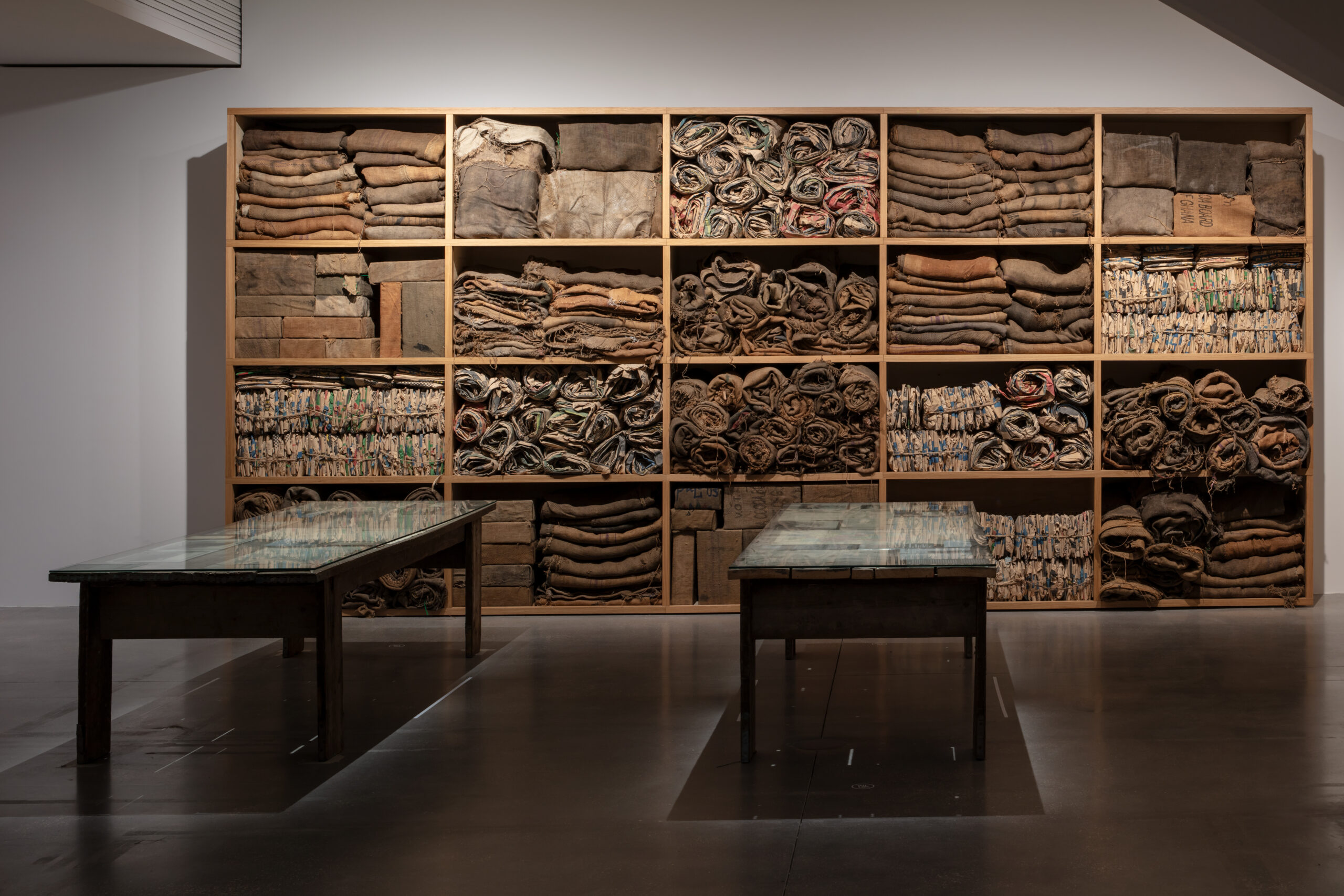
When I started doing experiments using jute sacks, Dorothy would invite me to her class to share some of the ideas I was working with. She would also send students to help me in the studio or in the installation of work. I remember one of the first major installations I did, she sent her entire class to help me. That was very important for me in order to think of how I could conceive my work in the future. That led to doing large projects across the city, and deciding later on to build my studio in Tamale, with regards to making it a space where we could share the work we’re producing with the larger community. Understanding that art was not just about producing objects, but about how you could rebuild space and share that space.
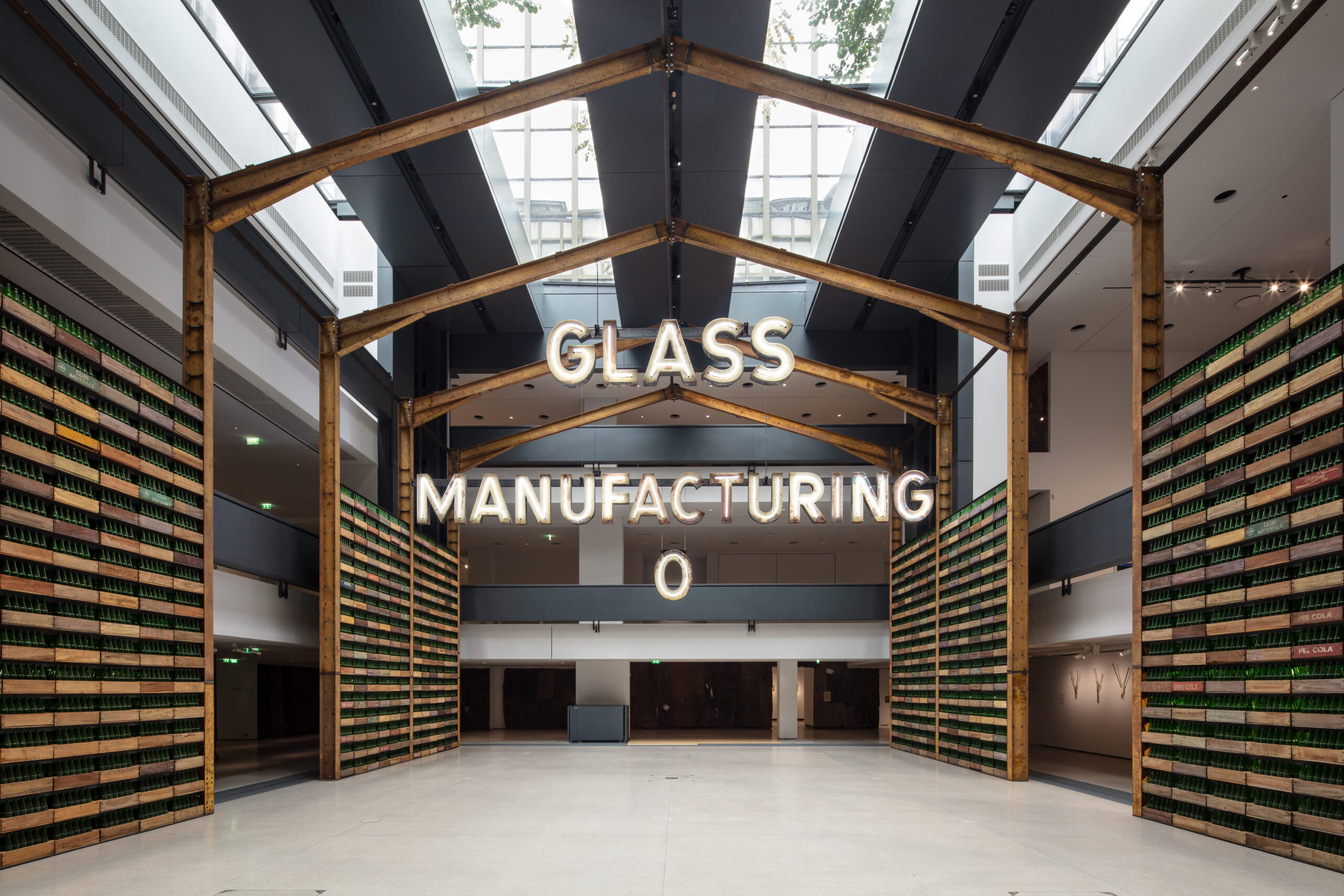
In Kumasi, it was about communality. Before, artists were in their own small corners trying to create opportunities.Now, it’s about how they could share, how we all come together to do things. So, if we’re talking about practice, for me it’s been very wide and broad but I like talking about it in relation to this question of community building.
That’s what The Harvest Season at Cartier is about. That’s why we have Dorothy as a very important part of the exhibition – because it’s also about influence, about people whose work and legacy has shaped some of the thinking we’ve conceived within our generation, and how we are pushing it forward.
The work I’m doing is also largely focussed on redistribution: how do we redistribute what we do artistically, materially, and ideologically? Because we’re coming from a severe history of deficit. There was so much deficit in the colonial period, and so much promise in the independence era. In the post-independence era, there was a decline. Materials managed to embody these deficits in many different ways. As an artist, I think our role is to use artistic agency and a question of collective responsibility to excavate the promises that are hidden within decay and the deficits of history.
Dorothy: I think you’ve said a lot and almost all. The Faculty of Art, and especially in sculpture, was mainly about traditional materials like wood, cement, and clay. Stone work was even a bit recent. But then, right from my undergraduate time – that was the late ‘80s and early ‘90s – some of us started questioning, should it be like this forever? We started looking for other materials, everyday things that people encounter that could have this sculptural effect.
It caused some of us to go back and look into history, [to] see whether there were some unconventional materials. In the ‘60s, people like [Claes] Oldenburg would make soft sculptures and I was wondering, “How come in the system, in schools, we’re not doing that?” That pushed us to start to look at other things we encountered that were not hard sculpture. Initially it was like, “Dorothy, what are you doing? Blah, blah, blah.” You encounter that. But I also realised, because of the way sculpture appeared, you get very few ladies who wanted to come and be lifting [heavy] metal and huge wood. My mind was, “Must it be difficult? Must it be hard? Must it be heavy if it’s sculptural?”
These questions led me to explore materials that [would not be] problematic for the ladies who would want to [use them]. I would work with leaves, I would work with sawdust, I would work with fabric. And it grew and grew. Initially, even my soft sculptures with soft material would turn out a bit hard – instead of casting cement, I’d cast paper and leather, so they would appear hard. I think that the idea of working with what we have, our everyday existence and experiences, is what art is about.
Community and the exchange of ideas are big themes within both of your bodies of work. How does teaching feed back into this for you, Dorothy, particularly in regard to Ibrahim? Ibrahim, why was it so important to you to get Dorothy involved?
Dorothy: Ibrahim, would you like to speak?
Ibrahim: Oh no, you speak. I’m just listening. I’m a good boy today.
Dorothy: Look at you! [Laughs] For us, the opportunity [is] to keep sharing. Not that this person is my student, this person is my lecturer – we’ve gone beyond that and have found ourselves in a space of sharing. When that happens, the thought is: what do we have to give to the world?
Because our bottom line is the gift we have to give, and how we give it. So we find ourselves in spaces of sharing: a museum is a space of sharing, the objects we use are spaces of sharing, what we create are spaces of sharing.
Somebody was asking me [why] I talk about pillows. A pillow is about thought – the pillows may be different kinds and shapes, but the bottom line is a place of thought. It may not be a physical pillow, you see, but whatever it is that gives people the opportunity to think becomes a pillow, a place of thought. For me, Harvest Season is [about] sharing pillows, sharing ideas, letting people see what we have been thinking. My pillow is different from Ibrahim’s pillow, but they are still pillows.
Ibrahim: I totally agree with Dorothy on this. The question of sharing thoughts is very important. Sometimes you have mentors, you could even have mentors within the same generation. Now, of course, I relate very well to Dorothy and all the lecturers within the faculty. But at the same time, I give them all the respect that is needed because they are also people that nurtured you. They are older than you. In Ghana, we don’t play with that.
We have to talk and find ways in which we can help one another to get things done. I don’t take it for granted at all.
You both draw on the African independence movements as a source of inspiration for a more hopeful future. What creative material does this period of time provide you both with, what does it represent to you and what does it mean for your work?
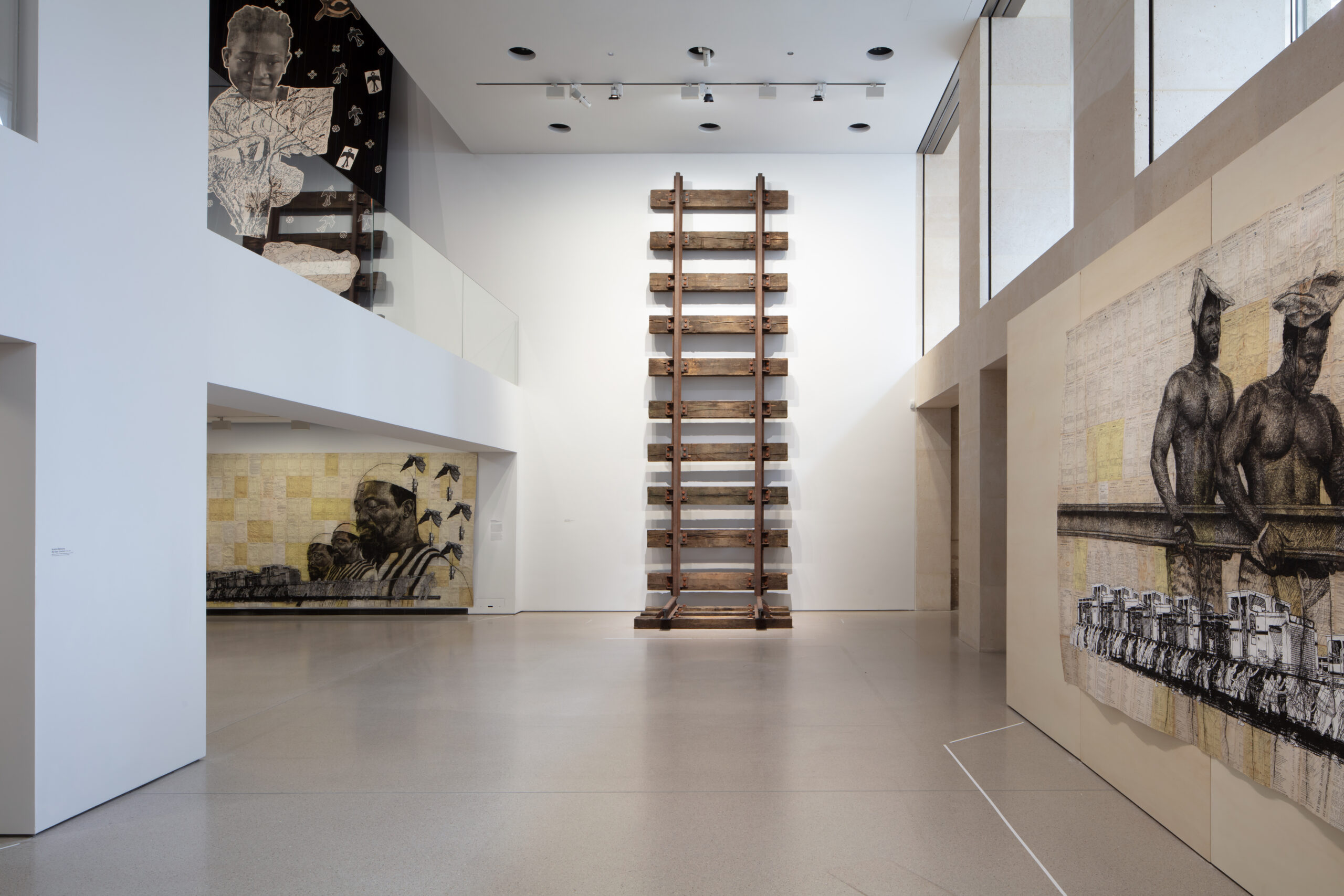
Ibrahim: Before the colonial period, there were different traditional societies that gathered knowledge, shared craft skills, weaving techniques – and the colonial period disrupted a lot of things. The idea of the independent struggle was a revolutionary revival, a way of going back into the past [and] producing new knowledge because so much had been extracted.
They took all the energetic people during the post-slavery period to build railway systems, but the railway system was not for us: it was for the extraction of raw materials. There are residues that still linger in buildings and architecture. Sometimes it’s easy to be gloomy and think that nothing is possible in the world, but I like to think there’s so much possibility out there.
As artists, we want to create work that can renew promise within the world. That’s why building a studio or teaching is important. Dorothy could have stopped her teaching and concentrated purely on her practice, but influencing a generation of people is very important. That’s why I kept on having this relationship with the university. Being there and people seeing you reminds them that they are not far [from achieving similar things] because it wasn’t many years ago that I was sitting in those classrooms. It makes them realise they have that same capacity.
Dorothy: It is very important for us that students [who] have gone out and are practicing and experiencing the world beyond Kumasi and Ghana come back and share their ideas. I think we’ve come to a point where we understand that what we have here is capable of creating [something] the world can see as important.
I create scrolls from the natural Pandanus plants. I go to the Volta region and commission people to weave. They were previously the kind of plants they weave into mats that people sleep on, but these days, because of the mattresses we have, they don’t use them anymore. So the people have gone out of a job. I’ve gone back to them, talked with them and these days, only a few people come for it. They come for it because they keep it in their house so that – should anybody die in the house – they don’t put the person on a mattress, they put them on the mat. So then I order a whole lot to create my works with them. They [said], “Hey, you come and you make us do this for you. At least you’ve put us back into business!” And I say, “Yes, that’s part of the art that I do.” It will draw people’s attention to [the fact] that we still create these things.
It’s not just about me, it’s about all the people who are involved in what we are creating through the production of the basic materials, the art creation itself and what we give back to the community.

What’s one thing you want people to take away with them from the exhibit?
Ibrahim: It’s about the harvest season [but] it’s not just about the question of physical harvest. It’s like we’re harvesting history, we’re harvesting ghosts, stories, collective memories [and] we’re re-sharing that with the world. [In] Parliament of Ghosts, we’ve taken stools from Ghana all the way to Paris to live the lives that they were still living when they were in homes. Most objects that were taken to Europe during the colonial period were reduced down to ethnographic objects in museum cases. You never touch them. This time around, we are bringing these objects of significant historical memory as gifts, where people can sit on top of them. People can even see the history of repair on these objects.
We’ve seen our fair share of extraction and brutality. And if we’re willing to share with the world, then it means that people who find themselves in the European continent or in places of extreme privilege, can think of the world much better. Because if you can be hopeful in the context of deficits, then you should be more hopeful in the context of excess, you know? The question of the harvest is the question of harvesting hope in the midst of crisis in order to be able to give to the world.
Dorothy: We are all hopeful. We are all enthusiastic. We are hoping that people come to the exhibition and be enthused and also learn beyond what they see.