
Last month, Sable Elyse Smith spoke with Johanna Fateman – art critic and editor – on the occasion of the artist’s exhibition at New York’s FLAG Art Foundation. Through repurposed prison furniture, newly commissioned video installations and text-based works, Clockwork examines the overlapping systems that govern contemporary life – from policing and incarceration to media, language and popular culture – and the often invisible ways that they shape perception. Their conversation is transcribed below.

JON RIDER: Good evening. My name is Jon Rider and I’m the Director here at The FLAG Art Foundation. I want to thank you all for joining us tonight for a conversation between artist Sable Elyse Smith and critic and editor Johanna Fateman, presented on the occasion of Smith’s solo exhibition, Clockwork, which you are currently in and spans FLAG’s ninth and tenth floors.
For context, Smith is the recipient of the 2026 Suzanne Deal Booth / FLAG Art Foundation Prize, the last and final iteration of the award. Following its previous presentation at The Contemporary Austin, which operated more as a monographic survey, FLAG reframes the work by expanding its more cinematic elements into an immersive stage environment where video becomes the immediate means of visualizing when seeing ordinary violence.
To give a bit of background, Sable Elyse Smith is an interdisciplinary artist and writer based in New York. Her creative practice spans video, performance, and the visual arts. Smith’s work has been featured in exhibitions at The Museum Modern of New York, MoMA PS1, the New Museum, the Studio Museum in Harlem, the Solomon R. Guggenheim Museum, and ICA Boston, among others.
In 2022, she was included in both the Whitney Biennial and the 59th Venice Biennale. Smith has received awards at the Joan Mitchell Foundation, Creative Capital, the Louise Comfort Tiffany Foundation, Fine Arts Workshops, Skowhegan and Art Matters.
Johanna Fateman is the Chief Art Critic and Editor of The Critic’s Table for Cultured Magazine. Previously, she wrote regularly for 4Columns, The New Yorker and Artforum, where she was a contributing editor. She was nominated for the 2026 National Magazine Award in Reviews and Criticism category for three stories she wrote for The Critic’s Table, including an essay on the work of Kevin Roland and a dispatch for New York Art Week.
She also has an essay in the Metropolitan Museum of Art’s catalogue Krasner and Pollock: Past Continuous, published in conjunction with this fall’s landmark exhibition, and for Jody Pinto: Body/Land, the first monograph on the artist which accompanied her presentation at moCa Cleveland. Tonight’s conversations will be about 45 minutes long, followed by a Q&A. And with that, I want to thank everyone for joining us today and welcome Sable and Johanna on stage.

JOHANNA FATEMAN: Thank you, Jon, for the introduction and thank you to The FLAG Art Foundation and Sable for inviting me. It’s an honor to be here.
I just wanted to start off by saying that this show is my first chance to see your work in quantity, to see a few different bodies of work interact. I’m trying to remember when I first saw your work. I think it was at the New Museum exhibition Trigger: Gender as a Tool and a Weapon, which is the landmark show about gender and embodiment. I then saw it in the MoMA PS1 show, Marking Time: Art in the Age of Mass Incarceration.
Your contributions to both exhibitions were very striking and memorable to me. And both exhibitions really framed your work in a certain way. As thematic shows, they highlighted specific aspects of your work. So this has been my first chance to see it breathe a little bit.
I’m wondering if you can tell us a bit about the show in Austin, and a bit about the process of creating this distilled version for the New York iteration of Clockwork.
SABLE ELYSE SMITH: The Austin exhibition is maybe three times the scale of this space. The state capital of Texas is also located in Austin and it’s right near the Museum. So, when I stepped out of the front door of the exhibition, I could look right at the Capitol Building. There are a lot of questions around language censorship and what kinds of speech acts or utterances are possible in public. And so I was thinking about that a lot, and it resonates with a lot of topics that I’m interested in. So that’s one foil around the exhibition.
I never had a large show in Texas before. I’ve shown one off pieces in group shows. So it felt important to contextualize my overall practice. The other thing that I was interested in which hadn’t happened either was having a “sculpture show.”
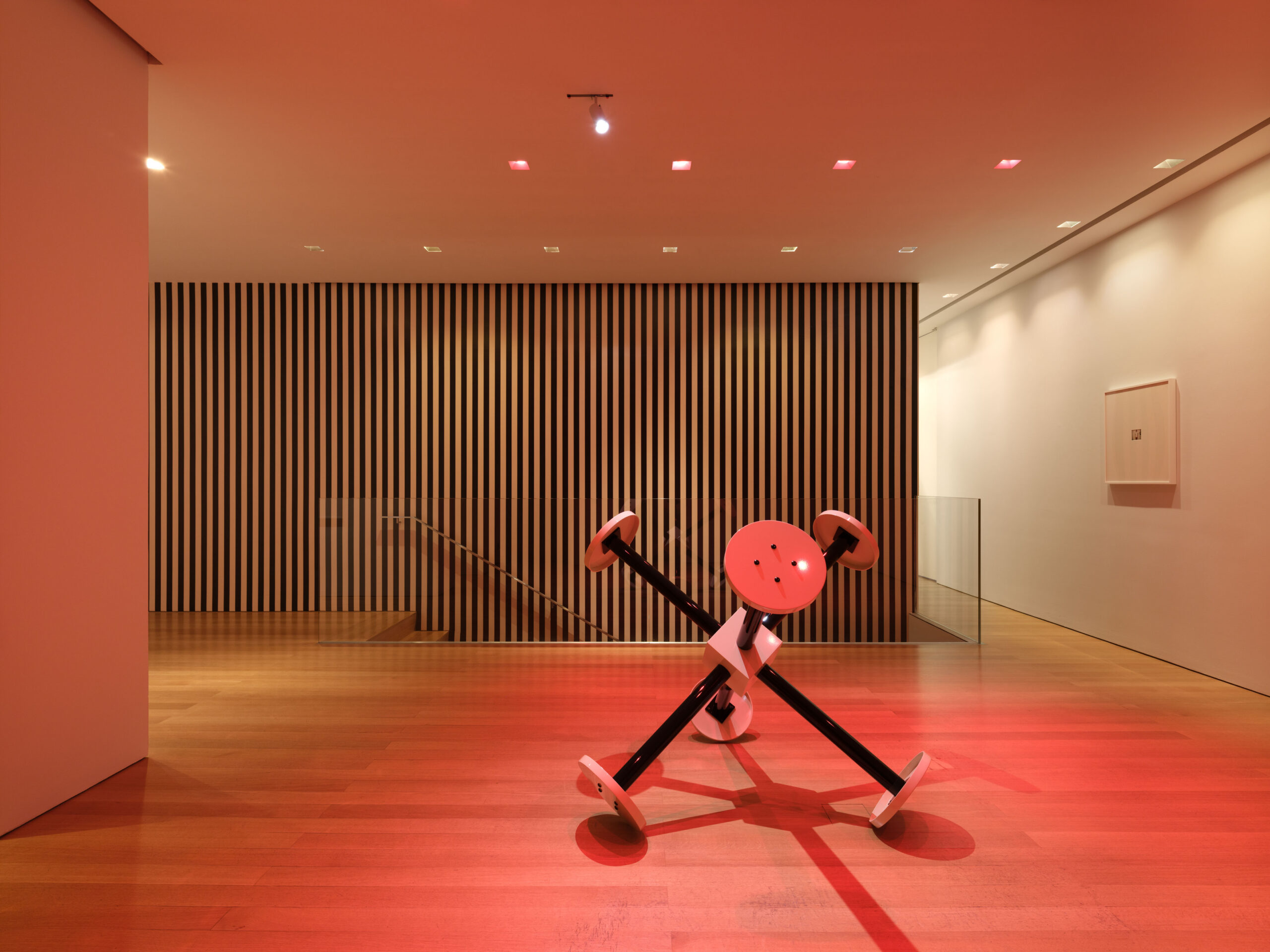
I’ve made sculptures for a long time and there’s a series that I’ve been working on for maybe 8 years now and I was interested in seeing those things in relation to each other. I informally call them the Table Series because they are using one-to-one scale replicas of prison visiting room furniture and then taking those dimensions and materials as modular building blocks to make other things. So, architectures, objects, things that are expressing their obsolescence in a way. Their initial function is no longer possible in the way that they are rendered. It was a kind of simple idea to start with, especially because the scale of the space afforded that. I wanted to have a sculpture exhibition because those works are riffing on minimalism in a very particular type of way.

FATEMAN: If you walk into a room that only has these sculptures, the Table Series, you have to wrestle with the formal manifestation of a heavy concept without much information: They are defined by constraint. They are geometric objects. The color palette is constricted, the scale is somewhat predetermined.
SMITH: The construction of certain types of mechanisms of power aren’t immediately legible on the surface of the objects. There’s many things that a viewer would have to deal with as an entry point to my practice which felt important.
So it’s kind of an overview of a number of things that I’m making, but then also trying to see these things at scale. As I was talking about the Austin show with people, especially some of the curators on the ground and other people, everyone’s kind of talking about the intensity of the exhibition. Thinking about this show and the contrast to the Austin show, the Austin show somehow feels softer in a way which feels a bit absurd, but also I’m constantly working with absurdities and actually trying to exploit the absurd and manifest a kind of trickery or kind of camouflage in the work.
When I was conceptualizing the Austin version of the show, which was two years in the making, the informal title of the exhibition was “American Horror” because horror is part of my interest in thinking about the structure of America. I think that title still has a kind of ring and resonance to it, but then also in the aftermath of 2025, I feel like the word “America” became a kind of audible loop that was everywhere. And so its charge and its power felt dull and then also the redundancy of it felt like it could kind of slip into another space.
FATEMAN: I’m curious: When you say that the Austin show felt softer, is that because here, in New York, we have a certain explicitness, explicitness of language because of the neon works, and then we also have photographic images—the Young Thug (2023) photos and, of course, the videos?
SMITH: I think a couple of things contribute to this show maybe having a bit more charge. In the Austin show, the first floor that you walk into, there’s a series of coloring book paintings that I’ve been making for a while. They’re flat, very simplistic drawings, almost like caricatures, and they have these simplistic texts or prompts for activities. And then my intervention is with large oil stick marks. They feel whimsical. There’s a system that I’m using that allows those works to operate, but it’s not confrontational.
For this show I knew people would have encountered my work before and so I knew I could do something different than in Austin. I think all of that kind of touch, that kind of organic sumptuousness was removed. There still are materials that are seductive and slick but they have a different edge to them, so that gives them a different kind of resonance. Also the scale of this space is much more intimate so the things that I put in the space fill it up rapidly.
I was thinking about conceptualizing this exhibition almost like finding ways to imbue it with a type of humidity, with a kind of thickness so that it actually was a bit difficult to breathe or take air or have a pause or kind of beat in the space, and that’s part of what the exhibition design does. We can really hear the neon. We can hear the buzz and everyone’s sort of colored by this room.

FATEMAN: Let’s talk about the photos, specifically the Young Thug series (2023) because that seems like a very different way to engage with minimalism—or, rather, with seriality.
SMITH: I have this collecting practice, which I think probably becomes maybe even more resonant in this exhibition. The images that I find are kind of stumbled upon out in the world or on the internet, but then I’m also constantly going to flea markets and all kinds of spaces and collecting vernacular photos. Perhaps because I’m interested in how we present ourselves, how people imagine themselves and the kind of layers of performance that happen in that, and how various kinds of systems that teach us or that sort of train us for certain types of social roles or performances slip into our private and personal spaces.
I have probably over 300 to 400 photographs that I’ve bought and collected from a million places. This one specifically I remember I got this between 2011 and 2013 from Brooklyn Flea. There’s this young white boy that looks like he’s between maybe 8 and 12, and he’s wearing an American flag du rag. After scanning and archiving it then I start to think about, you know, what are the things that are operating in this image that have a kind of charge? As I think about this show as a text, you know, how language operates and functions is very resonant across the objects. And here’s an image that we all can see and we can potentially understand what’s happening or we have an assumption or kind of projection of what’s happening. And then I can draw another frame around it if I give it a name, that name maybe gives it a kind of narrative and then structures how the audience encounters it. It makes them have to reconcile with their own acceptance or rejection of that frame or that apparatus that I placed around it.
FATEMAN: There are 11 in this exhibition and the group of them together is called a Group of Thugs. It’s funny. It is both a joke and a farce and a provocation and something that makes people incredibly uncomfortable because…this is a young boy in the photo, right?
SMITH: A kind of pillar of innocence, maybe. People have a kind of understanding or an assumption about him. And then, ‘thug’ also has a different type of resonance. And those two things create a kind of dissonance in the collective mind’s eye. And that’s a simple gesture, but also I hope it starts to make us think about the act of naming or the act of labeling and what the narrative here is, what is this boy trying to do or doing? And then also this kind of extreme contradiction of the American flag being this thing that’s sort of wrapped up in this stereotypical performance of Black masculinity.

FATEMAN: When I arrived earlier today, you were talking about an article from the nineties that illuminates some things about the video and about the photo.
SMITH: So, this was a cover story for New York Magazine. I think it was, if I can remember correctly, the December 16th issue from 1996. I’ve been trying to hunt down a physical copy and it’s been very difficult. It was a cover story and it had two titles: the online version was “Prep School Gangsters” and the print version was “Teenage Gangland” by Nancy Joe Sales. This journalist is kind of doing a ride along with these like 14 to 17 year old mostly white boys who are incredibly wealthy and go to prep schools, and they’re performing this kind of mask of hip hip hop culture, right? So they’re talking about how they’re selling weed to every single kid in the network of prep schools in New York City.
The article becomes almost a kind of caricature of performance, but also really starts to highlight or at least unravel the edge of the risk factor of performance. The article also describes the families that these kids come from in very thin terms. Many of these kids’ parents are billionaires. And it’s like there’s a kind of ventriloquism that’s happening that feels like it starts to maybe trace how language, performance, repetition, reenactments, start to establish these different kinds of power structures and then become cemented in very real ways in the real world through imagination, fiction, performance.
FATEMAN: I feel like we could go a couple of different places from there. Maybe before we talk about the videos, let’s talk about writing in the neon works and your writing more broadly.
When I came back to see your work after my initial visit I was really thinking even more about representing violence. When do we choose to use words? When do we choose to use an image, and when is it harmful to use an image? How do we make violence visible? What does and doesn’t do harm? It seems like you’re really wrestling with all of those things here.
Tell us about how you choose what text to use in your neon works. What is neon worthy, or neon appropriate?
SMITH: Writing is incredibly important to me and maybe closer to me than making art or objects. It’s kind of the space that everything is kind of birthed out of. I’m out in the world and I hear a turn of a phrase that resonates or it just makes my ear perk up and I write that down. I write descriptions of things. I write about what the work can do and what it can’t do or what I think I wanted it to do and I turn over those verbs to get to something that feels accurate or kind of propulsive and then maybe generative. And then, you know, I’ve been working on fiction and kind of poetry and things like that.
So that’s the way that I conceptualize the neons in the first place. I was also thinking a lot about landscape paintings, and was interested in all of the violence and all of the disappearance of people and then started thinking about this sort of refrain about the sublime, and those paintings related to the presence of natural light and this exalted landscape kind of washed by sun glow. I was thinking about those paintings in an art historical context and wondered, “how can I fuck with that?” That’s kind of how I came to art in the first place, honestly, in this roundabout way. I was never trying to be an artist.

Neon is interesting because there’s a spectacularness to it, right? And there’s this kind of real information embedded in a commercial conversation, there’s advertisement and obviously it has its own art history as well. I was thinking about life and trying to find a way to consider life and a kind of seduction, a kind of grandeur that would maybe mimic the scale of the way that those paintings are talked about and how the light in those paintings are talked about. And so then I was like, okay, I have light. That’s a kind of element. Then there is the horizon. Also neon attaches to the wall. So it can hold the space of the wall and kind of perform this idea, this kind of conceptual idea of a painting, which could be a landscape. It defines this kind of psychological apparatus at times, right?
So, that was there for me in the back of my mind. Like there’s the experience of standing in front of the work and the sheer number of words slows you down and takes time to read. And therefore your eyes are sort of fixed and trained on this light that also starts to sort of have a perceptual impact on you. It shifts the way that you’re able to see. There’s a difficulty in that. There is some kind of impact and thing that happens sensorily that is quite oppressive. And then, you know, there’s the sound that starts to register or eventually registers once you’re aware of it. So, all of these invisible elements start to become pronounced and maybe become foregrounded.
What language exists in them, I think, is quite intuitive and depends on the context. I don’t just make these in my studio. Maybe I extract a sentence that makes sense for the context of the exhibition or the location or how it will be installed and then once I sort of pulled that existing text from somewhere, then I have to work with it to resolve it in a way where it stands on its own outside of its larger context and in space where we consider language.
FATEMAN: One thing you said when we were talking before: we were talking about scale, physical scale, and then time scale. And you mentioned these as works that simmer for a long time. And I’m interested in that idea and also the title of the show, Clockwork. I think part of the reason I started our conversation by referencing those group shows—those large institutional shows you were in—is because those happened at the beginning of the Trump era. And I’m not saying your work in particular felt this way, but rather that everything felt like a reaction, very political. And because of the situation, the work in these thematic shows had a new urgency or a new relevance or a fresh public presence. We’re obviously not out of the woods there, but we are no longer in that state of shock, I guess. So, we’re now seeing your work not as belonging to a moment in the same way. The moment is longer. The moment is now a decade.
SMITH: I think that’s an interesting framework that has definitely circled around my practice. I am investing in unraveling and kind of turning over all of these ways that violence is learned and therefore made manifest through these often small and simple ways that become difficult to register. I’m interested in how a word or a label can make its way to equalling prison in a way, right? Like there’s a thread from here to there that makes that architecture and makes the building concrete. It allows it to operate.
There is a period where that became the art world’s concerns, prison specifically, but also the work is doing much more than pointing at a kind of simplistic statistical representation of why “prison is bad.”
There was an interesting moment where I was in a lot of prison related shows. I was getting tons of invitations to be in a show almost every hour, and I did participate in many. But I’m looking at the idea in a different way, I’m engaged in an intersectional structural context around it.
FATEMAN: I hear your critique and I definitely agree that we saw some work instrumentalized by institutions. I guess, as a kind of idealist and someone who loves art, I also do love that art can respond to these moments or give us an entry into talking about these issues. That’s not a defense of any curatorial practice, but just to say that I have seen your work respond powerfully to the moment—and not because you were trying to say something about Donald Trump, or whatever.
In your work you’re talking about socialization, education, family structures, all of it, right? So, let’s get into the videos, which offer a way to talk about time scales again, from the emergency of a police stop or the imminent threat of violence, which puts you right in the now.

SMITH: So this work is called skin suit (2026). It’s about 18 and a half minutes long and is the center piece of this exhibition for me. All of these works were made at different scales of time, but I feel like everything in this exhibition orbits around that video.
I don’t know when exactly this was, but I was reminded of Cops, that TV show from I guess late 80s, early 90s and that jingle pops in my head. It’s reality television, it’s a “docuseries.” And this genre implies something specific. Here’s another example of an intricate marriage of violence and entertainment. In a way that’s sort of outside of the fictitious. Even though we can say there’s fiction there, it’s being presented as a kind of realism. I went down this rabbit hole of looking for all of these television shows that were sort of in that vein. I started excessively watching and downloading hours and hours and hours of episodes and trying to see what I could find or understand in both the format and the structure of the program and how the frame operates.
You’ll see some of these clips where we’re on a ride along with a cop. It’s a paired down production crew, maybe one cameraman, maybe two. There’s also body cam footage. You stop someone or a police officer engages in a stop, they determine if they’re going to make an arrest. They make an arrest or they don’t make an arrest. So I’m starting to think about how the show actually operates. How does it come together? And what we get is a record of that. What’s also present here is this false mechanism of consent. The police officer goes through this set of practices: they decide if they’re going to arrest the person, it happens, and then the producer is like, “Ok, well here’s a release form.” Essentially that’s what happens and so either the person signs the form or they don’t. There are also questions about the arrests, who’s arrested and who’s not, and the full autonomy and leeway that each officer has while making a decision.
FATEMAN: Let’s get into your process a little bit. You have this very intense spiral down into Cops, and you can pick out some things, but there are a lot of formal decisions beyond that.

SMITH: I see this as a nonfiction work. So, I have all of this footage from live PD. There’s also some images from college wrestling. There are images, or there’s footage of people kind of like self-imaging on YouTube and the like. So, you know, things that are real and concrete. And then there’s news footage. And these are all cut back and forth to expand their meaning and context. We start to see the treatment of certain people over others at scale.
FATEMAN: One thing I was thinking about is that these television shows are meant for entertainment, and if you watch them as intended, you’re moving through a narrative structure that has a climax. It has a very specific point of view. We are in the shoes, adopting the perspective of the authority, the cop.
SMITH: There is humor at the expense of the person who’s being stopped. This is how the gross construction of humor functions when the people pursued follow what seems to be a very specific formula. These are usually people in a socioeconomic demographic close to poverty. And on average, a lot of the stops are related to some kind of addiction issue. The momentum of the episode is the thing that creates the “comedy,” at the expense of an individual caught up in a serious kind of structural system. And so I’m looking at that and then making editing decisions that resist the sort of easy narrative expectations.
The audience does not get any reprieve from the repetition that happens through certain images and through the score, but then also there’s the repetition of a certain type of scenario that I think speaks to the scale of this whole kind of apparatus.