
Tara Fay Coleman speaks with the artist about how his anthropomorphic sculptures of everyday stuff – clocks, telephones, combs, and fans – sit within conversations about consciousness, ritual, communication, ancestry and the movement between physical and spiritual worlds.
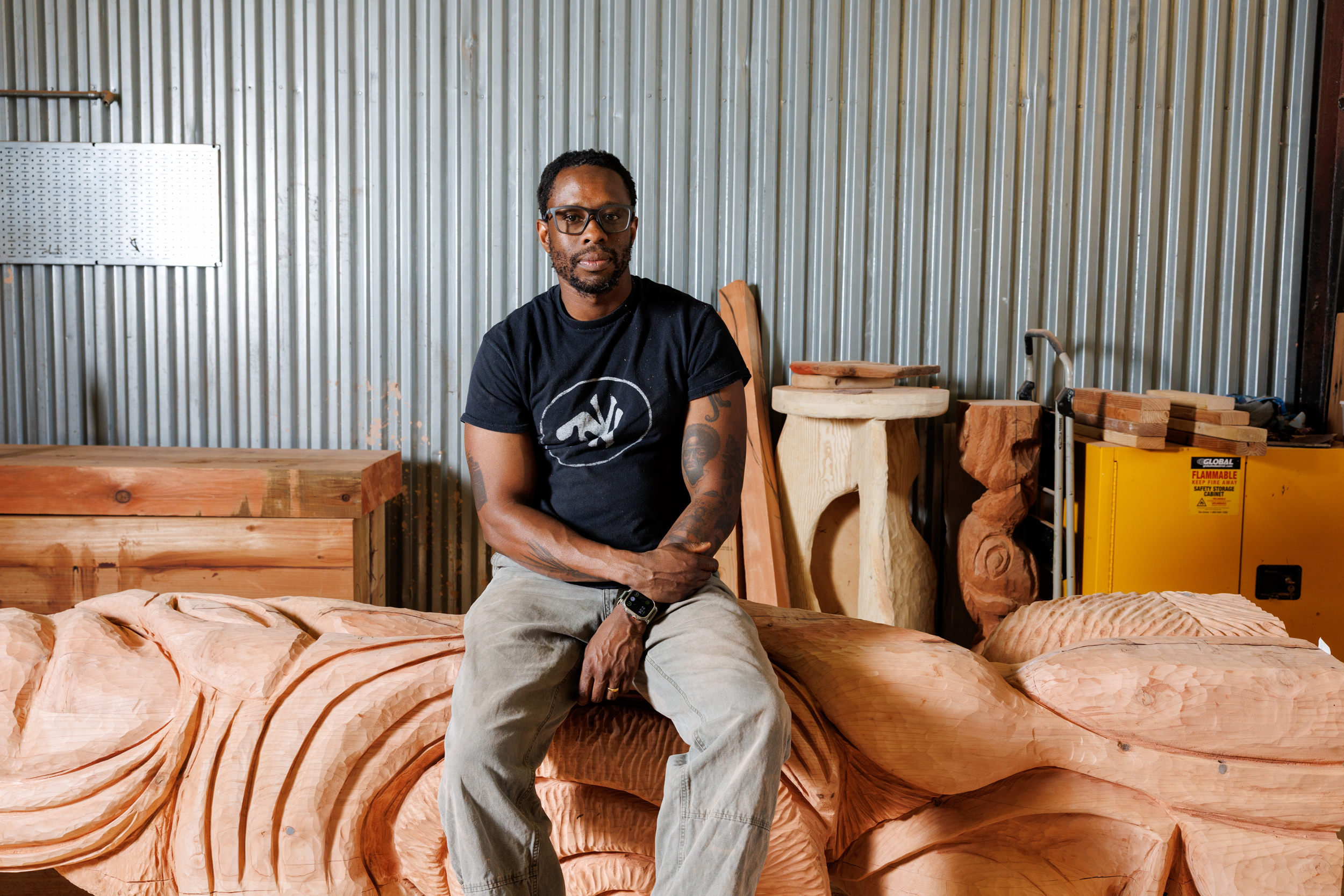
For years, Woody Othello has returned to clocks, telephones, combs, cups, fans and vessels, transforming ordinary objects into sculptures that bend, slump and sometimes seem to be responding to the weight of their own existence. He has not always known exactly why certain objects continued to find their way into the work. More recently, as his research has moved deeper into African and diasporic spiritual and material traditions, Othello has begun to recognize connections between the forms he chose intuitively and much older ways of thinking about consciousness, ritual, ancestry, death and the relationship between physical and spiritual worlds. “There’s a huge lexicon that I was already using in my work that, to me, relates directly to some of these influences,” he tells me. “It was almost like the work was doing its thing before I made the left-brain, logical connection between the two.”
Othello, who was born in Miami to Haitian parents, has long engaged African and diasporic traditions in his work, but these relationships have become increasingly explicit. His recent exhibition coming forth by day at Pérez Art Museum Miami marked his first solo museum presentation in his hometown. Rooted in precolonial and diasporic African traditions, coming forth by day explored relationships between body, earth and spirit, drawing from spiritual practices and cultural forms including nkisi power figures, Dogon ritual objects and Egyptian pyramids. His current research has also taken him into Kongo funerary practices and back to Robert Farris Thompson’s Flash of the Spirit: African and Afro-American Art and Philosophy, a text that examines the continuities between African aesthetic and spiritual traditions and their expressions across the diaspora. Othello is interested not simply in incorporating these references into the work, but in how they have changed the way he thinks about the objects themselves. “I often look at objects as like a metaphor or as a psychic kind of tool or instrument,” he says. The built environment, and the things that make it up, can point us toward what he calls “the land of the unseen.” To Othello, “everything is, in a sense, like frozen imagination.”
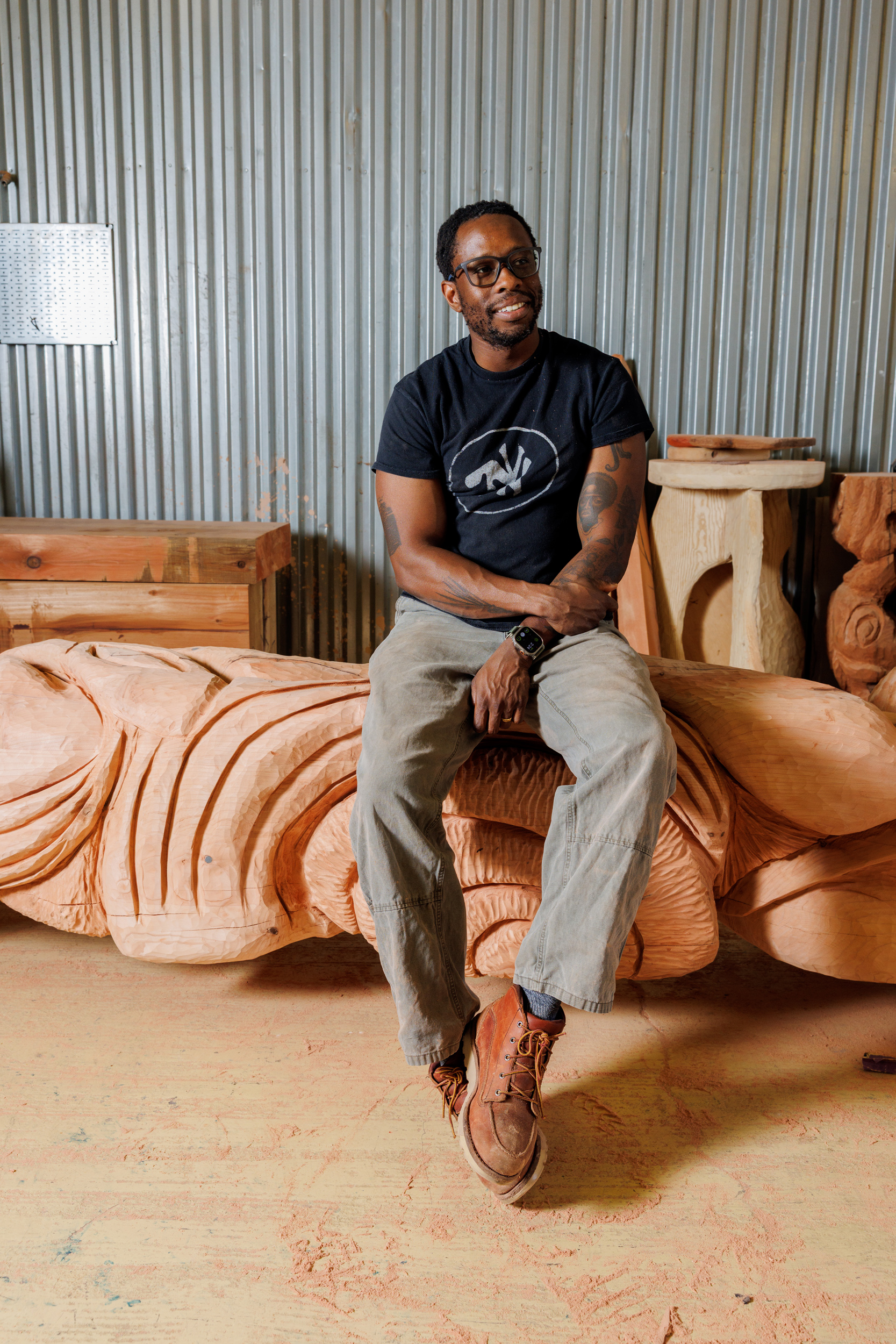
The artist is also interested in the relationship we develop with the objects around us. “There’s just like a ritual with some of the things that we come in contact with, how they start to hold our energy, they start to hold our presence,” he says, “and they become vehicles for this kind of open exchange and contemplation.” His research into Kongo funerary practices has given him another way to think about that exchange, particularly the possibility that objects can retain something of the people who once lived with and used them. What has surprised him is how many of the forms he encountered through that research already existed within his own vocabulary: phones, combs, cups, plates and bottles. Rather than discovering these histories and then making work to illustrate them, he is finding language for instincts that were already there.
This has also complicated one of the most familiar ways of discussing Othello’s sculptures. His work has often been described as anthropomorphic, and understandably so; clocks sag, phones bend and vessels seem to take on bodily states. Othello has used that language himself, but he has begun to question the hierarchy embedded within it. He has been thinking about animism and what he describes as precolonial understandings of the natural world, as well as panpsychism, a concept he says he encountered through Michael Pollan. “Anthropomorphism creates this hierarchy of humanity then being imprinted on everything else,” he explains. “To me, it’s just actually the other way around, where nature has imprinted all of this.” Even something as ordinary as a cup becomes more complicated from that perspective. It may not have a soul in the way we understand one, he says, but “it has parts of a soul in it.” Someone had to imagine it before it could be made, and someone’s physical labor transformed that thought into an object. “Everything to me has trace elements of our humanity, of our collective thought, of our soul, of our spirit,” he says, “of that creative pulse, that creative energy.”
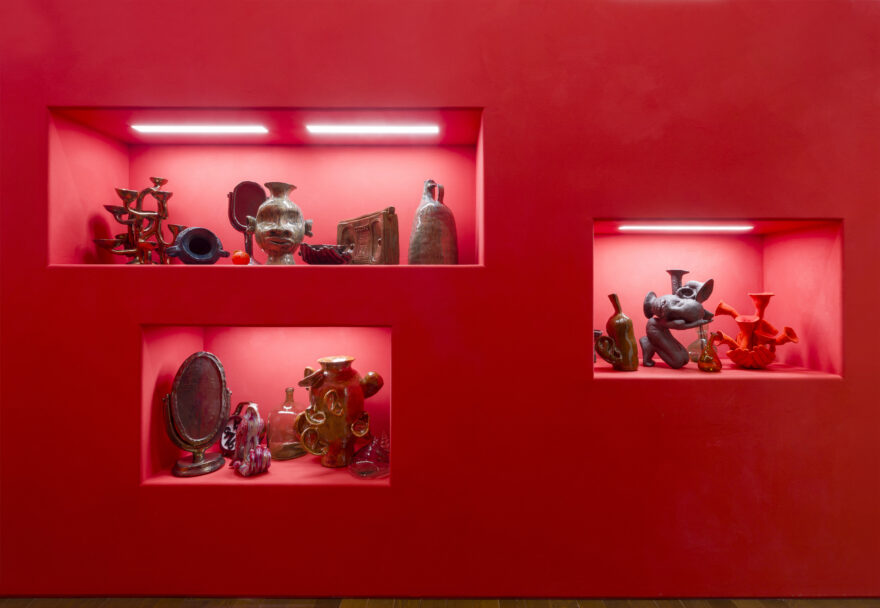
Clay makes this exchange between body and object especially direct. Othello’s ceramic sculptures are shaped through touch, and he thinks about his own energy, as well as that of his studio assistants, being physically transferred into the material through the process of making. “When you’re using the clay, because you’re touching it, it has that thing in it,” he says. Clay has also become one of the ways Othello enters these histories. He began making ceramics without fully understanding how far back humanity’s relationship with the material extends – following it has opened another way of understanding his own place within a much larger history. “The material is like a doorknob into the canon of history,” he says. For Othello, that path has increasingly moved through Black history and toward what he describes as an effort to unlearn a “colonial Eurocentric gaze.” When he talks about this, there is a noticeable shift in his energy. Othello is interested in the histories of Black life that exceed the familiar emphasis on violence and rupture, and in understanding the intellectual, spiritual and material contributions that have shaped cultures far beyond the continent. “Black people are really amazing, and we all need to know about the incredible contributions that we have had,” he says. What his research has given him is a pathway through “not only a lot of Black pain, but just Black triumph and innovation.” There is an excitement in the way he describes these discoveries that feels important to the work itself. The research is not there to explain the sculptures; it is continually showing him that forms he was already making connect to histories he had not yet consciously considered.
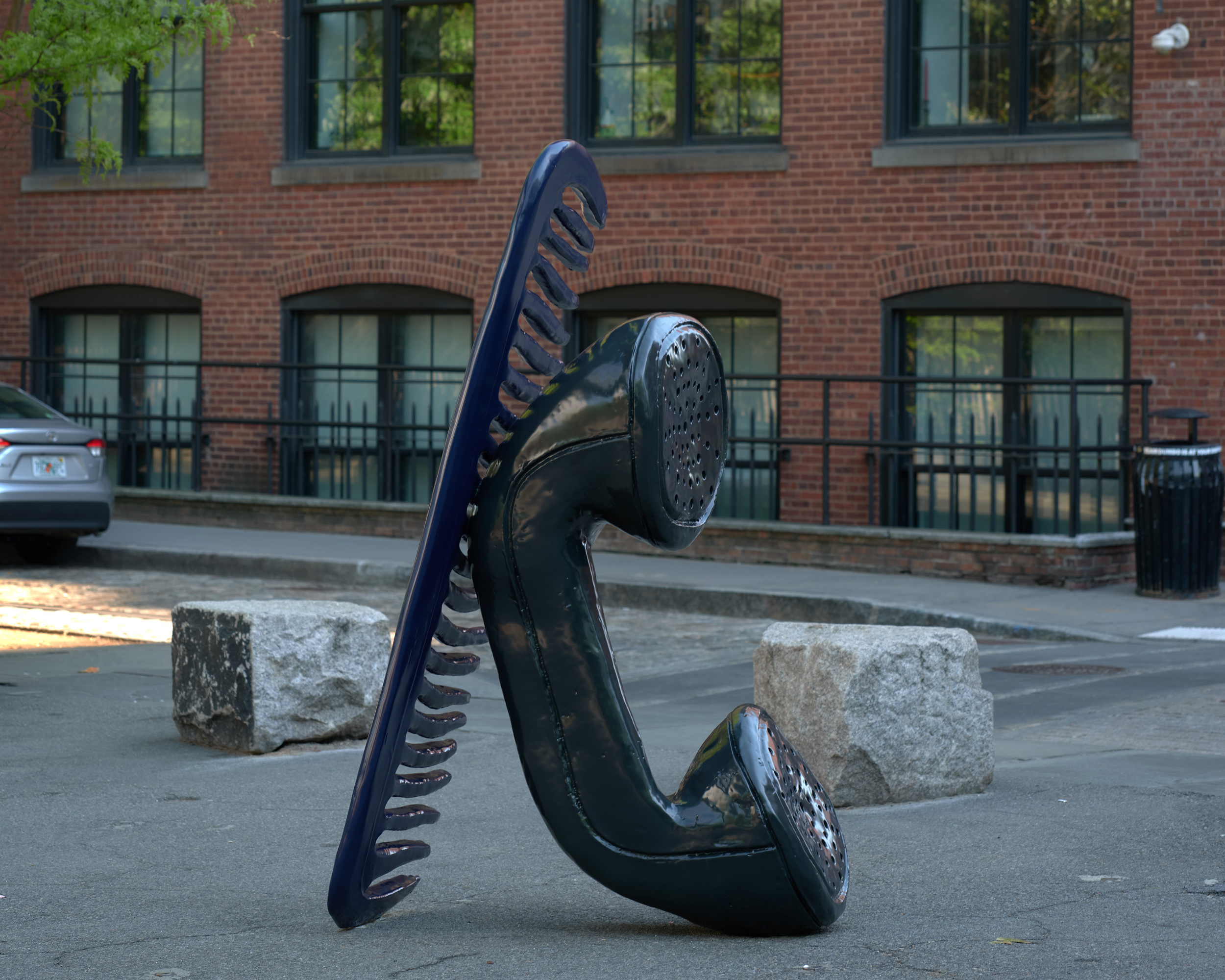
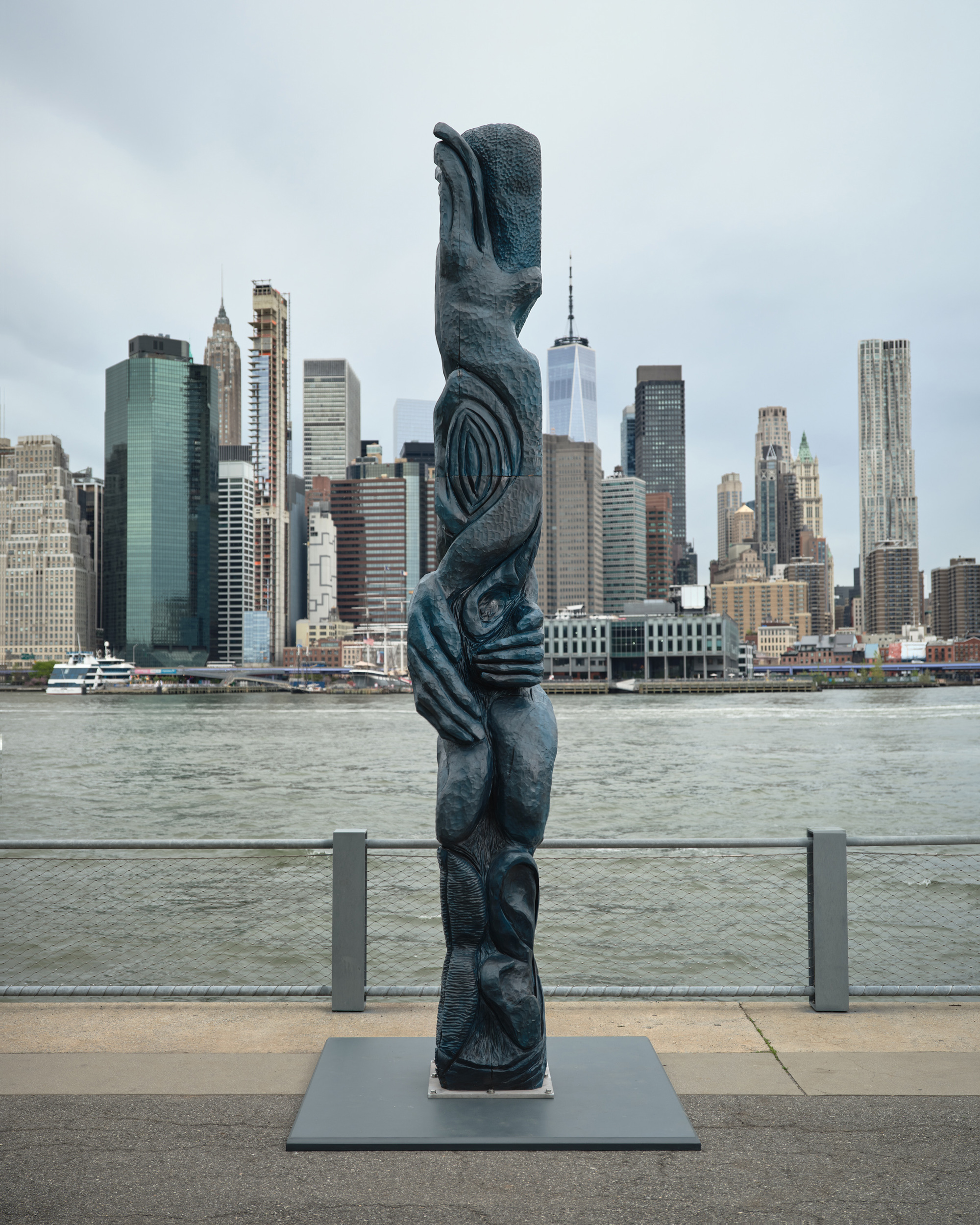
That process of recognition is particularly visible in Guardian Spirit, Othello’s first solo outdoor exhibition in New York City, installed across Brooklyn Bridge Park. The exhibition brings together four large-scale bronzes and three new hand-carved redwood sculptures, furthering his engagement with nkisi and his interest in the spiritual possibilities of objects. The redwood works, Awareness, Reverence and Listening, incorporate reliefs of hands, kneeling figures, ears and birds, while the bronzes Capacity, inner knowing and Involution bring ears and hands together with trumpet-like forms. Throughout the installation, listening, gesture and sensation become ways of considering the relationship between visible and unseen worlds. Among the bronzes is thought in mind, an enlarged telephone and comb leaning against one another. For Othello, the phone begins with communication and the uncertainty built into receiving it. “A lot of times, we don’t know how a phone call is going to change the trajectory of our day, our hour, our lives,” he says. The comb takes him in another direction. He thinks about grooming and the act of sorting through or straightening his hair as a metaphor for sorting through thought, but he also thinks about carved African wooden combs and the larger history of the sculptural head. His research into Kongo funerary sculpture has included representations of chiefs, where gestures and accompanying objects can suggest contemplation, composure and deliberation. A pipe, for example, creates a physical pause before speaking. “It allows you not to speak in haste,” he explains. “Your thoughts are kind of composed.” What begins as a phone and a comb can move outward into communication, consciousness, Black material culture and the discipline of thought. “I love how something very kind of almost commonplace could be a vehicle for something larger,” he says.
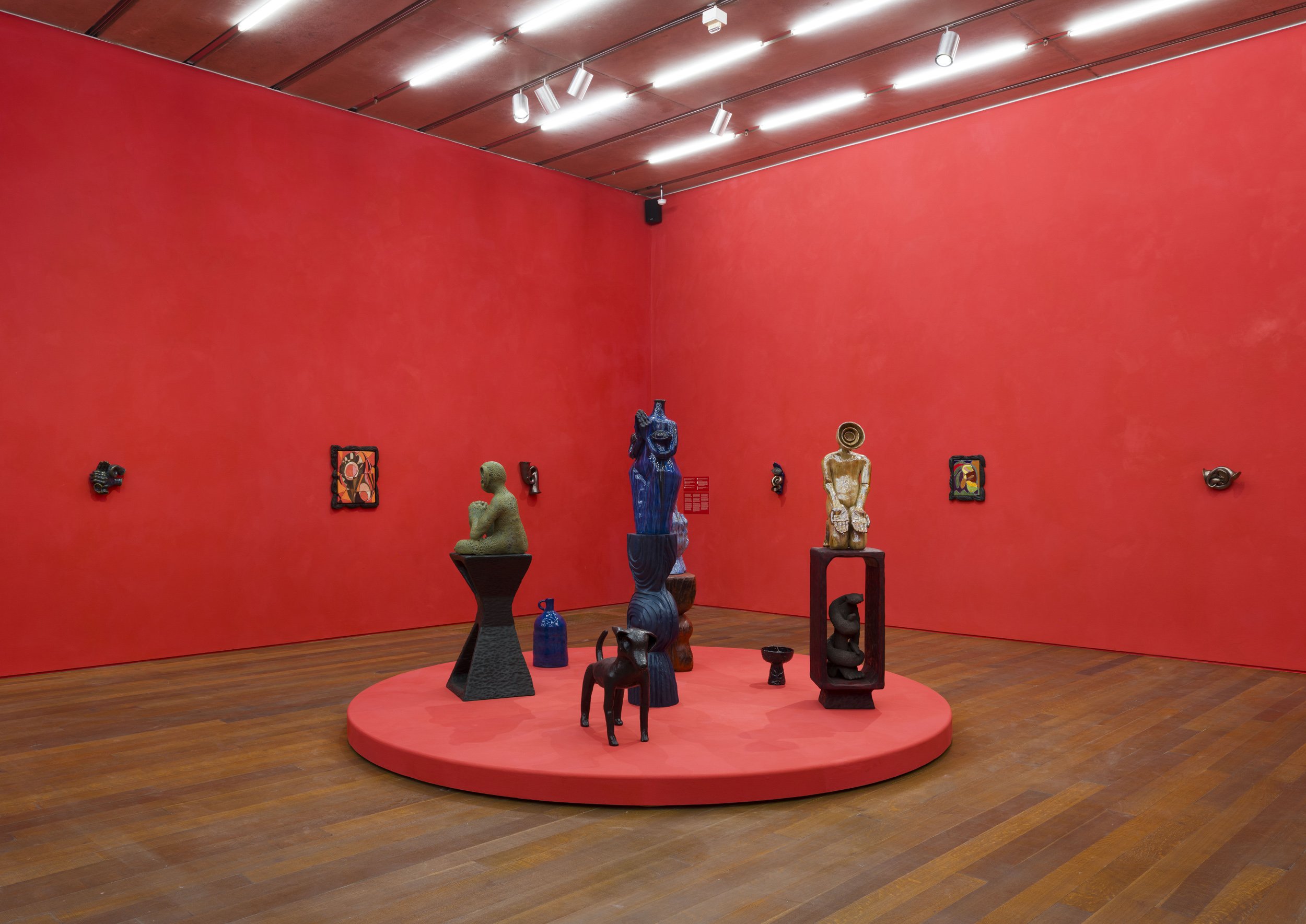
Othello’s recent rereading of Thompson’s Flash of the Spirit has prompted similar reconsiderations of the fans, air-conditioning units and air purifiers that have appeared throughout his work. Growing up in Miami gives these objects an obvious relationship to heat and the need to cool a space, but Othello also thinks about houses almost as bodies, circulating air and breathing through their windows and vents. Thompson’s discussion of “coolness” in African and diasporic aesthetics has given him another way to think about those forms, particularly the idea of a cool head as a condition of composure and deliberation. The connections are not always something he consciously seeks. “I feel like my subconscious is whispering to me, like, ‘Hey, bruh, you remember. You know what’s up,’” he says. There is a sense that the sculptures sometimes know where they are going before he does. That trust in intuition is essential to Othello’s process.
When I ask how he knows when a recognizable object has moved beyond representation and becomes something else, he tells me: deliberately trying to make that happen usually prevents it. “If I try and do it, then it doesn’t do it,” he says. “But when I just let the art happen, or just let the intuition take place, there’s this way where it starts to kind of lean over into something else.” He approaches emotion in much the same way. Othello’s sculptures can appear exhausted, mournful, funny or tender, but he is less interested in directing a specific response than in creating what he calls “a place for feeling to maybe happen.” While working, he asks himself not necessarily what something means, but how it makes him feel. “You tap into your critical feeling faculties more so than your more logical making sense of stuff,” he says. “Something doesn’t need to make sense in order for me to try it out.” For him, this requires “using the whole body as a form of perception.” He talks about looking at something and feeling his posture change, or asking, “How does something make me feel in my feet?” Scale becomes part of that bodily exchange. Making an object life-sized, very small or unexpectedly large can make someone newly aware of their own proportions, while sculpture itself refuses a single fixed viewpoint. As the viewer moves, the work changes with them. The body has become increasingly important to Othello for another reason: he has been thinking a great deal about what happens when we no longer have one. The clocks that have appeared throughout his practice have become particularly useful for thinking through that question. He remembers his first as Wishing Well, placed on the floor with its time frozen. At the time, he thought about wishing for a moment of resolve or stillness. Years later, his research into Kongo cosmology has given him another possible way of understanding why the clock continues to hold his attention.
Othello has been thinking about the dikenga, the Kongo cosmogram that maps the cycle of existence through four moments associated with the movement of the sun. In the way he describes it, dawn, high noon, sunset and midnight become a means of understanding stages within the life cycle, while the horizontal Kalunga line marks a threshold between the worlds of the living and the dead. The circular clock face has begun to resonate with him differently within that framework. He is especially interested in the contradiction of a frozen clock: an object created to measure time that can no longer perform its function. “When we pass on, when we die, when we don’t have a body,” he asks, “do we still keep track of time?” He is not suggesting that the clocks were consciously conceived as illustrations of Kongo cosmology. Instead, the form arrived first, and the framework through which he might understand his attraction to it came later. Our conversation about time and the body eventually becomes personal. Othello’s daughter, Violet, is seven months old, and when I ask whether becoming a father has made him more aware of his own mortality, his answer is immediate. “The second she was born,” he says. At first, he describes what he felt as relief before realizing that is not quite the right word. His sense of purpose changed. “Part of me, I just remember feeling like, oh, all of this was worth it, because now this soul has the experience of being made physical,” he says. Violet will learn, experience joy and experience grief, but she will have the opportunity to experience being here. For Othello, there was something profound in realizing that he had become “a collaborator in making that happen for somebody else.”
Her birth also shifted his relationship to death. “Damn, I’m more chill with the idea of dying,” he remembers thinking, quickly adding, “Not that I want that to be imminent.” What he means is that he feels a kind of fulfillment he had not experienced before. Becoming a father has also changed the way he sees his parents, who are now grandparents, and the generations of his family suddenly map onto the cosmology he has been studying. He returns to the three moments of the sun to explain it: Violet is at dawn, he sees himself around high noon, and his parents are moving closer to sunset. A system he has been studying through history becomes immediate when he sees his own family within it. That connection also changes the way the objects that have followed Othello throughout his career can be understood. A clock, a comb, a telephone or a vessel may have entered the work intuitively, but he is increasingly finding that these forms can sit within much older conversations about consciousness, ritual, communication, ancestry and the movement between physical and spiritual worlds. This does not mean that every object contains a singular symbolic meaning, or that Othello is retroactively turning earlier sculptures into illustrations of the histories he is studying now. If anything, the opposite seems true. His research is making the objects less fixed. A comb can remain a comb while also opening onto grooming, thought, African material traditions and the sculptural head. A fan can cool a room while suggesting breath, composure and spiritual coolness. A phone can remain an ordinary communication device while retaining the possibility that a single call might change the direction of a life.
For all the histories moving through our conversation, Othello repeatedly returns to the ordinary routines of being alive. He talks about walking through his neighborhood with his wife and daughter, following the same route often enough that it has become part of their daily rhythm. Loading and unloading the dishwasher has become another pattern. Getting older and losing friends and loved ones have made him more conscious of how easily these repetitions disappear into the background. “I’m like, damn, this is actually pretty remarkable, because we know that we’re not here for that long,” he says. Domestic space has always been central to Othello’s work, but his attention now seems to be shifting toward the routines and objects that shape our everyday lives. “I guess it’s just like a kind of contemplation and a gratitude and an acknowledgment of being made physical,” Othello tells me. “Once this thing is said and done, we don’t have our bodies at all anymore.” It is difficult not to think about the sculptures differently after hearing him say this. The slumped clocks, bent telephones, combs, vessels and fans are still funny, strange and emotionally suggestive, but his current thinking gives their physicality another urgency. The objects depend on the body even as the body itself is temporary.
Toward the end of our conversation, I ask whether he hopes someone who encounters his work returns home and sees the objects around them differently. “Not really,” he says, resisting the impulse to assign the viewer a lesson. What he offers instead is awareness: being conscious of picking something up and of having a body capable of doing it, drinking water, or simply noticing the act of breathing. Othello practices meditation and breathing exercises, and after a conversation that has moved through Kongo cosmology, funerary traditions, nkisi, Haitian and Black diasporic histories, parenthood and death, his conclusion is remarkably simple. “Just being aware of your own breath,” he says. “I think that’s what the name of the game is.” Othello’s sculptures have long transformed the familiar, but what feels especially important now is how his understanding of those forms continues to transform alongside them. The research has not replaced intuition or given the work a single explanation. It has given him more ways to understand where his intuition may have been leading him, while leaving room for meanings he has not yet encountered. As he put it earlier, the work was already “doing its thing.” He is still finding out what it knew.