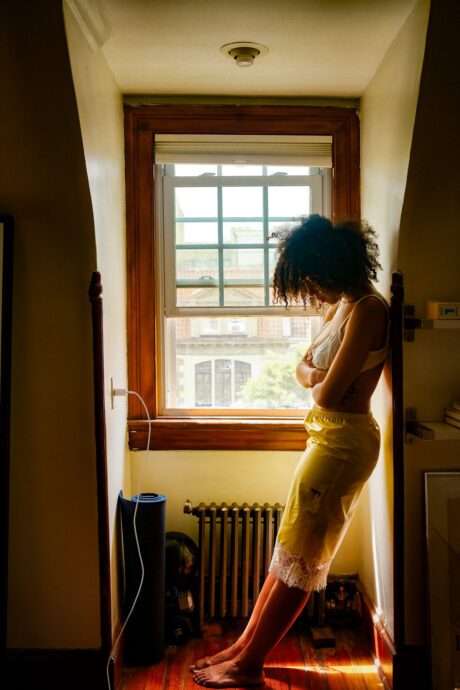

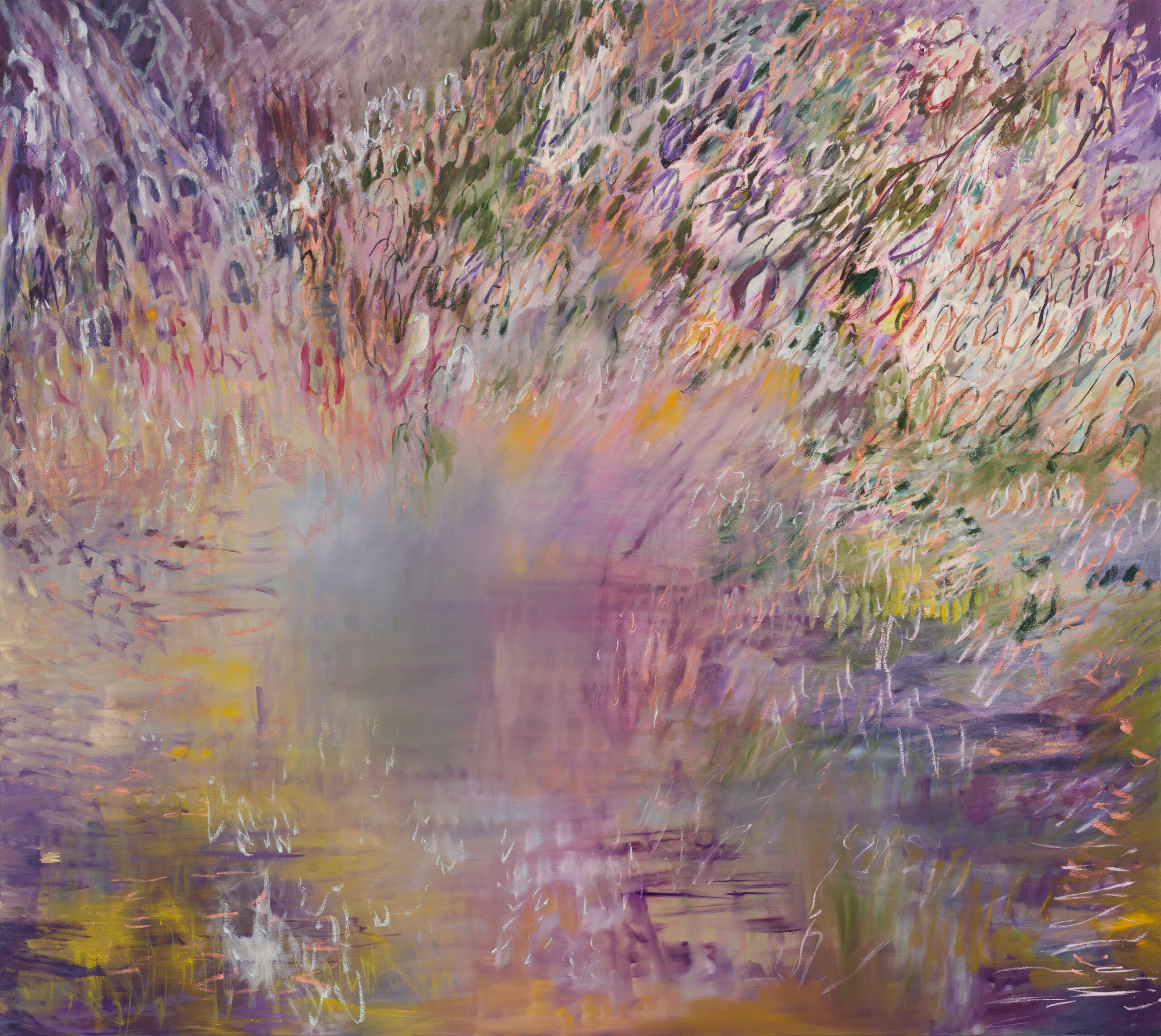
Bringing together three artists whose practices are rooted in the physical possibilities of paint, Alchemies explores transformation, memory and the natural world. In conversation with Minna Moore Ede, artists Nour Malas, May Cockcroft and Sarah Martin-Nuss discuss the instinctive, often unpredictable processes through which their paintings take shape.
MINNA MOORE EDE: Firstly, thank you all for joining me for this conversation. It is so great for us to be able to speak in advance of the show and of course it’s a lovely moment for you three to all meet for the first time. I wanted to start by trying to explain what it was that drew me to your work and why I think there are synergies between you, though your paintings look visually very different.
There are two aspects to each of you that I found very compelling: the first is that all three of you are very painterly painters … all very driven by the materiality of your work. This fascinated me because I have spent much of my career working on exhibitions around stories and myths but for you three, your work is based much more around process, almost as an end in itself. The second thing is that they you all have something quite distinctive and intriguing about your backstory- your autobiography- which of course affects the work itself and the way it looks. It was the combination of these two things that stood out for me.
The exhibition is titled Alchemies in reference to the ancient practice of alchemy which had to do with the transformation of matter. Alchemy has long been tied to artistic process because of this idea of material transmutation and so, as we began preparing for this show, I sent a short piece of text I had written about alchemy to all the artists.
So, can I start by asking you all, what does alchemy mean to you in the context of this show?
NOUR MALAS: I’m excited to just even have this conversation to get deeper in the show. It’s interesting because I thought about alchemy a lot when I read the prompt of the show. I thought of it as a very literal thing, more on a chemical level or literally paint on canvas. But then, as I scratched the surface, it was just an endless possibility. It’s a word with endless possibilities because it’s spiritual. It’s a metaphor. It’s cultural. It can hit so many different boxes, and I realized actually how much alchemy is a big part of what I am interested in, and a lot of my work is a metaphor of practicing resilience, accepting shift, change, transformation, accepting this idea of the unknown, and going into a more spiritual way of approaching the world and the things that happen to us or around us. And so, you know, I was thinking about metamorphosis and this idea of things kind of moving and becoming something else, and whether they’re growing or imploding or exploding. And you know, I’ve mentioned this before, but with Hieronymus Bosch and all the Dutch painters from the 1500s, alchemy was a big part of what they were exploring on a more spiritual level. So I guess in a nutshell, that’s how I related to it mostly. I mean, of course, chemically and technique-wise, alchemy is some part of art making and definitely part of paint. You know, you are working with chemicals, but I’m not that interested in it on a chemical level. I need to understand it, and I care about paint so much because of what it can do, the doors that can open for me and the way that it can allow me to paint. But I care about the painting part.
MINNA: So it forced a degree of self reflection about what you do.
NOUR: Yes.
SARAH MARTIN-NUSS: Yeah, I was going to say that I love what you just mentioned about through seeing the word alchemy in relationship to this show that you began to realize that alchemy is part of what you’re interested and already doing because I had a similar experience. I found that when I read the show prompt and I was thinking about my practice, I was researching the word alchemy because I love starting my paintings with words, and I noticed that there were these stages of alchemy. And so how I started my process of making work for the show was by making a note card, which I still have here in my journal, but it’s you know dissolution, purification, integration. It’s the three stages of alchemy. And when I wrote those down, I thought, oh well, I’ve been interested in alchemy my whole practice. It’s just the language I use is slightly different, but it’s very much within the huge history of alchemy, and so through those three stages, you know, dissolution being decay, breaking down, purification being this moment of separation and clarification, and then integration to me feeling like this moment of new life or emergence. I found that the word alchemy took on a whole new meaning within my practice, and I loved that because now I have a richer relationship with that word. And but just generally, I love the thinking about matter as being dynamic, loose, constantly changing and in flux, so I found the prompt alchemies to very much in line with my practice, but also spurring it forward to develop new languages and new techniques around exploring something new within my own practice.
MINNA: Thank you, Sarah. And May, can you say a little bit?
MAY COCKCROFT: I think for me it’s very much about my materials. It’s making these concoctions of different mediums, and having unprecedented outcomes, this making and unmaking thing that we’ve spoken about. The exhibition title, Alchemies, encouraged me to think about these processes more deeply. I was thinking about alchemy in an elemental way: fire, water and earth. So, for the paintings I have made for the show, I chose my colour palette carefully to reflect this- terracotta, clay, sea-water blues and natural greens.
MINNA: It’s interesting because actually one of your paintings is called Mortar and Pestle, which were alchemical tools. There was that nice serendipity there, wasn’t there? You had already started going down that route, maybe already.
MAY: Yes, definitely. And because I’ve always been very drawn to materials and working with unconventional materials and seeing what comes of that, connecting that to alchemy is a sort of product of something that you can’t necessarily anticipate or control and then now that’s the finished product of it. But it was all very fortuitous.
MINNA: We can talk more about your processes, how you all transform this material that is paint- but first can I ask you to say a little bit about the stories behind your work? Nour, starting with you, I’m interested in the fact that you move between figuration and abstraction more than the other two. There are actually faces visible sometimes in your paintings. Tell us about what is going on when they appear?
NOUR: You know, I had this epiphany moment recently where I realized I’m not an abstract painter. I think all painting is abstract. The first layer is, I think all painting is abstract. It is a complete subjective interpretation of someone’s reaction, like someone’s response to a reality, it’s completely abstract. Even figuration is abstract. So in a way, I’m still in the umbrella, but not to say that I’m a figurative painter either. I’ve been making work since I was like 15, ever since I was introduced to art. I’ve always been interested in the way it opened doors for me to relate to myself, to access my emotions- I always felt like it was a channel. I feel like I’m a channel doing what I do – I think artists are channels and portals. I grew up in Dubai. I’m Syrian. I visited Syria multiple times a year, so I had a deep relationship with it, but never grew up there. And then after the war, that was no longer part of our reality in terms of accessibility. So there was a big period of grief for my family of losing home in every form, without actually having lived there myself, and I was always confused about that. It’s almost a part of survival’s guilt. Another part of it is that I was just a teenager and I wanted to go out and live my life. But at the same time, I’d come home and there’s this big dark cloud, it was a very layered experience of grief.
With time, I moved to London and I lived there for a while. I was studying, I was working with other artists, I was making sculpture, and painting, always on the side, but never really regarded it as part of my work. It was this way of letting out this anxiety, it was an impulse. It was something that came very natural to me, almost a little too easy for me to consider that as part of my practice. I went to Goldsmiths and it was very theory-based, very heady. Everything had to have an idea, and my paintings don’t have an idea. They’re an expression of recording the time that I’m living, being internal, external experiences, things that exceed language, and that’s what painting offers me. I’m sure many other artists, find themselves hovering between abstraction and figuration, as I do. It almost feels sometimes like the painting already exists, and I’m just pulling out the layers, like I’m creating layers to allow the painting to emerge from behind it. I actually really resisted this because there’s this trend in the painting world of ‘world building’, but that’s kind of where I see my trajectory of interior landscapes as very much influenced by nature in a way.
I live in New York, I don’t have access to nature but I have had divine experiences with nature, whether seeing a blood moon set or, very cheesy, gazing at the stars or passing by in a car and seeing the sun come between the trees. These are things that stick with me on in terms of light and in terms of divinity and movement or stillness, and then I want to feel that again when I’m painting. It’s almost subconsciously in the movement of the paintings, especially a couple of the paintings in the show are inspired by the moon, so the starting point is trying to feel what the moon allowed me to feel, and so it works in that kind of like circular motion. But then it’s turbulent, and then it goes in and out, and it has this kind of flow. And yes, it’s abstracted, but it is a landscape on some level.
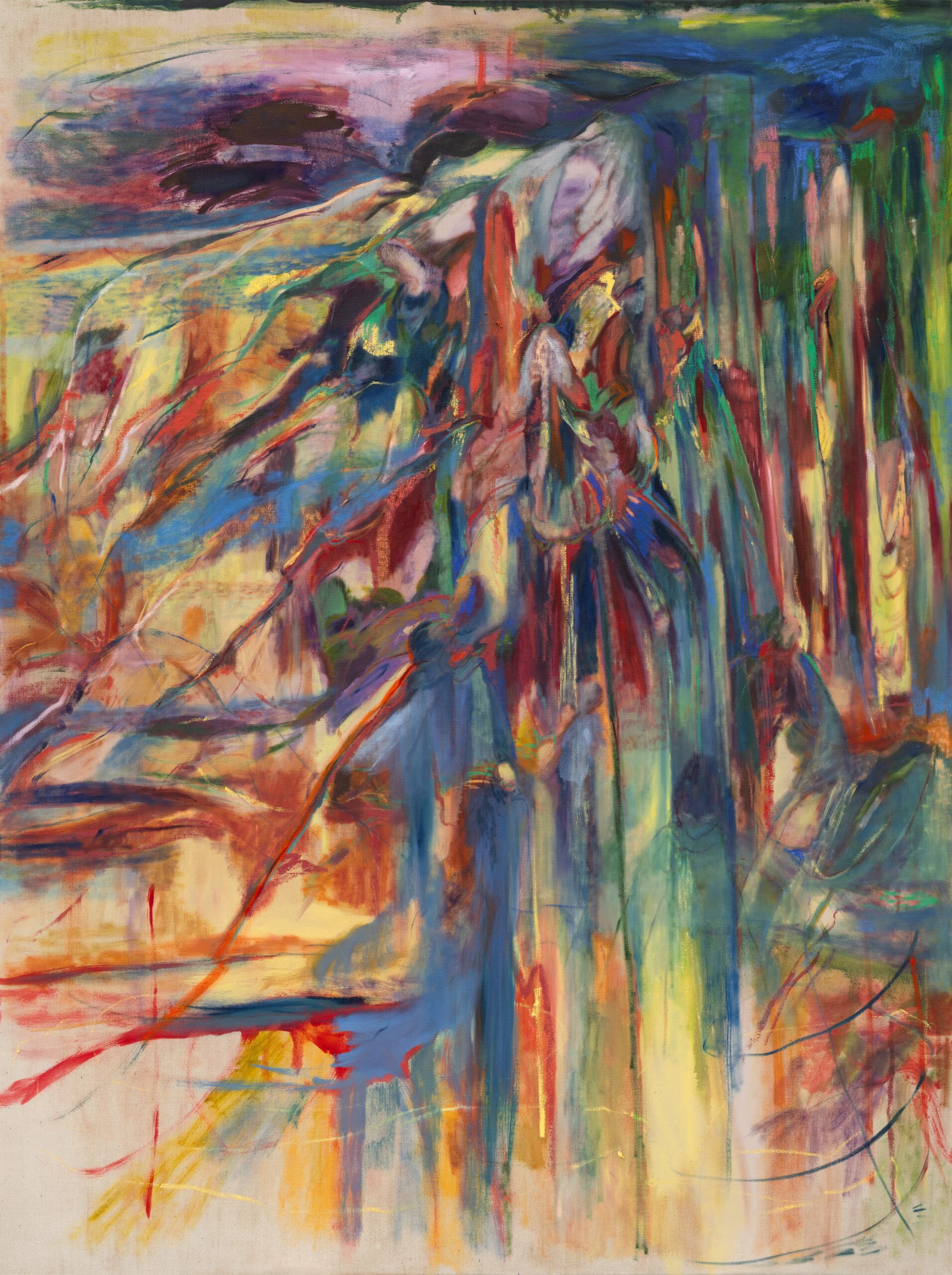
MINNA: Can you say a bit more though about this push and pull? Are you saying that painting is so gestural, so instinctive, that maybe it would take over if you didn’t have some kind of story or concept or idea behind it that reins in this desire? Is it a push and pull between those two things in your work?
NOUR: When I’m painting, I’m really not thinking that much about idea or story. It’s not like that already exists in my body. I don’t need to consciously bring it out. For me it’s a tension between my hand and the painting. Its a tension – a negotiation. It’s instinctive. It is the opposite of academic. While I’m working, when it comes to creating a story, the work just happens. It happens, and then sometimes I don’t even know what the story is until it’s done. That’s what’s exciting. If I knew the story, I wouldn’t really be compelled to make it.
I think about this idea of negotiation when it is finished- where is it working, where is it not.. the painting gives a little, we fight, we make up. It’s like a complete relationship that happens. It’s at times turbulent, at times smooth, and then we come to an understanding, and then that’s where I feel like it’s finished. And you know, it’s a romantic way of putting it, but it is a romantic relationship.
MINNA: In fact, what you’re saying is that it, in some ways, the sort of stimulus, the mental stimulus, comes last…that the physical, visceral, instinctive, gestural process is cathartic for you… because through making it, things evolve and emerge.
SARAH: My practice in some ways is rooted in the ways that I experienced the world as a child, which was growing up on the Gulf of Mexico, and the moments of looking out on the landscape in South Texas, where it’s just very flat, very bright, very reflective. It’s where the sky meets the bay, and you can’t tell, where one starts and when the other begins, a kind of orientation towards space that could almost feel empty. Ther’s so much vastness in a place like South Texas that you could call it empty space. But in my mind and through my studying and engagement with that space, I found that space that is still is not necessarily empty. And so that encapsulation of where I was born is very much still with me in my studio in New York, which is a very different landscape than the one I was brought up in, but still, my works have these moments of stillness that I build within them that are moments of possibility. They’re not empty but vast with this suspense of possibility, bringing that compositional tool into the work for this show. The work for this show happened at such a transformational part of my life because I started the work very pregnant, and I finished the work after giving birth to my son. There could not be a more alchemical process to be physically experiencing while making large works for this show, and so I experienced birth as this simultaneous rupture, an end of something, an end of pregnancy, an end of carrying another being into this emergence of then being a mother with a being that is now separate from my body, outside of my body, and the work for the show inherently has that push and pull within it, and so I begin to experience the idea of alchemy through my lived experience of giving birth and then mothering an infant child while finishing the work for the show, which honestly has been one of the most moving and vigorous experiences of my life thus far.
MINNA: That is a beautiful meditation on what it is to become a mother and yes, I can see that this idea of alchemy and transformation must have really resonated with you, both in reference to you as a new mother and in giving birth to your first child. It is also very interesting because something I would not have pinpointed as common to both you and Nour is that nature is in the background of both of your works….how about you, May?
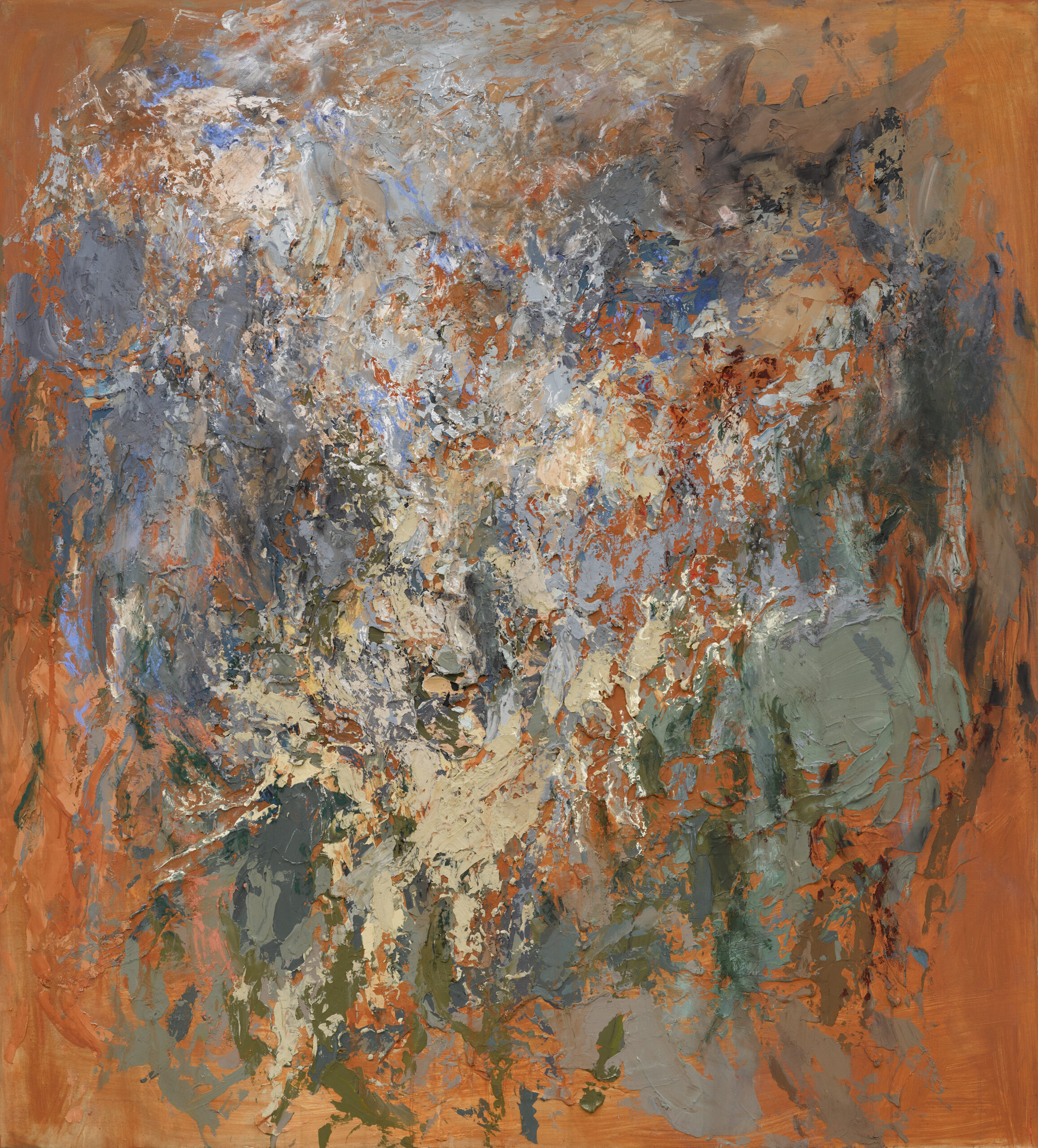
MAY: I grew up in Cornwall and lived there for 18 years, before moving to Edinburgh. Sort of soft launching an urban landscape from Edinburgh to London. I tried to do pure abstraction for a while through my undergrad, but the landscape was persistently coming through. No matter who was looking at it, their initial impression was ‘Well, I’m getting landscape from this’, which I found very frustrating at the time. But now I don’t know why I had such a resistance to that. Being in London, which is sort of the antithesis to the Cornish landscape and thinking about the Cornish landscape whilst being in London, I feel- very similar to what Nour and Sarah are saying- very conscious of being in a landscape that’s different to the one that I grew up in. When you’re not working from preliminary sketches, or en plein air, the landscape comes out in a different way. So yes, my work’s very connected to Cornwall and it’s geologies and landscape, the turbulence and changeability.
We had a crazy storm this this past weekend in Cornwall. So many trees were down. When there’s a northwest wind, it wreaks havoc. So it’s very changeable place and that is within my work too. I lean into this dimension of the landscape and it’s coming through more and more… its a very natural connection.
MINNA: What really intrigued me is that your painting process is very tied to the geology of your coastal home isn’t it …the layering of paint, scraping off, excavating, layering again… It echoes the geological process that is constantly shaping and re-forming the part of the world that you come from, which is fascinating.
One of the peculiar and powerful qualities of abstract art is – in my opinion- the power to trigger in your viewer a sensory response – a physical feeling on meditating on a work. I think this kind of response is less easily provoked by a figurative work. Sarah, you are also a musician and music of course also has that power doesn’t it..this idea that you can be listening to a piece of music and you can cry and you don’t really know why you’re crying. What do you all think of this idea?
NOUR: I think yes, because when you see someone’s hand in work…there’s this idea of process, that like ability to project yourself into this thing that happened, this moment that happened on the canvas. It is a magical experience to be able to feel something through that. That’s also kind of alchemical. I feel very similar to May, your resistance to accepting that your work is very much connected to the landscape that you came. Sometimes things feel too simple or too easy or too boring, but actually we forget that no, no one really experiences something the way that you have. It can never be experienced same twice. I saw this interview of Michael Craig Martin, an artist who was talking about how when things come very easy to us, we tend to ignore it or take it for granted because it’s just too easy, but actually it’s not the same thing for other people. Your relationship and the way that you’re able to bring in landscape is almost an excuse to paint, or a way to enter painting and making is a very natural thing to you, and that’s why it works so well. That’s something that I find very fascinating, and what I love about art is when someone is doing the thing that’s true to them, then you can connect in a way, even with music, that you just you can’t with other stuff.
SARAH: Jumping off that, I think that there is something about making physical work in the physical world as painters, that if you’re using your body to make it, there’s this embodied knowledge that comes with memory. It’s true, I’ve opened up the part of my memory that holds on to the landscapes of childhood, that’s also processing the landscapes of my adulthood, which is New York City, and it seems like you, May and Nour, are also doing that, and by making physical work- and I even argue abstract work- we’re bringing this embodied, rhythmic, inherent- ness to the work. I’m most moved by abstraction because when I engage with an abstract painting and feel deeply moved by it, there’s a generosity within the artist that they projected their embodiment into the work. But then I experience it in my own terms, and also mirroring the fact that it’s true that every experience is individual, so there is this moment where I can work with something and see an object, but then let it dissolve into something else, and it lets my mind work through the work differently than if it was a figurative work, which I think then works in its own different mechanisms.
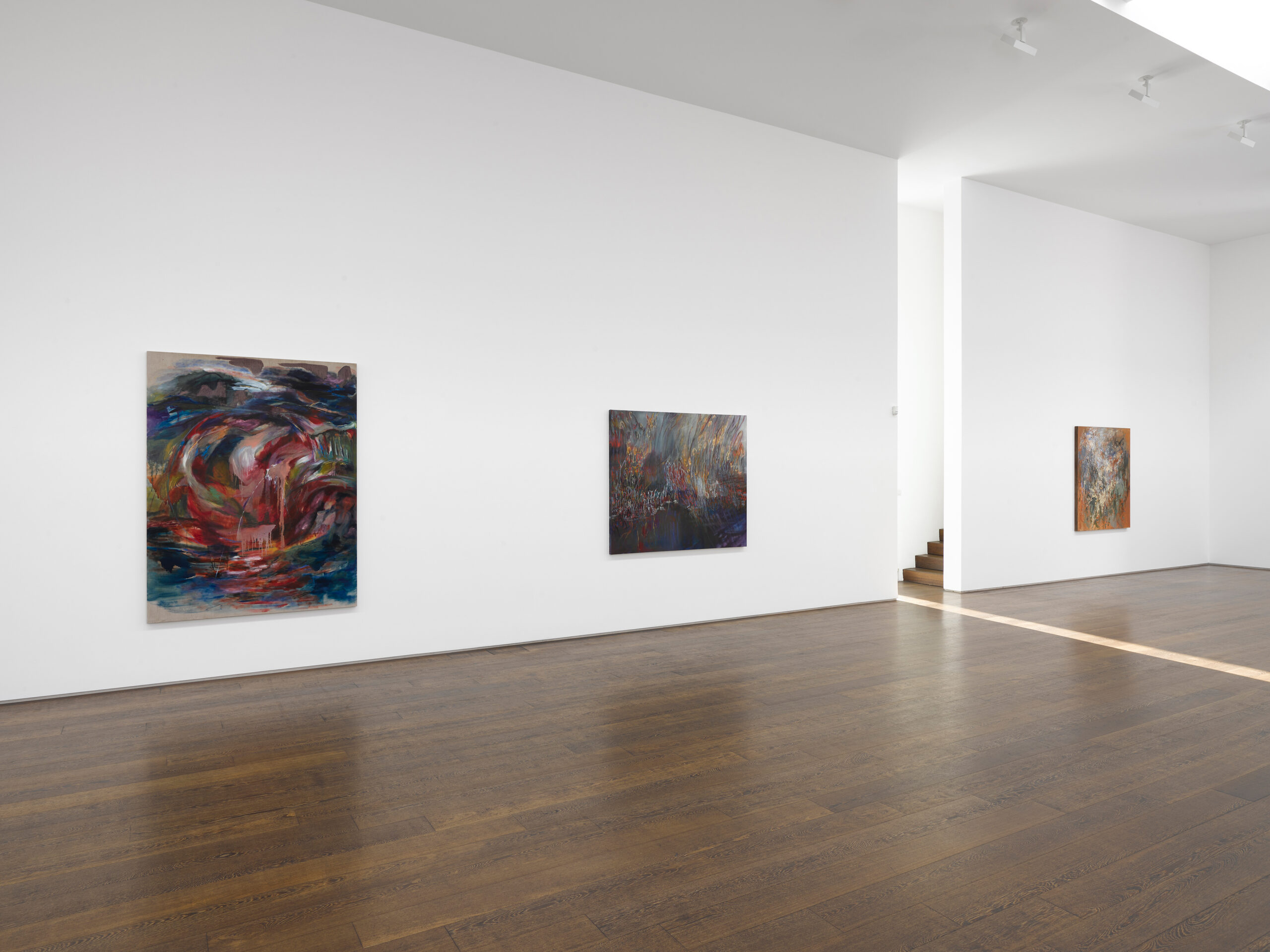
MINNA: It’s a very true point you make that in viewing an abstract work, one is aware of the artist behind the work instantly- more so than when looking at a representational work because in that case we are first struck by the question of what we are looking at.
May, something that struck me very forcibly when I first saw your paintings in real life was their three-dimensional, craggy surface. Will you say a little bit about how you construct your works…you put all sorts of things into your paints don’t you, to create this?
MAY: Yes! They are concoctions of different kinds of materials – plaster, marble dust, sometimes decorators caulk, charcoal and acrylic of course and all combined in a cup and then applied with a with a knife. They change every time because I don’t measure things out, the ratios are different and the temperature of the studio is different too. I am really drawn to really matte surfaces, and so that was the inception of using plaster- that it’s very fast drying. It’s a very robust, heavy material but I like to push materials in ways that they’re not necessarily intended to be used, so I lie the plaster quite delicately. I use pastels and charcoals and fix them many, many times to make sure that they’re not budging, they’re not going anywhere. So how they lie on the panel contradicts how the paint is- it appears quite light but is very heavy. This process is important to me, especially thinking about geological process and the weathering and the landscape of Cornwall. I then chip away, or apply a whole section of plaster over half of the panel… deleting parts and then building it up again. Whether you look up close or step back, it changes so much about what people see in my work… I think that’s something you don’t necessarily get when things are overtly representational.
MINNA: Given the importance of the act and process of painting for all of you and because it’s such a physical, gestural act, does your mark-making change according to how you feel, day to day?
MAY: I mean, for me, if I’m not in a painting mood, every time I go in and do something, I tend to regret it… I might try but it will not turn out how it was meant so I have to start over again…so I try not to start working in that frame of mind.
SARAH: Yeah, I agree with that. I don’t want to use my painting practice as personal expression… It’s not ‘oh I’m having a day that feels challenging and therefore I’m going to put these feelings on the canvas’… for me I try and recognize that there is more inner work to be done, more questioning. I often find that gets teased out through drawing or writing on note cards and then I am more able to look calmly rather than projecting everything that my physical body is holding onto the work. My way of approaching abstraction is not just the personal expression of my feeling that day, but it is about these overarching feelings and questions that I have that can be very emotional. And May, I love hearing about your studio… I think it sounds like such a fun studio… all the different concoctions! This idea of choreographing an abstract work really resonates with me; there are moments in my practice where I recognise the aliveness of something – so I’m not painting water for example, but the aliveness of water, and I make these marks but I then want to make them recede into the work… but that comes with this emotional quality that they need to be painted over…they’re not going to be what they were before. And there’s this constant feeling of loss within the way that I work. Its emotional and it mirrors life and the constant change that we’re all going through- a constant negotiation.
MINNA: That’s very interesting, Sarah, because it does sound like you’re in engaged in a kind of tussle between your original stimulus that is at the heart of the work and the power of the material itself… and it sounds like in the end it is the material, the paint itself, that wins. Have I understood that correctly?
SARAH: I try to lean into the qualities the materials bring. Paint is alchemical, it can do so many different things. When I’m thinking of subject, I then think, well, this would be interesting. How could this mark melt, tremble, or dissolve, and how do I apply the paint to make that process happen? And it’s similar to how I write music too. I sing a vocal line and then I apply effects to it, thinking, oh well, this would be really interesting if it had reverb …or how do I stutter the vocal to make it have this small quaking feeling, and mark making and music making in that way become very much aligned. I feel like the paint, the pastel, or vocal effects are all the medium in which allows me to have the effect that I would like to on the subject matter.
NOUR: I love what you both said – it’s so relatable. To your point of not going to the studio or not working from a place of emotion -out of respect to the work, I don’t let myself get in the way of it… and this goes back to this idea of feeling like a channel of creative consciousness. Personal feelings are blockages to work so to work from a place of clarity, regardless of what the day looks like, is important. And to have outlets other than painting, for me, is extremely important..if I’m working on a deadline, I set myself like a like a fitness goal, for example. I need to be doing something else in order to let out my frustrations or energy so that I can then show up for the work in a much more focused, calm, intentional way. To May’s point, it all comes down to an accumulation of multiple sessions of painting that then form their own entity – but you are recording your body in every single layer and that work will inevitably be a form of record of your personal emotions.
MINNA: Something I don’t think I’d realized before I visited all of your studios was the amount of layering that goes on in all of your works… to create these palimpsests of memory and feeling. I have seen your works at different stages, and I must say I’ve been very struck about how different the works look as they progress. Why do you all layer so much?
SARAH: For me, the layering is a physical accumulation of mental and physical spaces, and then the subject matter that I’m bringing, and its only through that layering that I can mirror what existence is. Nour mentioned this phrase ‘world building’ and it’s a term that that I’m using as well because we are all world building within our mental landscapes. We have our past, presents, and futures but we are living in all of them at one time. We practice things like meditation to be really in the present but we’re usually living in multiple different time frames at once. I don’t tend to like using foreground and background when talking about my work because it’s very important to me that there’s this oscillation between the marks, almost like pointillism, where form is made because of the way that the shapes are working off one another. And to me, the magic of layering lies in that ability to play with my eye and the viewer’s eye, and the image is created because of the ways the mark making works together.
MINNA: That’s very interesting. You’re very conscious of the viewer.
SARAH: Well, I am the viewer in some ways. I’m viewing the work daily, up close and far away and so I start to feel like the separation between me and viewer is edited in that way- we become closer. I’d argue that I’m making the painting – but it is also making itself through the relationships that are staying on the canvas, and so I like to see myself as the viewer too.
MAY: Yeah, it’s so interesting to hear you talk about the background and the foreground, Sarah, because that was my instant reaction to seeing your work in person, that there is this ambiguity about what’s in front and what’s receding. I think layering for me is also about solidification of material.. and then more and more paint is applied. And this is also an accumulation of time spent working on them.
MINNA: Is it hard to know when to stop if you’re layering that much?
MAY: For me, it’s definitely not done until the point when suddenly, very quickly, everything starts clicking almost instantaneously, and then it’s like, oh, it’s done. And that window is very small… after weeks of working on something. There are always things that I could do beyond this moment but I try and resist because the painting is telling me something. There’s the danger of overworking it and you don’t want to lose the energy of it.
SARAH: I love hearing you talk about it because I can just imagine the days I’ve walked into the studio and looked at a work and thought oh I could do this.. but for me the work almost seals itself off and I just feel like a manipulator trying to make it do something that it’s already doing and in a way I feel like I can’t re-enter the image because it has completed. And sometimes it takes the morning after I’ve painted to come back into the studio and really sit and look at it.
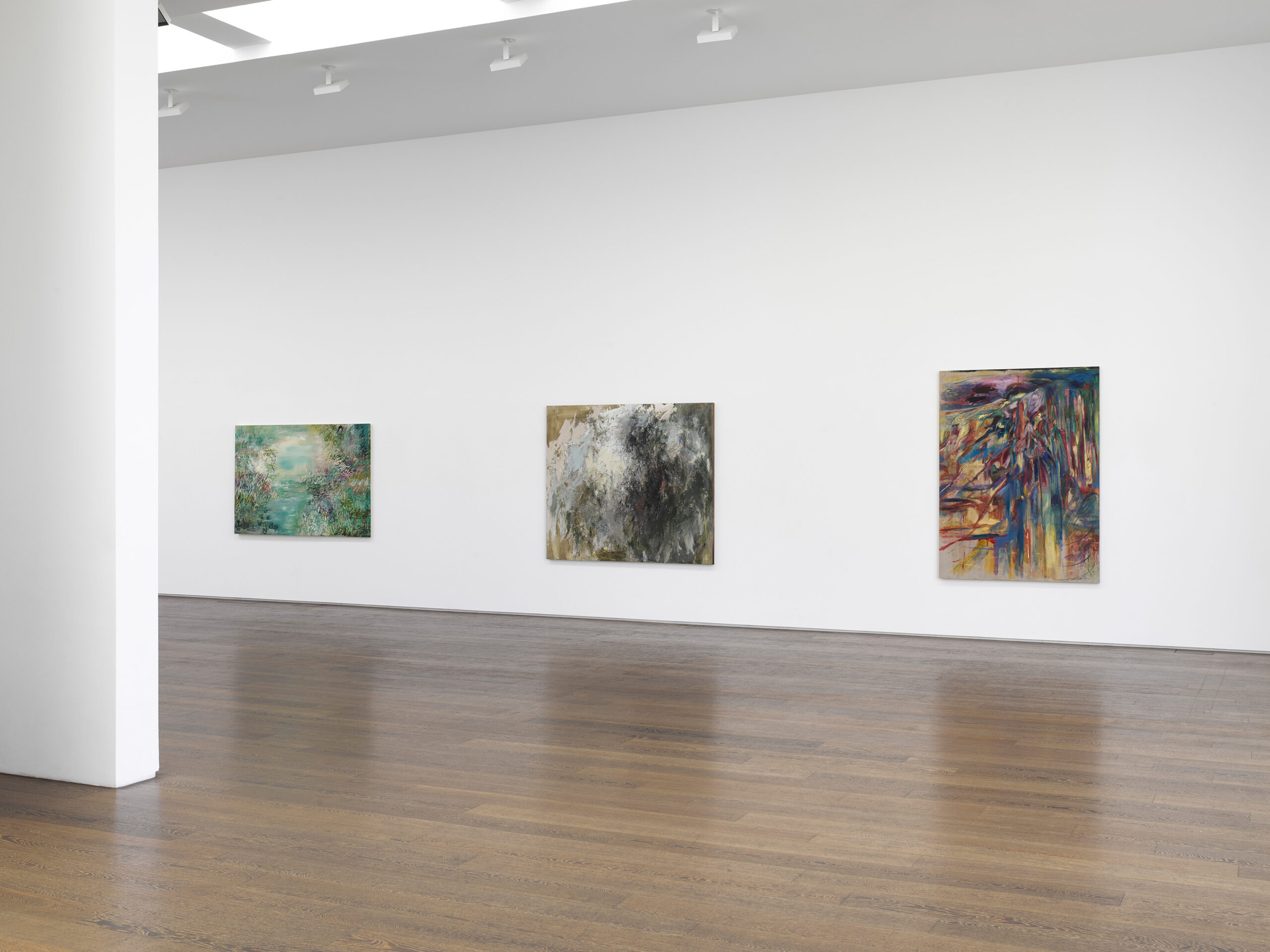
NOUR: I think paintings have their own life, and so they communicate back. And when they’re done, they’re done, and you know it. And there’s nothing you can do about it. You have to catch it in that sweet spot, just like the both of you were saying, and it’s actually both funny and also incredible to witness. Like, when we had a studio visit together, Minna, and I was showing you the work, and the work was halfway done, and when works are halfway done, they look horrible. Like they are just in their ugly phase, and to have to explain to someone that they’re not going to stay there, and you saw how much trust I had in this evolution. You know you’re making a painting and it’s looks fine in the beginning, and then it goes into this territory of crisis and then I forget every single time that it goes through a crisis and I’m like it’s not going to make it it’s not going to make it out and then it does and things click. Just like what May was saying, once things start to click, you can see it. It’s happening, and then it’s finished. You don’t touch it; it doesn’t want to be touched.
When I was younger, I would overwork paintings because I felt like I needed to like wait for the work to evolve …but there is a beauty, an aliveness, a pulse in the painting that you need in order for the viewer to be let in. It’s kind of comical how much painting is a metaphor of life. You know, you go in, you’re like, “This is gonna be great,” and then it’s just like, the lack of control and the needing to negotiate and the building something and the wisdom that you need to believe that you have, and then and then you get somewhere and you’re like, “Oh, okay, things are fine”, and it’s like that with every work. You’re lucky every now and then when you get one that doesn’t go through that. I don’t know if the two of you would agree, but it sounds like from your descriptions that that’s kind of similar.
MAY: That was so incredibly well put. I think that’s exactly it. It’s interesting hearing you two speak about your works, although our paintings are very different, I see so many commonalities in the process of making them, like that crisis point that you were talking about, Nour. It happens every single time, but then it’s almost like that moment has to happen for you to then be like, oh well, you know, the stakes are really low now.
NOUR: Might as well.
MAY: For me, when there’s a piece of a painting where I’m thinking, oh, this is a really strong section, I find I often have to get rid of that anyway later down the line because it’s messing with the rest.
NOUR: I learn so much from my paintings because it’s exactly to that point. I make a work and I think one section is so good and I want to keep it but it’s sabotaging everything else. And then you have to come to terms with that and trust that it’ll be better. Like it’s okay. You need to let go of this. There, it’ll get better. And I wish I could think that way in my daily life more because it’s such a valuable lesson. It takes so much focus..and I can see that in both of your works too.
SARAH: Yeah, it’s such a devotion. I feel like painting is such an act of devotion because you return over and over again to the surface that you’re creating. And the worst painting days are for me are the days where I’m protecting this one piece of this large painting, and I’m so focused on the controlling this one part that I’ve neglected the surrounding areas, and it’s like rebalancing, being allowing something to recede, so other things can be balanced. And I was thinking, in the word alchemy, there’s this constant quest, this constant searching for something that I feel like all of us are talking about. We show up to the studio. You’re a professional searcher. You’re essentially going to spend hours working with your body and these materials, looking for something. And I sometimes I’m even like, what am I looking for in the moment? And but when I see it or I feel it, I know that that was the answer the whole time. But the quest for what is always just changing and shifting, which you know really reminds me of kind of the alchemical process in itself, just kind of melding and waiting and all the different processes it needs to go through before it reaches a form that I guess in our case we can call the painting in its final form, but you know it’s even then it I’m like it won’t last forever.
MINNA: Very, that’s so beautifully put, Sarah…in fact the early medieval alchemists were considered like priests.
It has been completely fascinating to hear you all speak. I feel like I have been taken under the skin of the making of one of your paintings. Thank you all very much indeed for your time. It was the Renaissance artist Titian who taught me about the joy of looking at true painters’ paintings, but you all follow in that trajectory. It has been a privilege to hear you all talk about painting and this ongoing interrogation you all have with your medium. And now I can’t wait to see all your paintings hanging alongside one another at Victoria Miro in November!