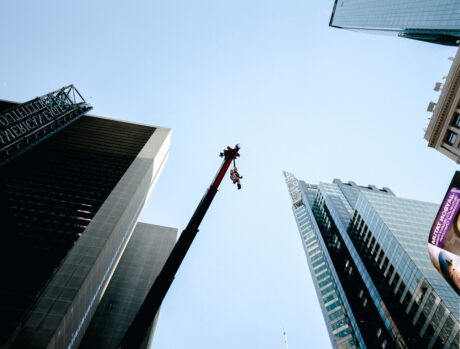

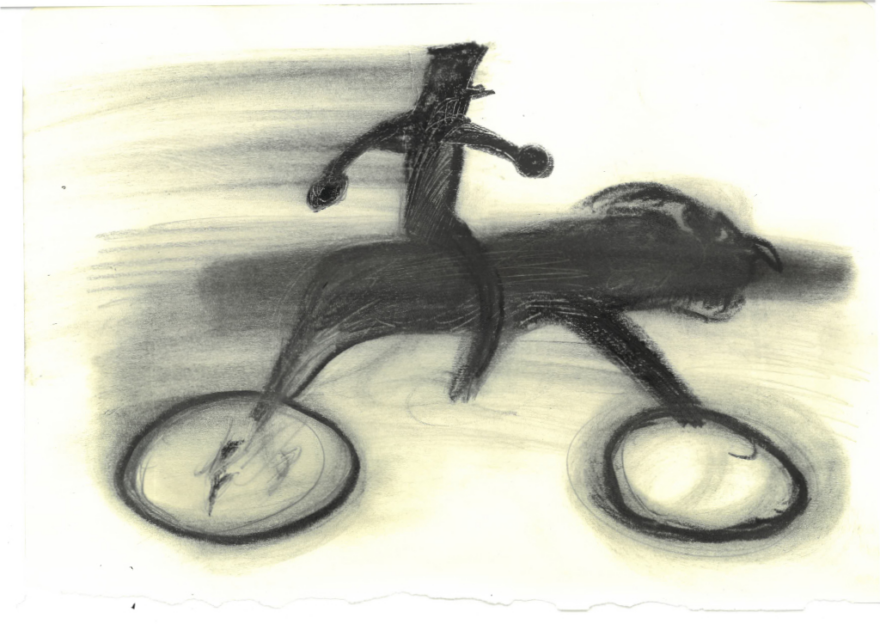
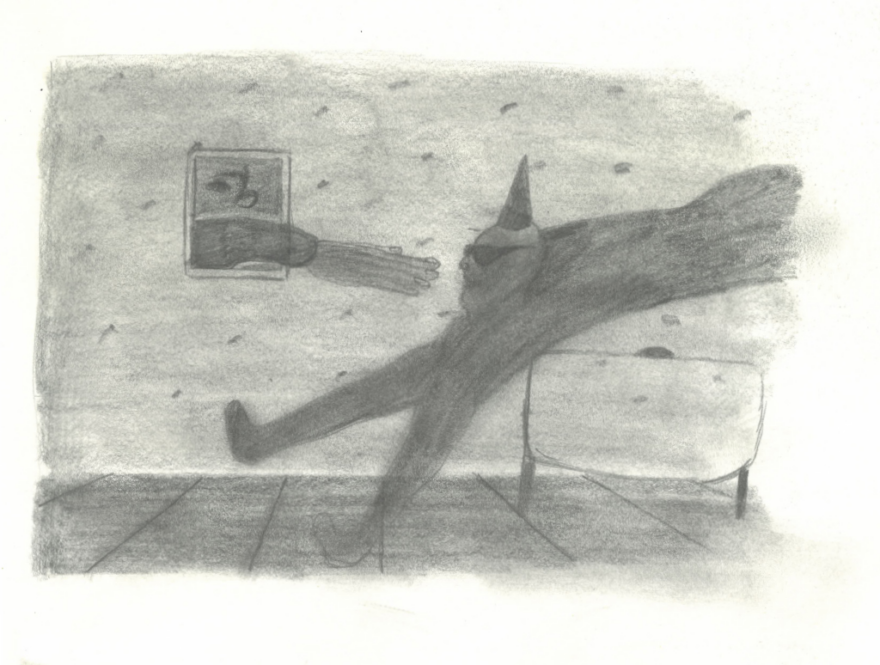
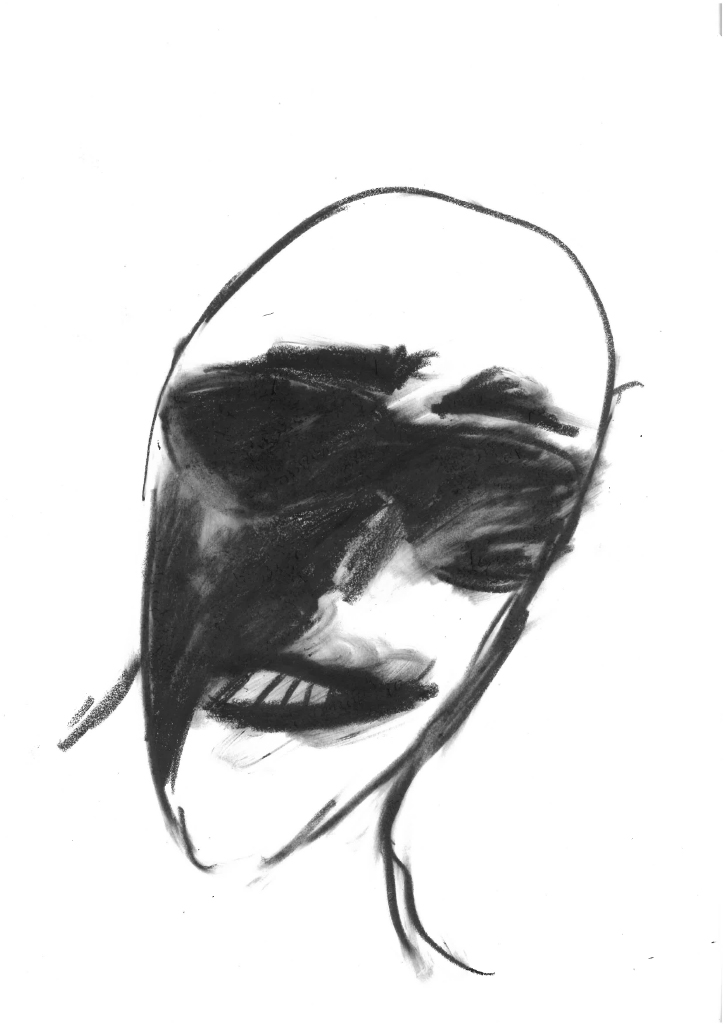
In his novel Descent to Bahia, French writer Matthieu Peck follows a young journalist to Brazil, where he reunites with his friend, the painter Pol Taburet. The book is published in English for the first time by HELA Press, with illustrations by Taburet. Here, Elephant shares an exclusive extract.
You probably don’t know it, but you can easily imagine it: it’s one of those blocks of flats that Belleville has by the dozen. You get there along a hidden street, typical of the area – ugliness is masked from walkers on the main drag. These blocks are camouflaged, so they’re a bit, let’s say, concealed: you first have to cross a boulevard, a few streets, and all of a sudden these big, fierce developments open up in front of you, with their esplanades in which the wind unsheathes its chill blades.
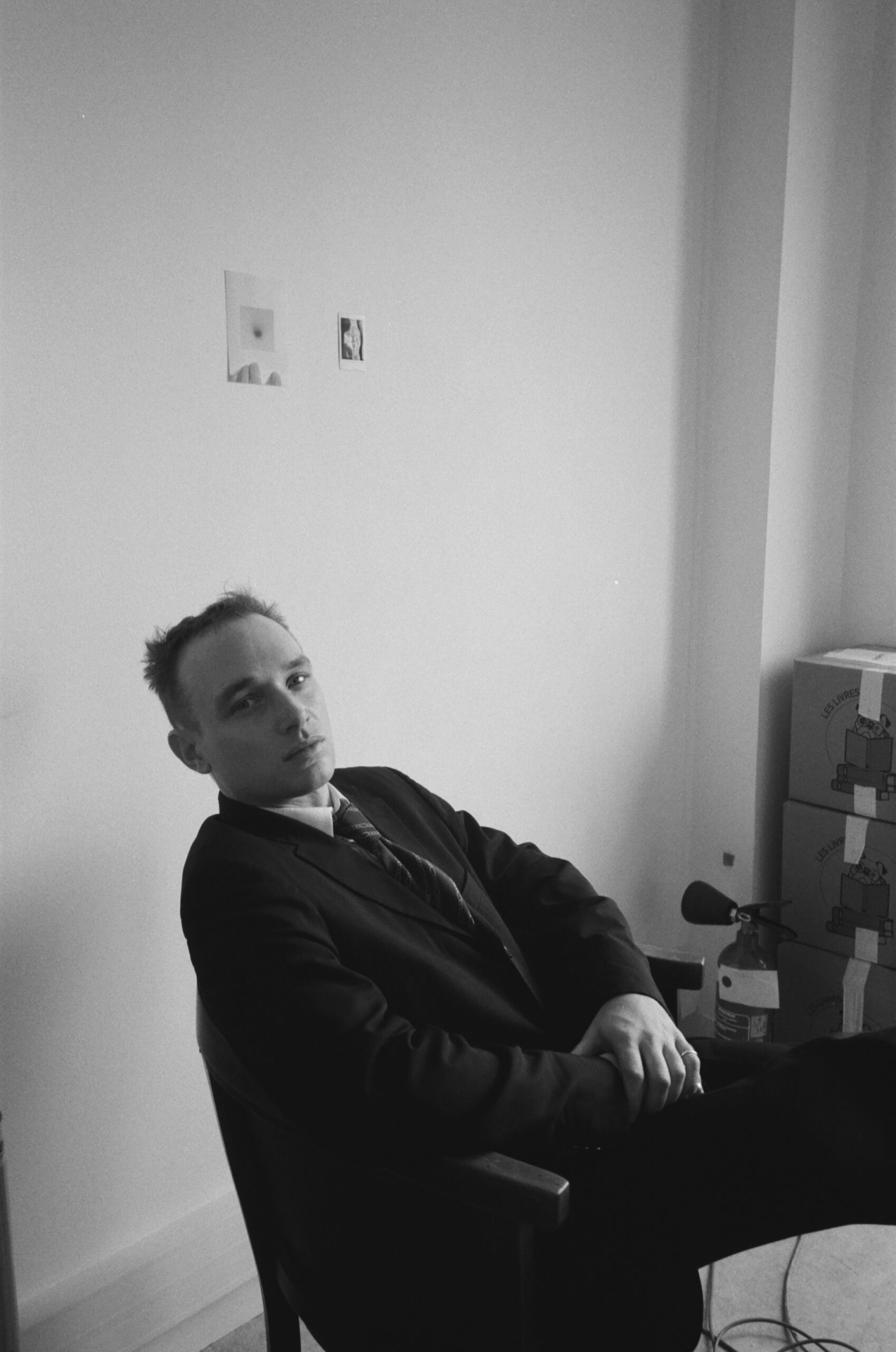
This wasn’t the first time that I’d met up with the artist, Pol Taburet, 26, with a gift for painting and the white-hot end of the night. Our meeting had its roots in a past long-gone, in mingled friendships one summer in the South of France. He had shown up just like that. I was there – that was it. I’d admired the courage required to arrive solo in the middle of a tried and tested gang of friends. It wasn’t the first time, I told him, but till now I had never seen his place, which was understandable, given that Pol still lived with his parents. How far back do those moments go? I like to let time destroy itself, slaughter me slowly, as jealousy does, or a tour operator. I like to do that, but I owe it to myself to be precise: four years separated us from this visit here, to his bedroom in the 20th arrondissement. But something manifested itself, I remember. What was it? I couldn’t say: one of those clarities, bright or dark; those flashes that suddenly show you beauty.
The lift didn’t work. I coughed up all the previous day’s tobacco as I climbed the five floors, and stepped inside his flat. Some narrow corridors, objects all over the place, then a little living room. I crossed it, receiving a warm welcome from his parents, before entering that upside-down bedroom – the tiny room that served as his studio.
Was it from the shrooms that Paul handed me? Was it under their effect that the world expanded as it did? I don’t know. The walls around me were painted, and the colours had traced their shades everywhere. In barely ten square metres, Pol Taburet was already displaying his gift for failure and his severity towards himself. The combination of those three words might seem convoluted, it’s true: gift for failure. But all art, I guess, is an elaboration of shipwreck and collapse. It requires an ability to bounce back and transform.
So I was in the studio of a painter without a permanent studio. At the time, formats had to be kept medium-sized to get through the door, as in Francis Bacon’s famous 7 Reece Mews in London. I’ve always been receptive to the particular beauty of an unruly jumble of objects, a room given over to itself amid the dust and tremors of experimentation. So that day, I wasn’t disappointed when Pol suddenly decided to bring some canvases back to his place.
I’m not relating these memories for no reason, and the first question that arose was this: why keep his own works facing the wall, and at home? Pol would later explain to me that it meant not being polluted by his own visions; that imprisoned like this, the motifs and forms, the colours and their sequence, the entire divinity that can be contained in a hand that holds its brush and its tyrannies, things that must never have their effects dictated by a work at rest. I acquiesced: I, too, was resigned not to read a single novel while I was writing. We are both drinkers, to a certain degree, and those who suggest that they have extirpated all alien influences entirely from their style are often the least gifted of forgers.
We opened a bottle of wine at that moment; it’s a tradition that mustn’t be lost, whatever anyone says, when words start to burn between one mind and another. We opened that bottle, and several canvases turned over one by one to reveal their curves, their sensuality, to pierce me to the core. The effect of the ash-tasting psilocybins would soon interact with that of the French cépages, and our words would distort into certain truths characteristic of minimum doses, to certain truths of a nascent friendship.
Subsequently, and in each of Pol’s future studios, over several years, we went on reviving the idea of a complicity spread out over several days, weeks, even, in places other than Paris. Meanwhile, I came at night, when he was painting, or to an unexpected party encroached along the veins of darkness. Sometimes it was just the two of us, although we were usually joined by hordes of lunatics. True, we often went out in the morning, a few packs of cigarettes and promises later.
Buildings divided up into artists’ studios always invite madness, the bad kind, and turn your working space into a bedlam of debauchery. I had already witnessed this when I called in to talk about our respective work, a neighbour from his floor knocked on the door, as if it was the most natural thing in the world, in search of a serum for his boredom. You politely let in one person, five, ten, and that golden rain is already splashing through the panes, that’s it; you came back, afterwards, children are weeping outside the schools, children want to stay children, and again you think methodically of the pointlessness of all the words exchanged.
When you move in a world of artists, butcher boys or philanthropists, everyone knows that Paris is a consuming furnace. Yes, but what? Leave? It’s not a matter of dressing yourself up in the cliché of the cursed artist, deep in a parish or deep in a forest – that would be too vulgar. To leave, yes, but with a view to coming back. Claiming you’re going to live a better life elsewhere has nothing to do with the solitude that is the magma of more serious souls. Writing in barbarous ink, here I should state that, you need to be able to espouse the city and its demons. That there is a gift in knowing how to extract the sap, in fits and starts, as the painter does, from what crushes us as well as what does us good.
Four years later, four years after our first meeting, then, this time I was in a plane above the Atlantic and its liquid latitudes. On the opposite hemisphere, in Brazil, I was on my way to join Pol Taburet. He had arrived a month earlier. He would certainly have had the reception he deserved. Would have been told that his success in France was promising, that you didn’t just find your way like that, from one day to the next, into prestigious collections that gave you the most precious thing of all – time. Pol was there in that solitude, genuine this time, fateful and superb: the solitude of language. He had been painting for several weeks, or rather drawing the first lines of a new series that he wanted to be the destructive element of his previous painting. Ambition should not be taken lightly, whether you succeed or not in a given space, I found grace in that voiced radicalism.