
Writer Bella Butler walks us through her experience of Canadian performance artist and sculptor Miles Greenberg’s latest performance titled WAR (2026). After speaking with both the artist and the curator, Zoe Lukov, Butler critically examines the work within both its political and artistic contexts.
On October 29 at 5 p.m., in a cavernous, industrial space in Manhattan, performance artist and sculptor Miles Greenberg, along with forty-three other performers, stepped onto their individual walking pads (flat, compact treadmills) and began what would become a six-hour durational work titled WAR (2026). Prior to entering the building—formerly the 86th Street Cinema on the Upper East Side—the audience had little information on what was to come, only the artist’s Instagram post, stating that the performance was a response to “the umpteenth full-scale campaign of abject violence initiated by the administration of the country I live in.” He boldly closes his introduction by asserting: “I want this to be my Guernica.”
And that it is.
WAR was presented by Performa in partnership with CAP99, Elephant and Library Fetish, and curated by Zoe Lukov, producing what is Greenberg’s largest performance to date. The durational work finally came to life after three years of tireless attempts to have his proposal accepted by various institutions. As Greenberg divulges to me, while most claimed their rejection was for budgetary reasons, there is no doubt that the political undertones of the work deterred some. After waking up one morning this year to find that the US had struck Iran, he knew the time was now. The work had to happen “before World War III,” he expresses. Lukov was his first call.
Lukov is animated and emphatic when we speak the day directly following the performance. “I told him that he needed to do it now and didn’t need to wait any longer,” she says when I ask her what her reaction to the proposal was. “We’re living through constant war and have been. There is so much violence, in our names. I thought that it was a poetic way to deal with it and I like that he wanted to talk about violence without showing us more violence. He wanted to speak about war without giving us more traumatic imagery to look at. He wanted to encourage people to feel something, to see something.”
Greenberg agrees with Lukov’s reading, and tells me that “it’s not about being provocative. It’s about giving people a reason to care.” More radically, he adds, “what people do with it isn’t my responsibility. I mostly want to offer something to the people who perform it.”
The original cinema marquee still stands outside the building, and on the night of the performance it displays “WAR” on its illuminated strips. But the interior does not resemble a cinema and instead is something of a tidy construction site, stripped of its design and furnishings. The ceilings are intimidating in height and the building’s structure is skeletal, due to exposed staircases and missing walls. From the ground floor you can see three floors up. In fact, within seconds of my entering, I can see above me what I later learn is “backstage,” which is really a large wall-less room on the second floor filled with performers. A security guard guides me up the exposed staircase and I follow a trail of bellowing sounds until I reach the third floor landing. Some people are mingling with drinks from the bar but I don’t stop until I have entered the performance, located just behind the landing.
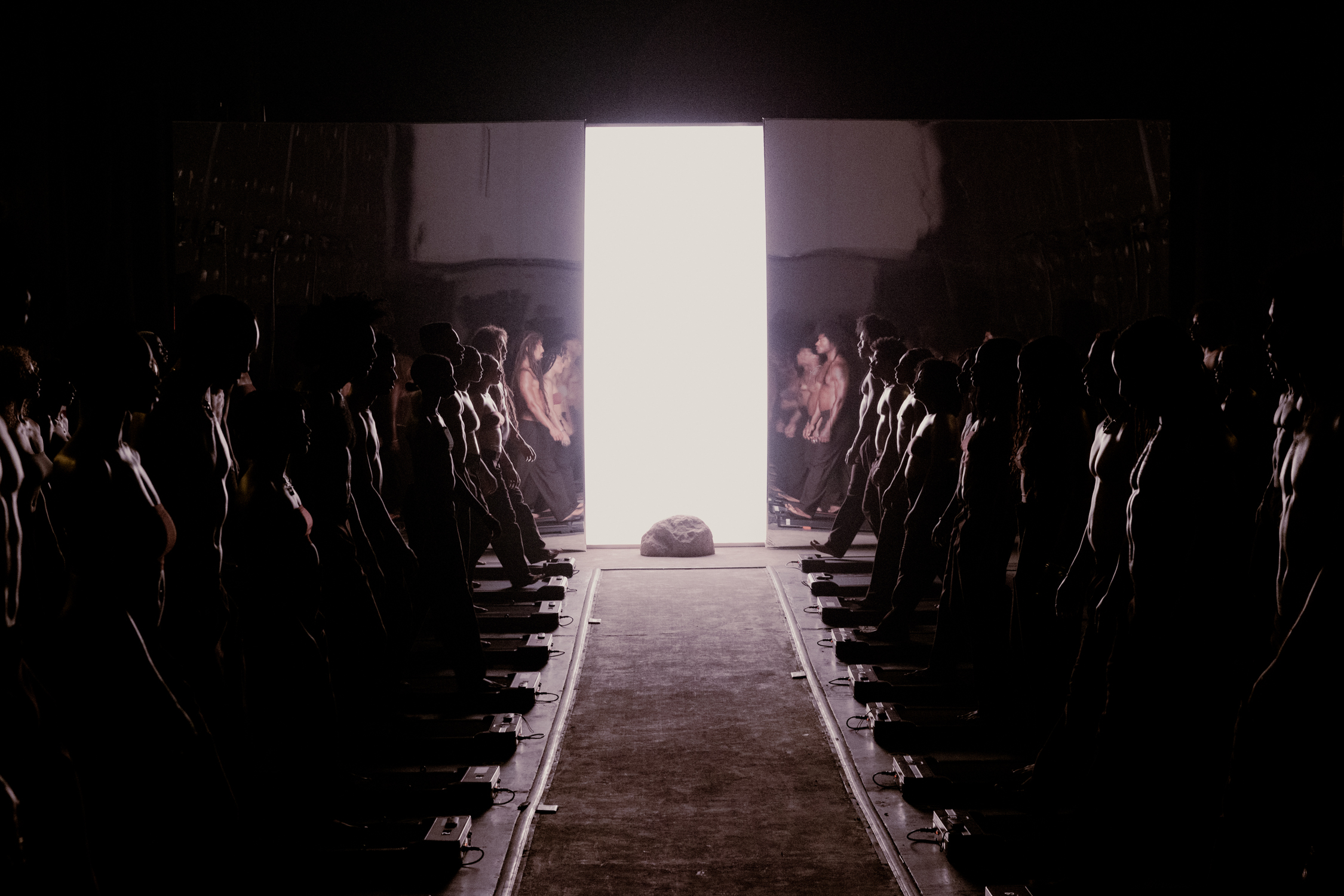
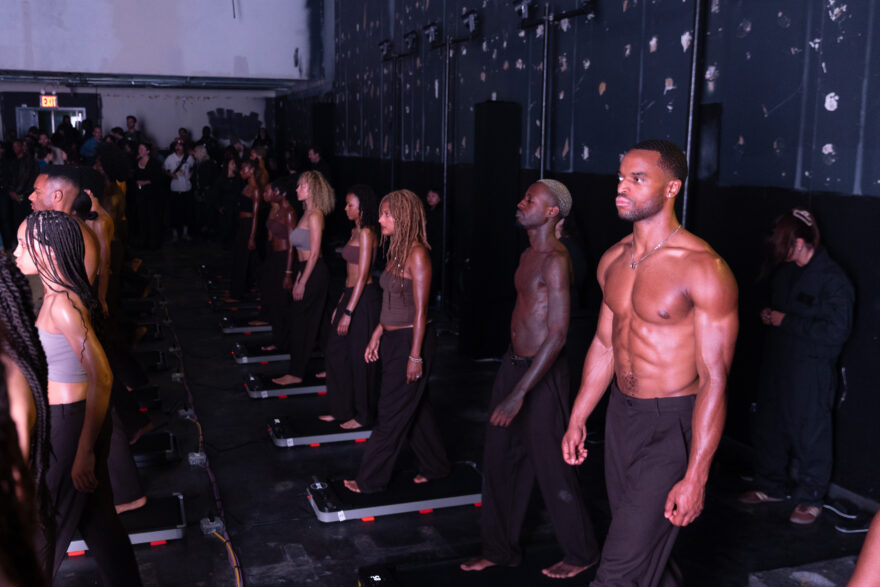
The room instantly envelops me with the heat and moisture of bodies as I begin to process the overwhelming stimuli. The space is dark—in the way a nightclub is dark—but the performance area is illuminated by a row of spotlights lining the side walls that shine upon the bodies of the sweating ensemble, shirtless or in tube tops with earth-toned pants. The performers, moving in place on their walking pads, are divided in half by an aisle down the middle of the room. The opposing sides face each other, evoking the image of two armies marching toward battle. While the performers’ movements operate along the x-axis, the bisecting aisle conducts movement down the y-axis, inviting audience members to walk freely up and down the path.
For the most part, the color of the room sits somewhere between a white and a blueish-purple, but sporadically transitions to an ominous red, the sound switching to blaring sirens to accompany it. The sonic component is a newly commissioned composition by artist Chino Amobi, consisting of fast percussive beats, droning synths, and ethereal singing voices. The room trembles ever so slightly.
I can hear the sounds but I can also feel them pulsing in my veins; I can see the lights but I can also feel them like a substance rushing through my retinae. Being an audience member becomes a full body experience.
While the side and back walls are left alone—black with dashes of white paint in preparation for renovation—the far wall holds a large mirror spanning the width of the performance area and double the height of the performers. The rows of performers are reflected in the mirrors, but a tall, rectangular neon light is inserted in the middle, denying audience members views of themselves. What they are met with instead is a rock, placed at the foot of the light. In keeping with many of Greenberg’s performances and sculpture works, the mirror and rock add a mythical element. In our conversation he explains that a mirror “creates a space where maybe the laws of reality have shifted. It creates a kind of suggestive state through illusions or tricks of the eye.”
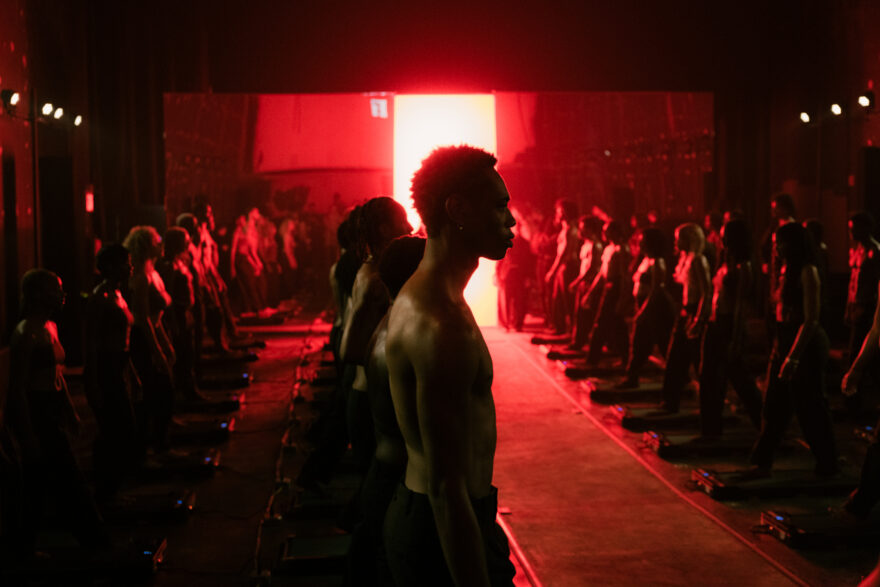
As real and ever-present as war is throughout human history, the extremities of it do seem to go beyond what is of this world. We have been forced to believe what should be unbelievable—or rather, ignore it. The mirror doubles the performers in number and extends the physical space of the room. The mirror serves two functions: it heightens the sensory experience of the performance, suggesting the overwhelming sensory realities of war, while also contributing to the theme of sight and looking omnipresent throughout the work.
The first mode of sight is simply the act of looking inherent to the role of the spectator—not to mention that the site itself, an old theater, is a space designed for the very act of looking. As an audience member, all you can do is watch. You can walk and change your point of view, but it is still just a viewpoint. As I move through the space, I am aware that there is both privilege and pervasive helplessness that comes with being an onlooker. Your body is more “comfortable,” in comparison to those “at war,” slowly marching towards a bodily deterioration. And, you can admire the aesthetics present in the visual language of the work (beauty, a complicated notion in itself when it comes to violent topics). But to occupy the role of the spectator also means you can look away. I am acutely aware that all I have to do to remedy my discomfort is turn my head or close my eyes—a privilege unavailable to those directly experiencing war.
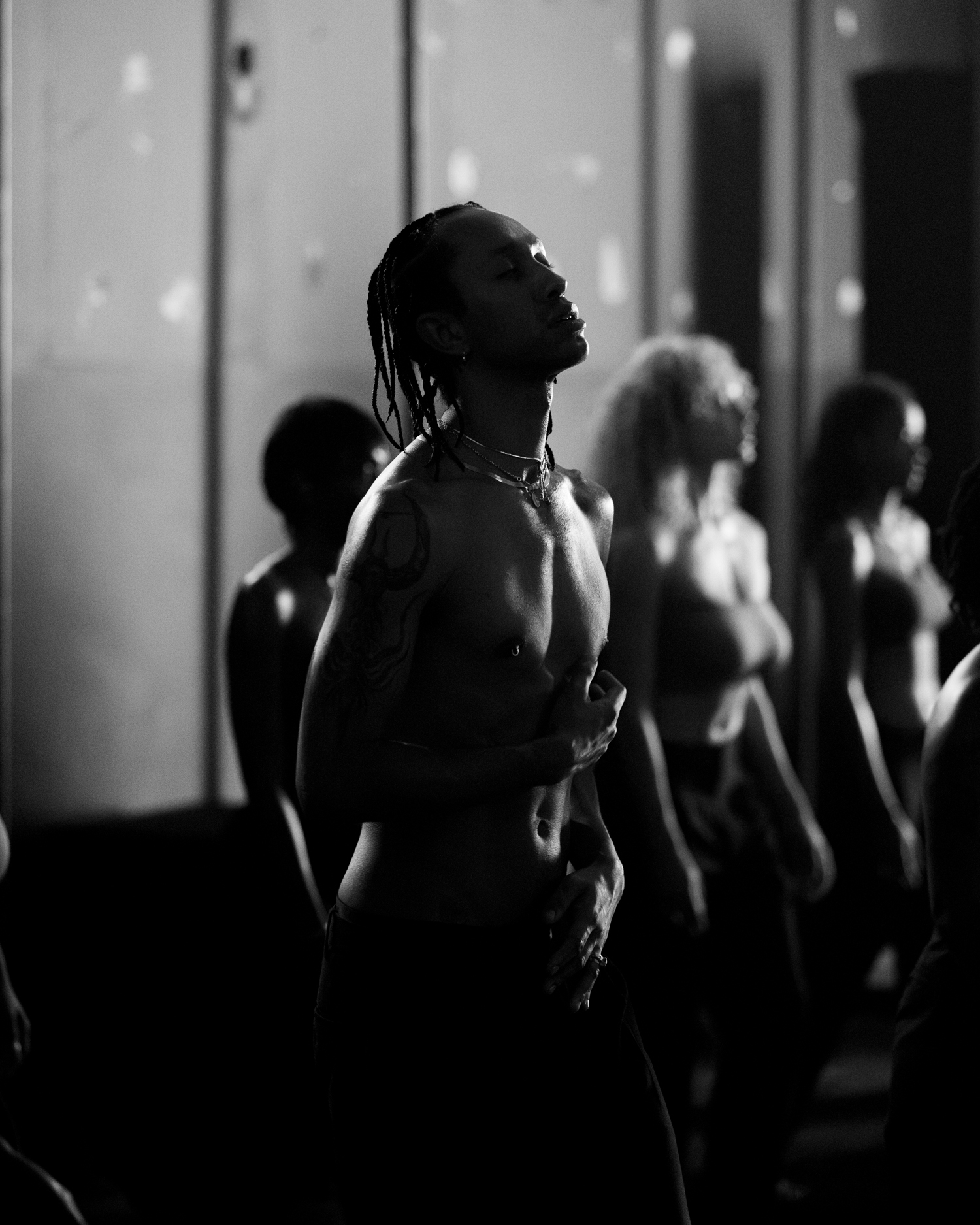
Another layer of sight in WAR is embedded in the performers themselves. A starkly visible component of their uniforms is a white contact lens on the eyes of the performers that faces the audience gathered at the foot of the aisle. It is unnerving to stare at a face whose gaze you can’t quite understand, and this makes me keenly aware of my own eyes functioning as mechanical parts that execute the act of seeing.
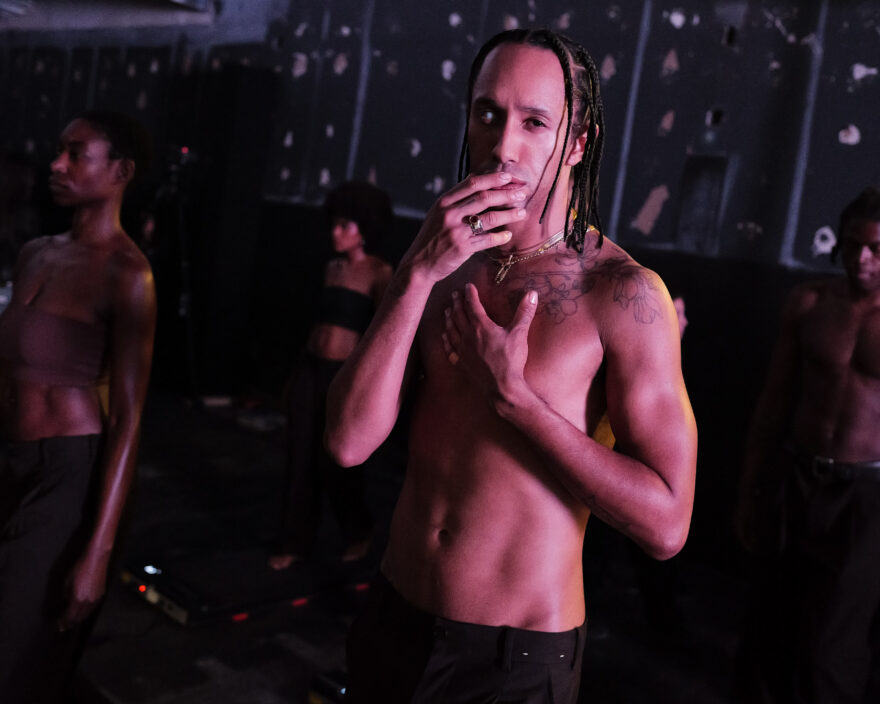
Where to look? Does one focus on the white contact or the uncovered eye? Should one be looking at all? Once again, the aesthetics of the work creep in as both alluring and dangerous. While not necessarily intended by the artist, I can’t help but think of the eye as a metonym for the mind and its psychic state. “You’re not seeing clearly,” someone might say to communicate an individual’s inability to see “the real thing” or the “truth” of the matter. This can imply the existence of a person or thing responsible for creating this obscurity, or, in this case, we might say responsible for creating both figurative and literal opaqueness. In the context of the performance, that thing is war.
When it comes to the aesthetics of war, the relationship between uniformity and individuality is an unavoidable issue. To be a part of an army, a collective of bodies who commit the overt acts of violence in a war, one must forgo certain human instincts in order to carry out one’s duty, one’s pledge of allegiance, in the face of danger. This historically involves blind trust—succumbing to an opaqueness—and a willingness to sacrifice a degree of individuality. Perhaps the most rudimentary exhibit of this is the uniform: the aesthetics of the collective. As we’ve seen exemplified by both life and art, from uniformity there can be something to be gained (togetherness, renouncement of ego, etc.) but in certain circumstances there is also something to be lost (“clear sight,” and the ability to act of one’s own accord).
But crucially, in this performance, only one eye of each performer is covered. Their sight belongs simultaneously to the collective and the individual. Each body is still of its own, walking with self-possession despite the danger implied by the enactment of war. This duality is visually established in one image: if you pay attention and look in the mirror as you walk down the top of the aisle, you will be looking at both the contact lens eye and the uncovered eye at the same time.
After speaking with Greenberg, it becomes clear that the use of contacts have a different origin and a deeper history with regard to his practice. The artist has used white contacts in the past, always wearing them on both eyes during a performance. He explains to me that they create an access point for audience members (mostly white ones) who feel intimidated by the returned gaze of a Black performer. Greenberg regards it as “counterproductive” to have a social barrier made up of fear and guilt between him and his audience, so he finds the opaque white contacts enable a degree of comfort, allowing the audience to engage productively with the rest of the work. But nonetheless, in my view, their implementation within a new theoretical context (war) affects and alters how they are read, especially since they do not cover both eyes.
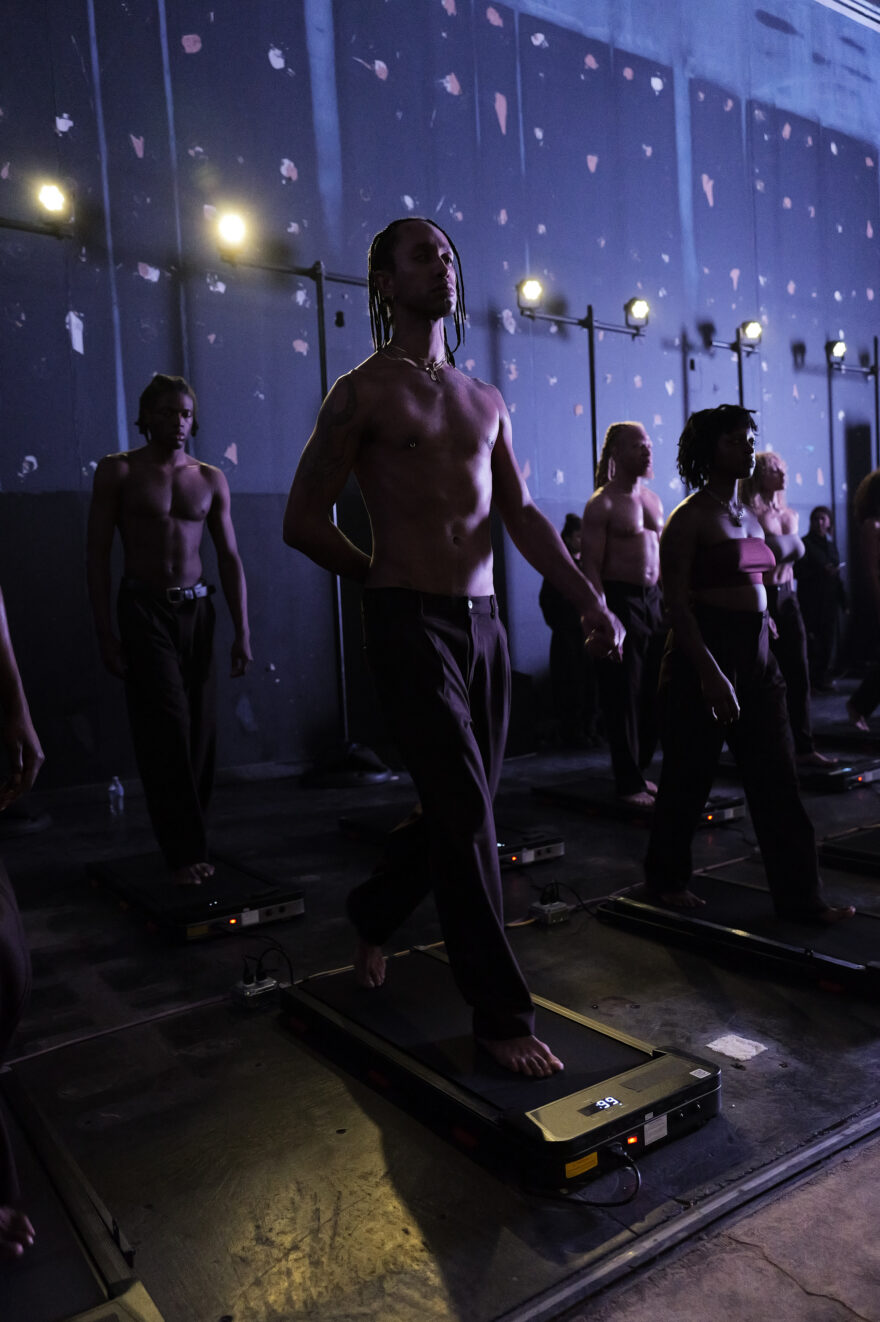
As the work progresses, so does the fatigue of the performers. Postures and paces of the bodies glazed in sweat are altered and feet begin to involuntarily show signs of soreness. Twelve performers make it all six hours (in addition to Greenberg) but the total cast comprises 78 people to ensure anyone can be replaced if needed. The artist’s first priority is always the safety of his group. Greenberg expresses to me that “they were incredibly generous with what they offered to ultimately a complete stranger.” He admits, “they took a huge leap of faith.” As I touched on earlier, Greenberg’s practice is not so much about evoking something from the audience as it is about the journey and experience of the performer—performance being an offering to oneself.
In addition to the walking, the duration of the performance is in many ways the framework and the script. It is time itself that informs the movements of the performers and the actions that Greenberg takes throughout. Stepping into time is the first gesture, and it is from this that everything follows.
Alongside curator Lukov, the iconic art historian and founder of Performa, RoseLee Goldberg, was involved in the work’s development and production, particularly in discussions surrounding its scripting and scoring. Greenberg speaks with deep gratitude about the two women, expressing his excitement in having had real generative and critical dialogue—as well as pushback—during the process, an experience performance artists are not always granted. He tells me that “RoseLee and Zoe were very much of the mind that it needed more of a score, more choreography,” but stood fast in his sensibilities explaining, “I think of performance as something sculptural, so in my mind, the development of a piece is more about how it deteriorates naturally and beyond control. So, it’s not something that I will script.” In the context of war, Greenberg’s approach feels particularly apt. “War is unscripted,” he points out.
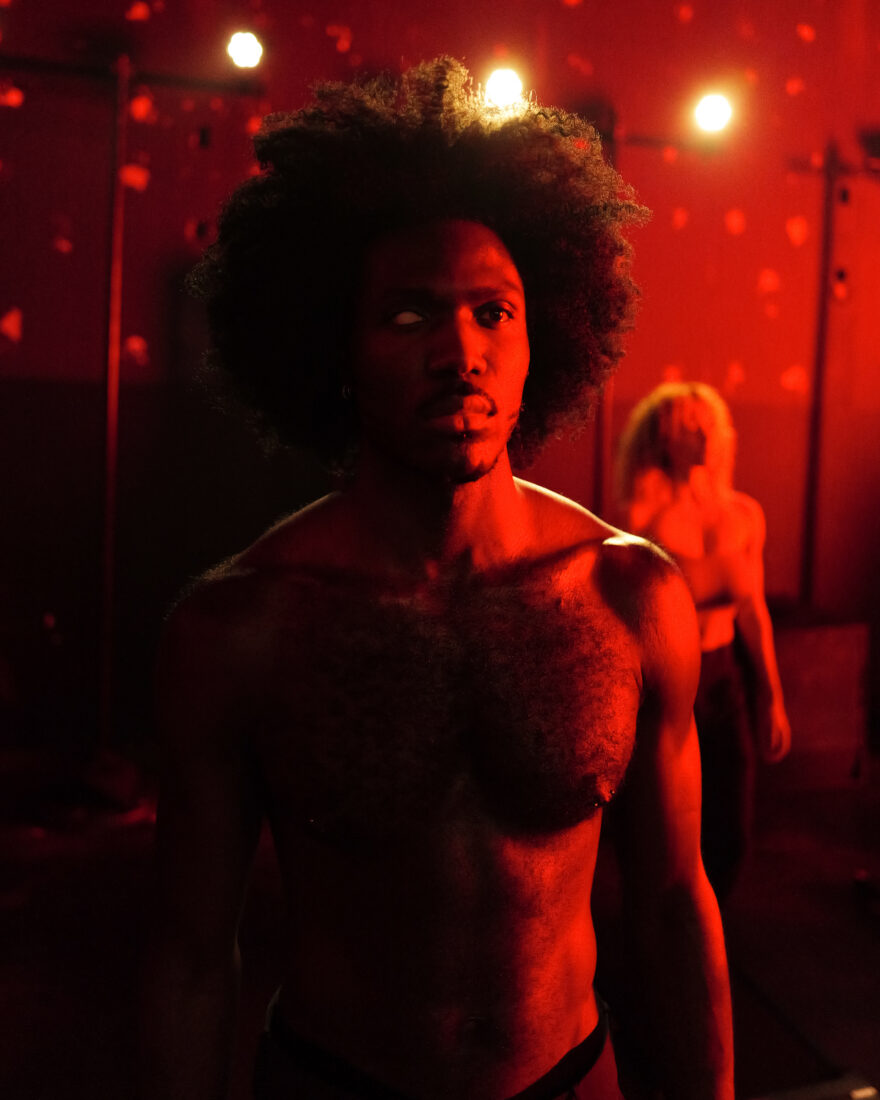
First and foremost, what all of this reminds me is that war is both made up of and done to the body. It is not an idea; it is not linguistic; it is corporeal. He tells me: “That is the function of my practice. To sanctify, to create a sacred analysis of what it is that we recognize or see or feel that has no language to it.” It is a confrontation with the life of a body and its destruction, its deterioration. But also, therefore, with its potential to be cared for, honored, and perhaps even restored.
Following his mention of deterioration—a highly physical word—he draws the parallel between sculpture and performance. He reflects that, like a sculpture, “the form eventually fails, from exhaustion and structural realities of the human body. The same way that a piece of stone will change shape over the course of 7,000 years. I don’t really see them as different. You don’t decide how a statue crumbles.” This idea solidifies for me the poetics of his practice and reverence for the bodies that take part in it.
War is dangerous; war is physical; and as I said, war is done to the body. It often feels out of our control. But something about Greenberg’s embodiment of it gives space for hope. And I believe that this is partially due to the stage of war he chose to represent: the lead-up to the violence. The physical collision between the two sides never occurs. Each body is still preserved in the sense that violence is not perpetrated between any two performers. Of course, the fatigue—both mental and physical—is visible and integral to the messaging of the work, but the path that bisects the walking performers creates a spatial gap that comes to represent hope for me, that tiny sliver of possibility: we have the power to insert ourselves, to intercept, in this epidemic. A breath is still attainable.
When discussing the artist’s relationship to language he explains, “I like noticing where the gaps are shared between languages. Those are the things I am interested in making images of. I started to make visual art, something poetic, out of what we lacked in our verbal definitions and things we haven’t come up with yet.” Greenberg is thinking about gaps too. I see the path as a gap that offers a visual language for what to do with ourselves in relation to war. Don’t stop engaging with the problem.