
In Paris for his first solo exhibition in France, Haitian-Canadian artist Manuel Mathieu discusses his relationship with European art history and his latest venture into fragrance, inspired by his homeland.
It’s lunchtime in Paris, and across the table from me, Mathieu is contemplating a crème brûlée. Before committing, however, he’s considering the relative merits of its proportions. Is the ideal crème brûlée deep, allowing for a generous quantity of custard beneath its caramelised crust? Or should it be wider and shallower, maximising the surface area of that brittle, burnt-sugar top? For a man with such exacting opinions on dessert, I wonder whether Mathieu is something of a chef himself. Not at all, he tells me. At home, a banana will do. Perhaps it’s just as well that he lives between New York and Montreal. Were he based in Paris, we agree, the temptations of its boulangeries might prove insurmountable.
We’re in the French capital for the opening of Ayizan, the Haitian-Canadian artist’s first solo exhibition in France, at Galerie Poggi. On view until 23 December, the exhibition explores spirituality, memory and history, drawing on Mathieu’s Haitian heritage while challenging the conventions of European art history. “To show in Paris is to point to our very dark legacy,” Mathieu tells me, reflecting on the complicated history that binds Haiti to France. He speaks of the violence of colonialism and the ways in which its mechanisms continue to operate today, drawing parallels with political events in Haiti, Venezuela and parts of Africa. “It’s something to bring my legacy and the legacy of this country together,” he says. “To underline it becomes very important in a show like this.”
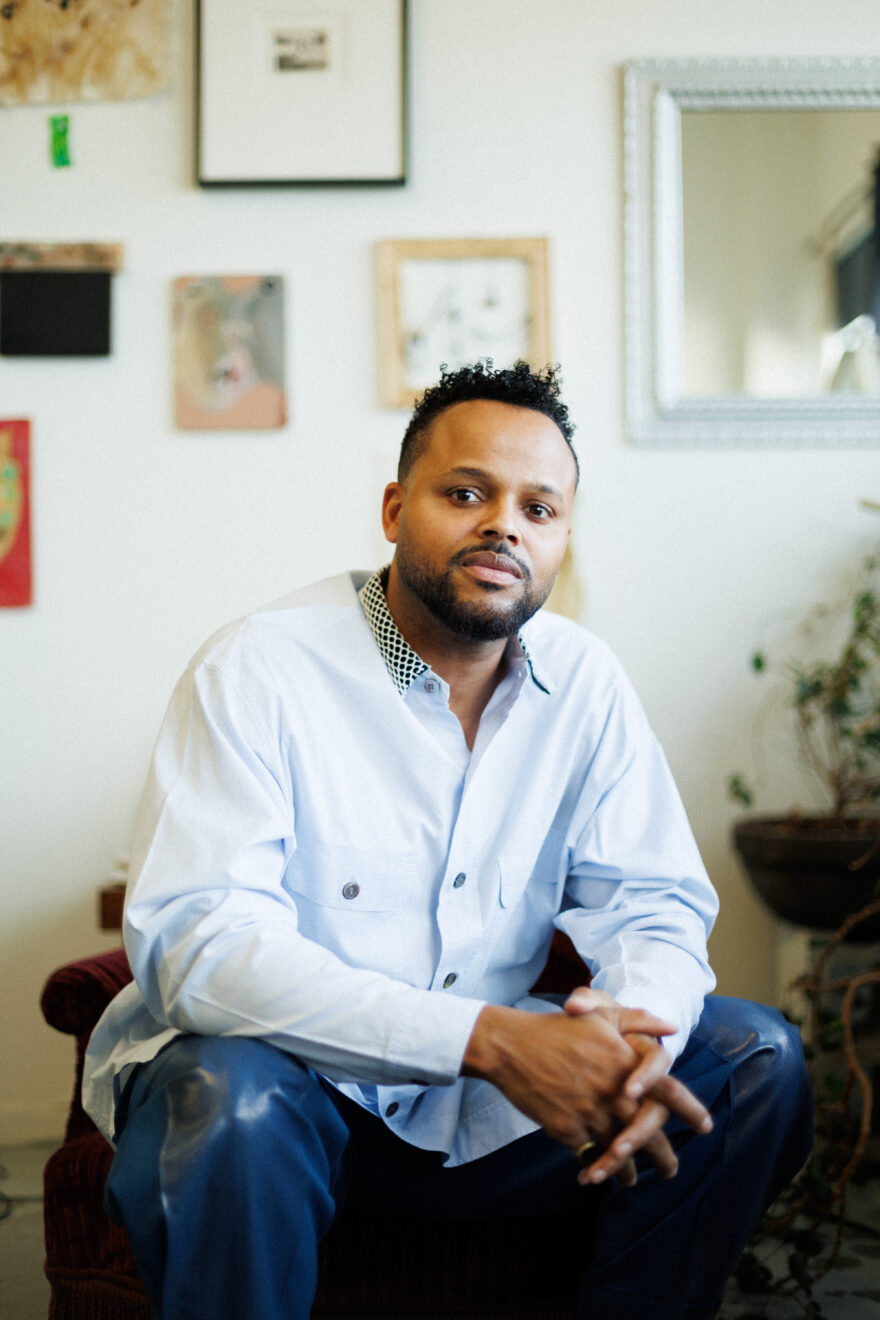
Born in Port-au-Prince, Mathieu grew up in Haiti in the aftermath of the Duvalier dictatorship, a period whose violence and political upheaval left an indelible mark on the country. Haiti’s history is itself one of extraordinary resistance. In 1804, following a revolution against French colonial rule, it became the world’s first independent Black republic. The legacy of colonialism, dictatorship and political instability has continued to shape the lives of successive generations, including his own. Mathieu left Haiti for Montreal at the age of 19, later completing an MFA at Goldsmiths, University of London. Since then, his career has taken him across continents, with solo exhibitions at institutions including Fondation Longlati in Shanghai, MOCA North Miami and the Saint Louis Art Museum. In 2020, Mathieu became the first Haitian-Canadian artist to have his work acquired by the Montreal Museum of Fine Arts, and this year made his Venice Biennale debut, presenting one of the most substantial contributions to In Minor Keys, with works spanning painting, sculpture, mosaic and film.
The exhibition takes its title from Mathieu’s first given name, Ayizan, which he shares with a spirit in Haitian Vodou. Regarded as the first mambo, or priestess, Ayizan is associated with initiation, sacred knowledge and the protection of marketplaces. “It’s not a common name,” Mathieu tells me. I ask whether his mother is spiritual. “I mean, we don’t practise voodoo and we don’t go to churches, but I think sometimes spirituality is inside of you. It’s not just about how you practise it, but it’s how you live your life.” For Mathieu, the name takes on particular significance in Paris. “France, and Paris more specifically, is a very mystical place,” he says. “And I understand that to bring my spiritual legacy in a context like that becomes important.” He wants visitors to invoke the spirit simply by speaking the exhibition’s name. “It’s also about vibration. When you talk about something, when you say it, it creates a certain vibration.”
In his paintings, faces, limbs and fragments of the human body emerge from layers of paint, their outlines smeared, scraped away or partially concealed beneath fresh strokes of colour. At Galerie Poggi, we are presented with Trois jours, un monde (Three Days, One World), a large-scale painting resembling a map of the sea, from which nine ceramic forms hang, threaded with wire. They suggest animal horns or tusks, the remains of something once living. The title refers to a promise Christopher Columbus is said to have made to his crew when they wanted to turn back: give him three days, and he would give them a world. The reference is pointed, given what the arrival of Europeans would mean for the Caribbean’s Indigenous inhabitants.
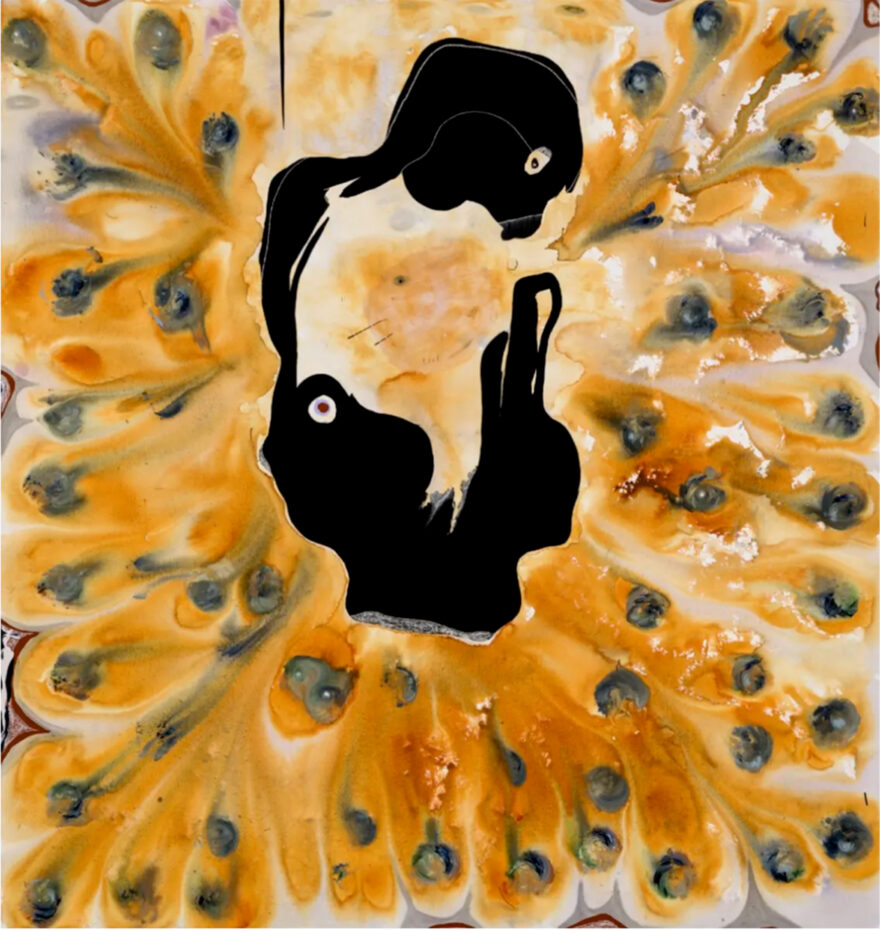
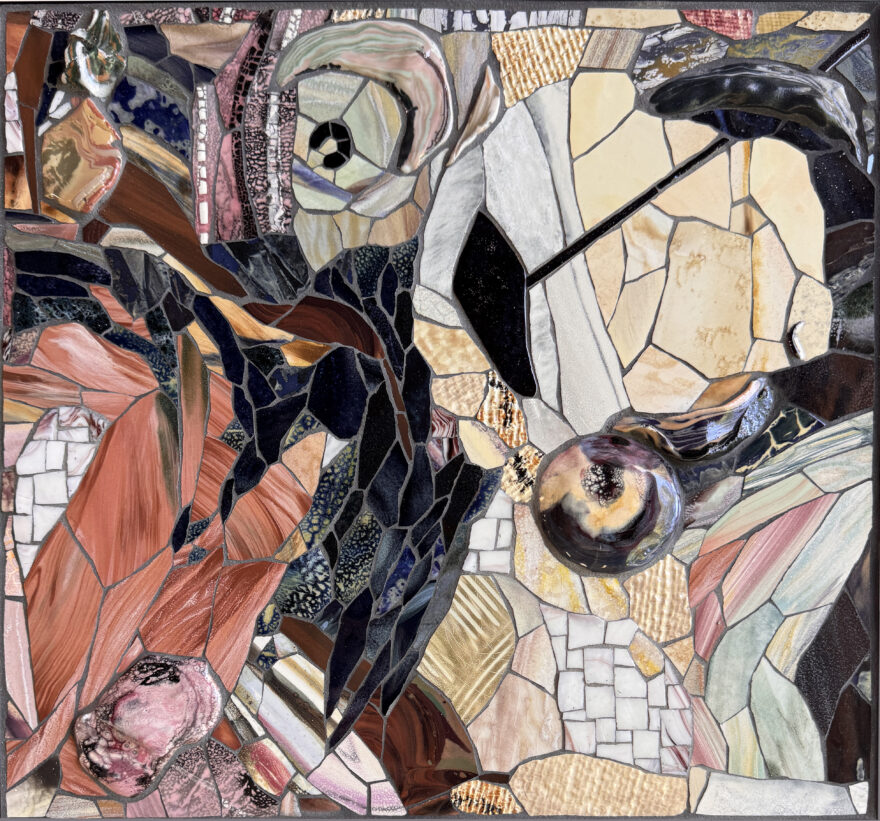
Elsewhere in the exhibition are photographs, drawings, mosaics and an installation made from iron wire. In Consumé, irregular fragments of ceramic in salmon pink, cream, rust and deep blue form a dense, fractured composition. With the same colours and swirling movement as his paintings, it is unmistakably a Manuel Mathieu, but rendered in glazed ceramic rather than paint. Mosaic is hardly unfamiliar territory for the artist: his monumental Le Mont habité is a permanent commission for Montreal’s Édouard-Montpetit REM station.
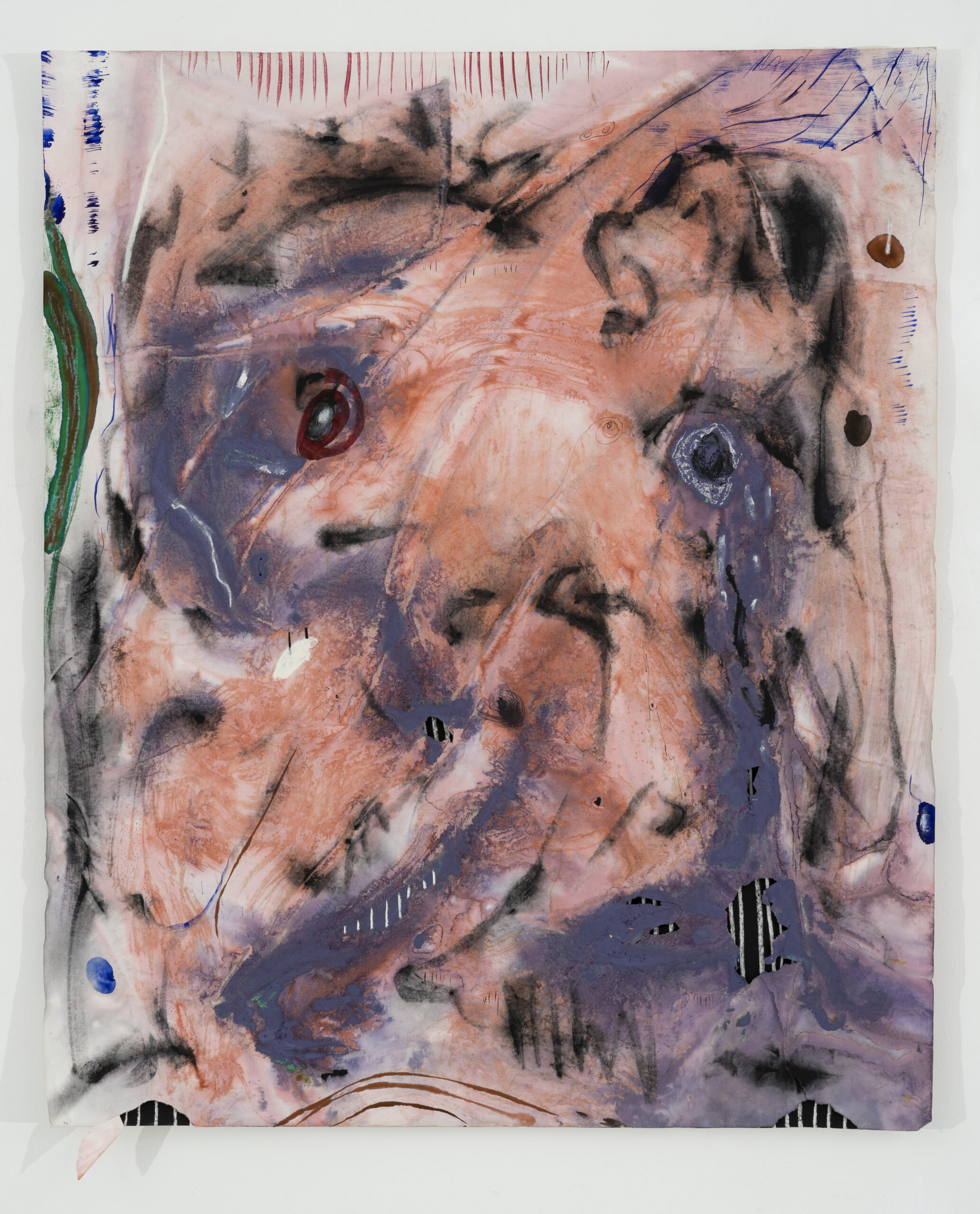
But it is A Square of Heart History that Mathieu is particularly keen to discuss. Thick swirls of mauve, violet and fleshy pink sit marbled at the centre of the canvas. At first glance, the composition appears entirely abstract, but a brief squint brings human features into focus: a blue eye, a tongue, the arch of an eyebrow. Just as quickly as they appear, they seem to slip away, dissolving back into the folds of paint. Surrounding this tangle of forms is a loose, brick-like grid of pale turquoise and ochre, its geometric regularity at odds with the fluidity of the image within. The painting is an assertion of artistic freedom. As a Black Haitian artist working within a predominantly European art-historical canon, Mathieu relishes the opportunity to “enter into that art history and tweak it, manipulate it, and use it.”
Mathieu’s relationship with European art history has been a complicated one. Growing up in Port-au-Prince, he was first exposed to Haitian artists, before a mentor he met at 15 introduced him to contemporary European and American art. In recent years, however, he has found himself looking back towards the artistic traditions of his homeland. “I felt I’d been diluted by learning so much about European artists,” he tells me. He has also begun questioning the terminology through which those traditions are understood. “Haiti was doing surrealism before we coined the word Surrealism,” he says. “And since that’s the case, what was it called? How do you name it? How do you talk about it?”
After lunch, we set off for Art Basel Paris, where Mathieu is showing new paintings and drawings alongside fellow Canadian artist Kapwani Kiwanga at Galerie Poggi’s booth in the Emergence sector. We make our way through the streets of the 8th arrondissement, past the Madeleine and towards the Grand Palais. As a Brit incapable of remembering which way to look when crossing a Parisian street, I find myself repeatedly being pulled back from oncoming traffic by Mathieu. “You need to be careful,” he warns, reminding me how, back in 2015, he was struck by a stolen moped while studying at Goldsmiths in London, suffering a traumatic brain injury.
We pass the Musée du Parfum, and Mathieu mentions that he has a meeting with his “nose” the following day. “My perfumer!” he adds, sensing my confusion. Mathieu has recently ventured into the world of fragrance, creating three scents inspired by Haiti, each with Haitian vetiver at its heart. Like his paintings, the fragrances draw on memories of Haiti, but through scent rather than colour and form. “I think we’re in a very important moment of paradigm shift in the world right now where the figure of the artist is evolving very fast,” he says, foreseeing a future in which the worlds of art and luxury “will play a big role in defining what an artist is.”
By the time we reach the Grand Palais, the heavens have opened. The wind catches the water from the fountains, sending it sideways in great sheets of spray. “The most subversive thing that could happen is for the entire of Paris to smell like Ile Noir,” Mathieu says. “I can’t even imagine if it happens in real life,” he adds, considering how it might change perceptions of Haiti, “and also about what perfume can be.”