

Tarini Malik, curator of the Global Futures section at the inaugural Frieze Abu Dhabi, on the solo presentations that connect place, material, and lived experience.

For the inaugural edition of Frieze Abu Dhabi, I have curated Global Futures, a section bringing together solo presentations by artists whose practices traverse generations, geographies and cultural histories. At its heart is an interest in the resonances that connect seemingly disparate experiences, and in art’s capacity to articulate something of our shared humanity without diminishing the particularities of place. Global Futures takes shape through the intersecting histories and contemporary artistic dialogues of the Gulf, West Asia, North and West Africa, and South Asia, considering how ideas, experiences and cultural forms circulate across these geographies and beyond. Rather than approaching these regions as discrete territories, the section proposes Abu Dhabi as a point of departure for conversations that extend far beyond its borders.
One such conversation emerges between Palestinian artist Mohammed Joha, presented by Zawyeh Gallery, and Jordanian artist Ala Younis, presented by Taymour Grahne Projects. Although their practices emerge from markedly different contexts, both explore how architecture bears witness to human experience, and how the built environment becomes an archive of collective memory. Ahead of a conversation with both artists at the fair on 21 November, I wanted to trace some of the affinities between their practices, and consider what might emerge through their encounter.
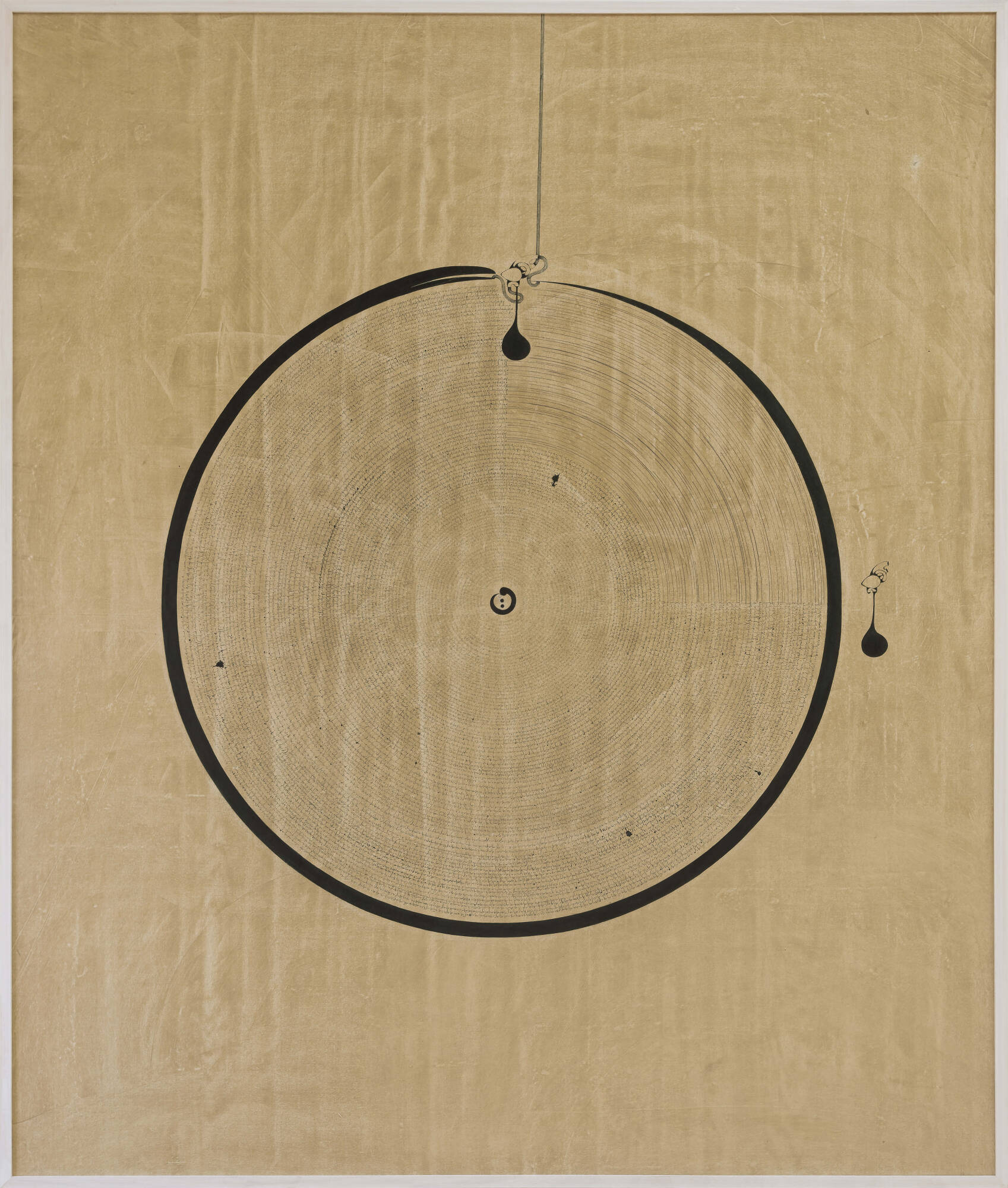
Born in Gaza in 1978 and now based in Marseille, Joha has developed a visual language in which painting and collage become instruments for navigating displacement, destruction and memory. In his recent Houselessness series, fragments of fabric, paper, cardboard and other salvaged materials are assembled into densely layered compositions that evoke the physical and psychological landscapes of loss. The series emerges from an intensely personal experience of dispossession: Joha’s family home in Gaza was destroyed, burying more than 500 of his paintings beneath the rubble. Some of the materials incorporated into his works include torn fragments of his own clothing, investing the act of reconstruction with an intimate, bodily dimension.
There is an important distinction within the series between the loss of a house and the loss of a home. For Joha, Palestine remains an enduring site of belonging, even as its physical structures are systematically destroyed. His compositions, with their exposed seams and compressed arrangements of material, speak to the precarity of lives continually subjected to violence and displacement. Yet within the muted greys, which recall the dust and debris of destruction, vivid passages of colour and pattern emerge: small assertions of life, domestic memory and beauty. The act of assembling fragments becomes both a formal strategy and a profoundly human gesture, suggesting that reconstruction is not simply the rebuilding of physical structures, but also the preservation of identities and relationships that cannot so easily be erased.
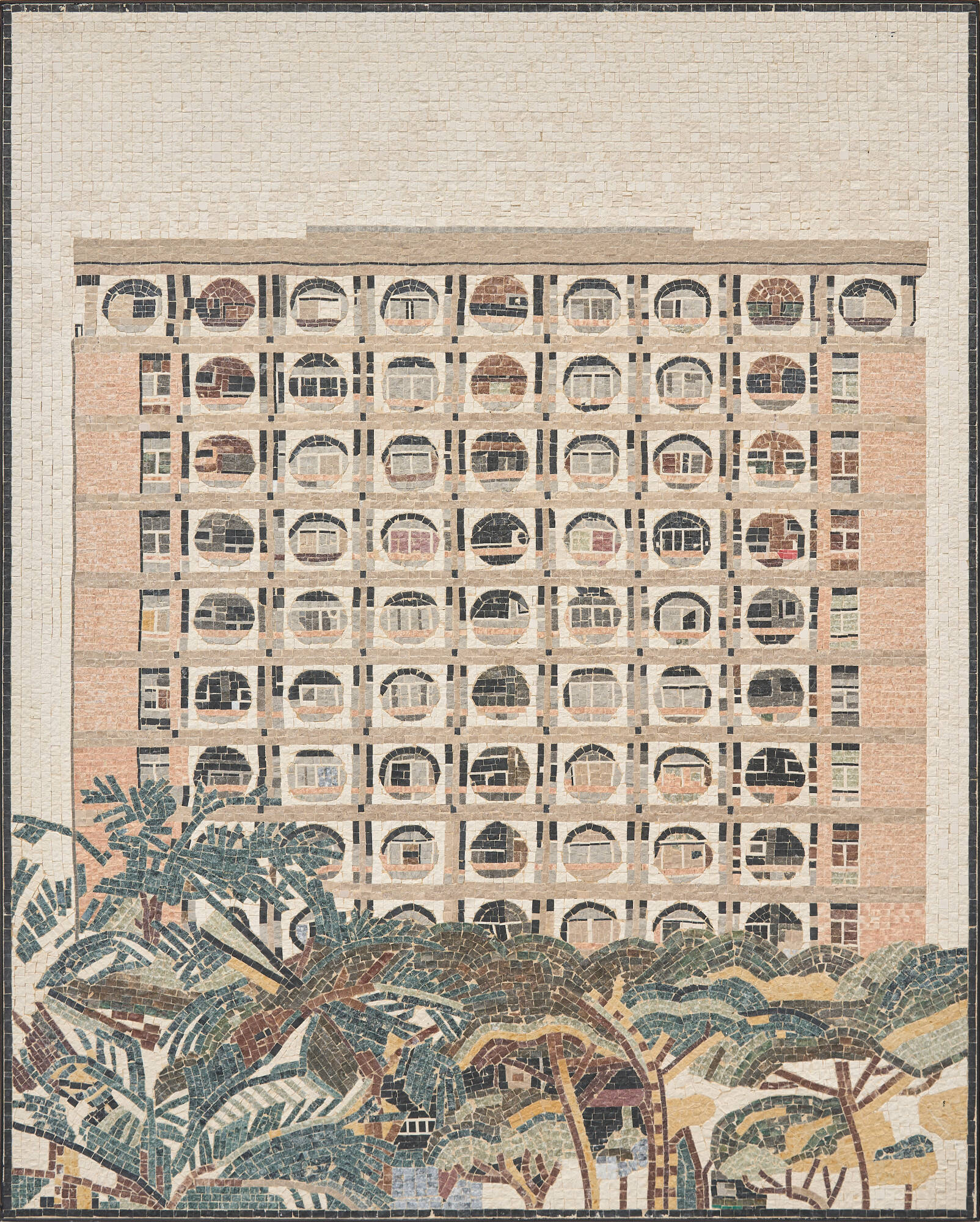
Younis approaches architecture through a different register. Trained as an architect, her wider practice explores the relationship between built environments, political histories and the often-overlooked narratives of modernity in the Arab world. Her Climate Conditions series, initiated in 2025, considers Abu Dhabi’s modernist architecture, particularly the residential and civic buildings constructed during the city’s rapid transformation in the late twentieth century. With their deeply recessed windows, shaded balconies and concrete façades, these structures were designed in response to the particular environmental conditions of the Gulf. Once expressions of an emergent modernity, many have since disappeared or face an uncertain future within the changing urban landscape.
Having lived in Abu Dhabi, Younis became fascinated by the almost animate qualities of these buildings: the sounds of materials expanding and contracting in response to the city’s intense heat, the gradual effects of humidity, and the ways architectural forms absorb the passage of time. In her mosaics, these ordinary structures acquire an unexpected monumentality. Their façades are painstakingly reconstructed through arrangements of hand-cut stone, each fragment contributing to an image that is at once coherent and visibly fissured.
The choice of mosaic is particularly compelling. With a history extending across Byzantine and Islamic architectural traditions, the medium has long occupied a space between image, ornament and the built environment. Younis returns mosaic to architecture, but with a subtle reversal: rather than adorning buildings, her tesserae reconstruct their images, transforming a medium historically associated with the permanence of monumental structures into one that commemorates the city’s disappearing modernist fabric. The individual fragments also evoke the physical stresses borne by these buildings under the region’s extreme climatic conditions. There is something affecting in this convergence of temporalities, as a centuries-old visual language becomes a means of preserving the architectural ambitions and everyday histories of a comparatively recent past. Younis’s works invite us to reconsider which buildings are deemed worthy of preservation, and whose experiences become part of a city’s historical imagination.
What interests me in bringing these practices into dialogue is their shared understanding of architecture as something inseparable from the lives unfolding within and around it. If Joha’s fragmented compositions confront the violent unmaking of the spaces that sustain everyday life, Younis’s mosaics attend to the gradual disappearance of buildings that embody histories of habitation and collective aspiration. The distinction between destruction through violence and transformation through urban development is fundamental, yet both artists ask what survives when the physical fabric of a place is lost.
There is also a compelling material correspondence between their practices. Both work through processes of fragmentation and assembly, constructing images from disparate elements. Their surfaces reveal the labour of bringing things together, while refusing to conceal the joins that make the whole possible. These gestures carry different urgencies, but each suggests that memory is not a fixed repository of the past. It is something continually made, remade and negotiated in the present.
For me, this is where the possibilities of curating become particularly meaningful. An exhibition can create a space in which distinct artistic languages illuminate one another, generating connections that might not otherwise have been apparent. Such resonances emerge not through the erasure of difference, but through its proximity, allowing us to recognise both the singularity of each artist’s position and the questions that travel between them. There is something of a mosaic in this curatorial proposition too: a constellation of individual practices that retains the integrity of its constituent parts while producing new relationships and meanings.
Their conversation, then, is not one of equivalence, but of resonance. Across different geographies and histories, Joha and Younis remind us that architecture is never simply a matter of what is built, but also of what is lived, remembered and lost. Perhaps it is here that art finds one of its most enduring purposes: to give form to what might otherwise disappear.