
At London’s Hayward Gallery, Renée Levi’s monumental paintings transform Brutalist architecture into a canvas for human expression. The artist speaks to Allard van Hoorn about the transformative power of making a mark.
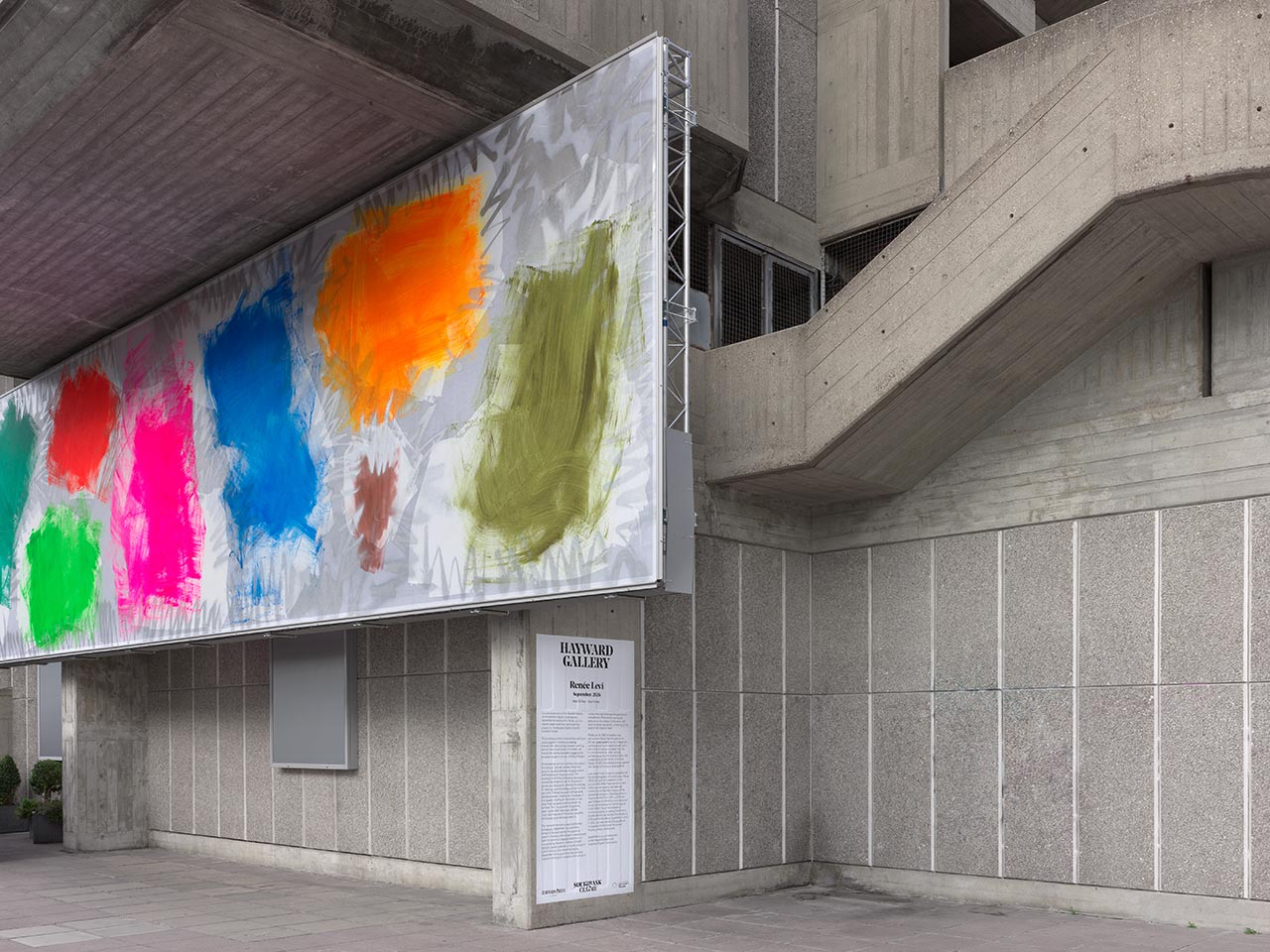
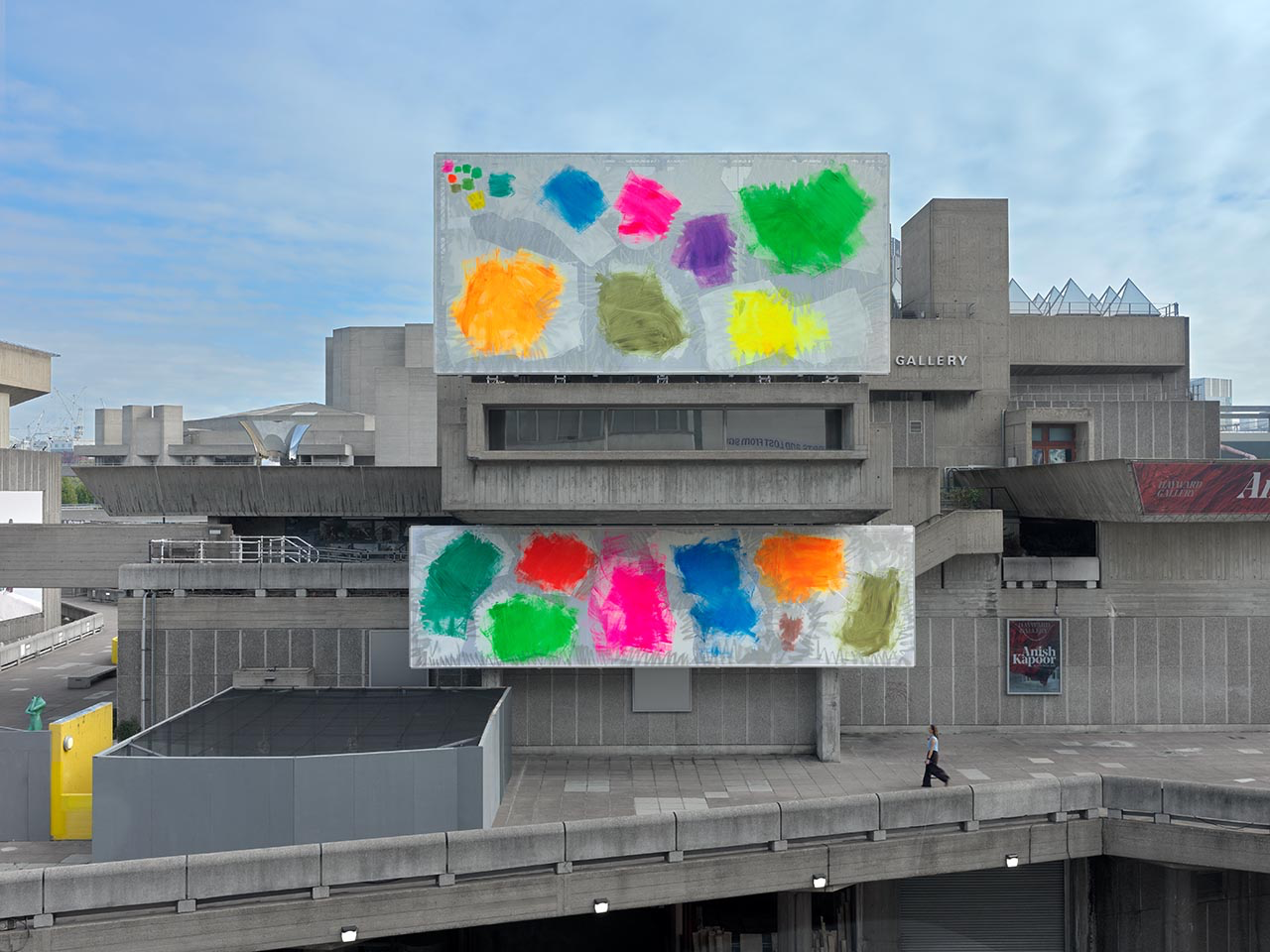
There is something arresting about the new site-specific artwork sitting on the facade of the Hayward Gallery, that hardcore Brutalist intervention in public space. The giant painting is a form of accentuated graffiti, a mark-making in the public realm that seems to say: humans were here, humans are here, we still see and feel and breathe, and we still interact and exist together. Here, we mark the grey concrete with colourful reminders of our presence.

Renée Levi’s September comprises two large billboards hanging off the short end of the building, with bright neon patches that almost resemble a mask. Could this be an anti-billboard, I ask Levi. She explains that nothing in her work is anti-, or against. “It is always positive, to add, to construct, to complete the existing architecture.” The act of signing a building with graffiti is, of course, a classic form of urban appropriation. But does this work reclaim the building it intervenes in? For Levi, it is about transforming the architecture into “something it should be, or at least into a space she would like to be in, live in.”
Sometimes the works are huge in scale, sitting high above us like artistic advertisements on the Hayward Gallery, invoking an urge to draw, to paste colour, life and happiness onto the familiar faces of buildings. Or, as Levi says, “everybody wants to draw a line.” She makes us complicit in this act, and in smaller interventions, scaled down to the human body, we find ourselves right there, our own bodies becoming a measure of the space.
At Palais de Tokyo, she created a monument to marginalised, suppressed and oppressed women. I ask her whether she feels the architecture temporarily takes on an energy of resistance, perhaps even protest. And whether this piece, titled La Elle, might be a manifestation of some shamanic, architectural or artistic ritual of transformation. I probe further, asking whether direct interventions in architecture, such as writing on walls, leave something of their energy within the physical material, perhaps even creating a permanent change. But Levi resists overtly political or existential interpretations. For her, it remains about the body, expressed through paint and the permanence of the painterly gesture, intervening in and completing the architecture so that she might feel integrated into it. It is, after all, a deeply physical experience.
As Levi’s body becomes the measure of the gestures in her paintings, her life and studio partner since 1998, Marcel Schmid, is the engineer of the couple. While Levi originally trained and worked as an architect, Schmid calculates, measures, engineers and reinvents the surfaces on which she works. There seems to be no poetry without the mathematics of construction. In the way Levi and Schmid collaborate, their practices are intertwined, working together to insert the brightly coloured body into space. Ultimately, they are anchored in one another: the works, the humans, the partners.
And finally, there is the aspect of sound, perhaps the most ephemeral quality Levi considers in her work. Not only do her urban interventions change the pace and movement of the observer, and with it the sonic fabric of public space, but naming itself becomes a sonic act, allowing for subtle shifts in perception. Through poetic, dialectical and phonetic gestures, Levi gently alters the ebb and flow of our experience of her work.
Audemars Piguet Contemporary commissions international artists to create contemporary artworks. The resulting works belong to the artists and contribute to their wider practice. With the support of two in-house curators, commissions are realised across a variety of scales and media, enabling artists to explore new territories in their work. The team oversees each commission from inception to exhibition, while the nomadic programme fosters collaborations with cultural institutions around the world, bringing the works to international audiences.
The intervention on the facade of the Hayward Gallery by Renée Levi titled ‘September’ is on view until 15 November 2026.