
Nicolas Poblete on the Swedish painter’s current solo exhibition in New York, and the new relationality to our cosmos that it offers.

“I am a citizen of the world [kosmopolitês]”
— Diogenes of Sinope, 4th century BCE
Somewhere among those stars composing the constellation Ophiuchus is Gaia BH1, the nearest black hole ever observed from New York City. It is here again. A meter away from me. 1,560 light years away from now. When we recognize that distance is relative, that only time separates us, it’s easier thinking our paths will eventually cross. Everything belongs everywhere at some point in time.
There is a loose region around black holes where spacetime is warped, twisted, pressured with such violence that everything inside its confines is coerced into motion, into the pull of their orbit. They are called “ergospheres.” Paul Fägerskiöld: Ergospheres, at Peter Blum Gallery, New York, takes this notion as an aesthetic principle. To travel through the spiral of the gallery space is to fall into the orbit of multiple ergospheres, submitting to their will and embracing the humbling magnitude of the cosmos.
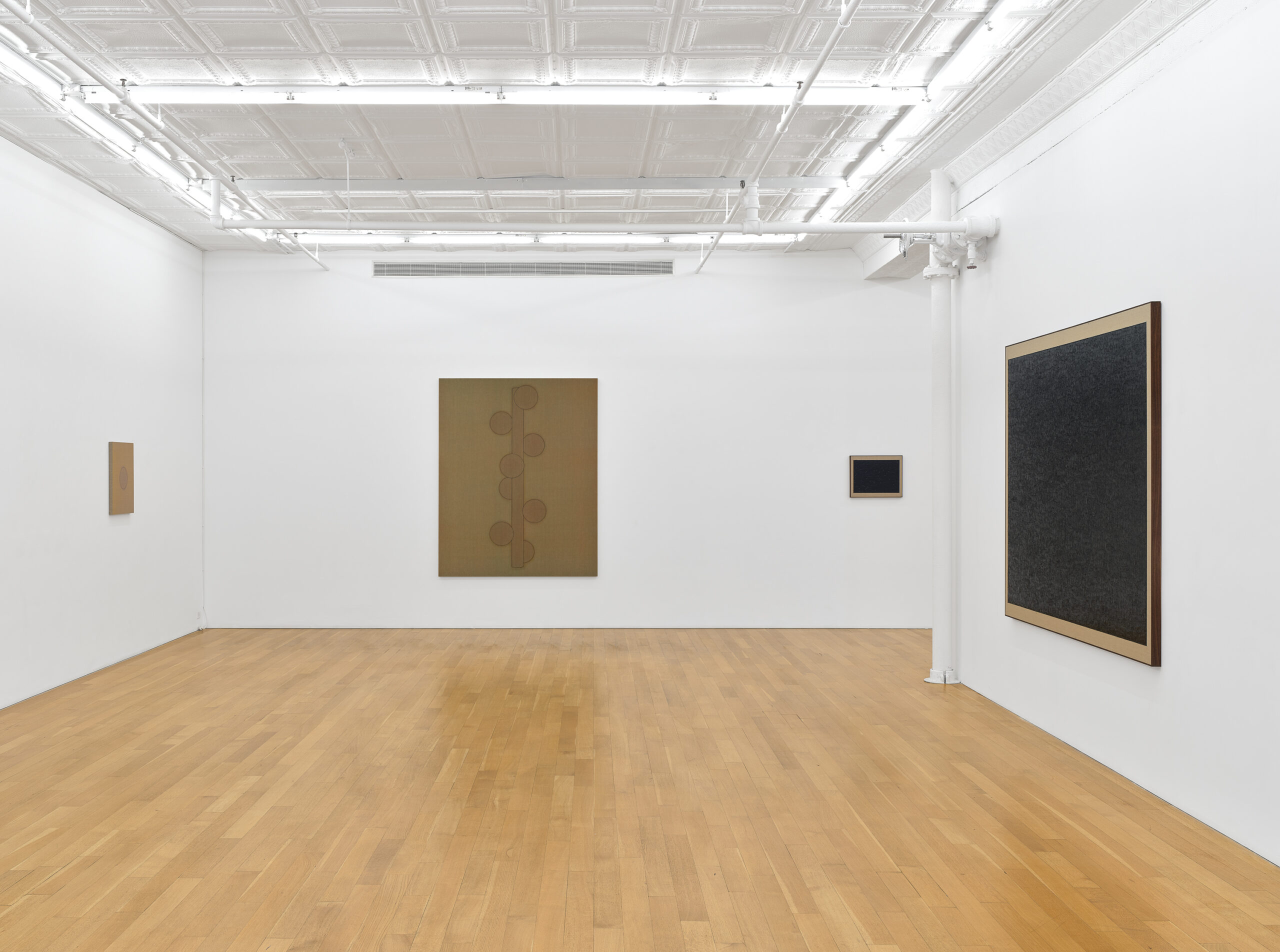
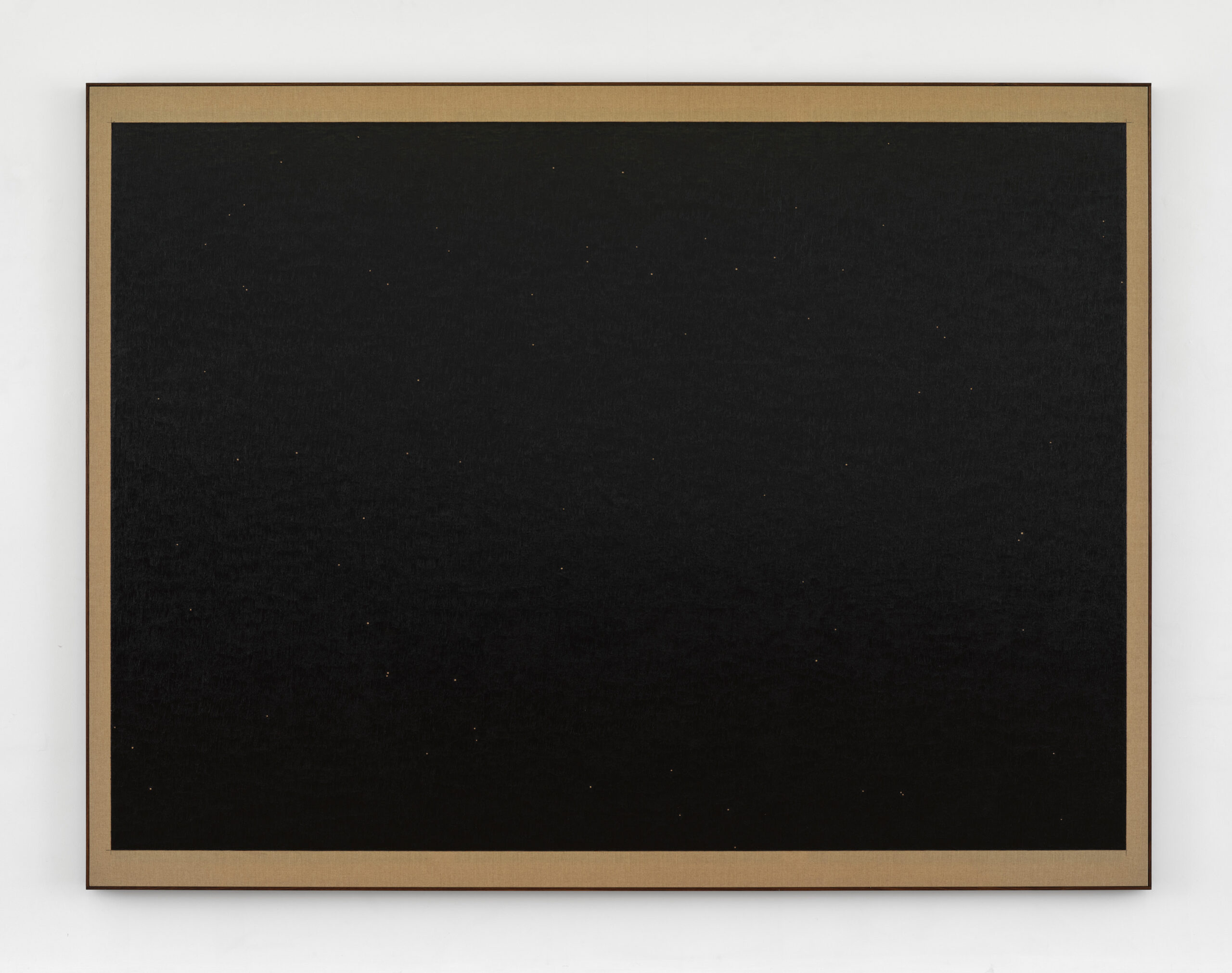
The exhibition is made up of three bodies of work. The Starry Nights paintings — visions of cosmic regions seen through the gaze of our solar system — contain sedimented coats of acrylic and oil on raw linen, left bare around the border of the canvas and in small circles to emulate stars. The Time Trees and the Spheres, frameless microscopic studies, are pictured with transparent paint applied so lightly that the medium imprints into the canvas, their spectral texture lending them a holographic presence. The artist muddies the borders between flatness and pictorialism, opacity and translucence, producing art with the logic of a black hole and toying with the holographic principle — the idea that all three-dimensional objects can be captured fully on a two-dimensional plane. What if a circle is a black hole? Fägerskiöld brings en plein air to outer space and makes you wander with him.
For all of its technical prowess, the body of work strikes me for its underlying concerns about the universe. What first came off as obsessive minimalism gradually unfolded as I spent more time with the work, each brushstroke brimming with a subdued sentimentality. There is certainly a Rothko-esque search for the sublime here, but what Fägerskiöld gets at is more specific, and dare I say human. While this is an ode to our expansive universe, Fägerskiöld adopts an anthropocentric gaze: these are views from New York and the Solar System — visions of what cradles us. Yet he never defines the “us” in question, treating every parcel of our Solar System as sharing a unified subjectivity and gaze. In this way, Fägerskiöld offers a new relationality to our cosmos.
I used to think space had nothing to do with our world — that space exploration was just noble escapism — but I was wrong. There’s a politics to our relationship to space (who gets there first; who gets to picture it; how it’s pictured; what is shown and omitted). NASA conspiracies are far too prevalent to diminish this. Across cultures, astronomical cycles and bodies have guided our conceptions of time and the self. The Solar System has always been part of us.
The word “cosmopolitan” helps us think about our rapport to the cosmos. The word originated from Ancient Greek Cynic philosopher Diogenes of Sinope. As the story goes, Diogenes was expelled from his city-state and during his travels asked where he belonged. “I am a citizen of the world [kosmopolitês],” he responded, supposedly bridging the words kosmos (“cosmos”) and politês (“citizen”) for the first time. Unknowingly, Diogenes was an early practitioner of the holographic principle. He defied the limits of human perception and saw through the expansive universe contained within his supposed flatness. I am a citizen of the world and so are you.
In a moment of rising hyper-nationalism in the United States and abroad, I can’t help but see Fägerskiöld’s spiral poem as a meditation on the meaning of cosmopolitanism, of being a citizen of the world. It’s no wonder why New York City — arguably the world’s quintessential cosmopolis — is the exhibition’s starting point. Fägerskiöld, like Diogenes before him, is a devoted practitioner of the holographic principle. A collapser of borders. A defier of the illusory platitudes of flatness. A proponent of oneness. I am a citizen of the world and so are you. The will of the ergospheres unites us all.