
“No society can tattle us off as being scribble-scrabble artists – and to that, we give ‘em the knife!” – Rammellzee
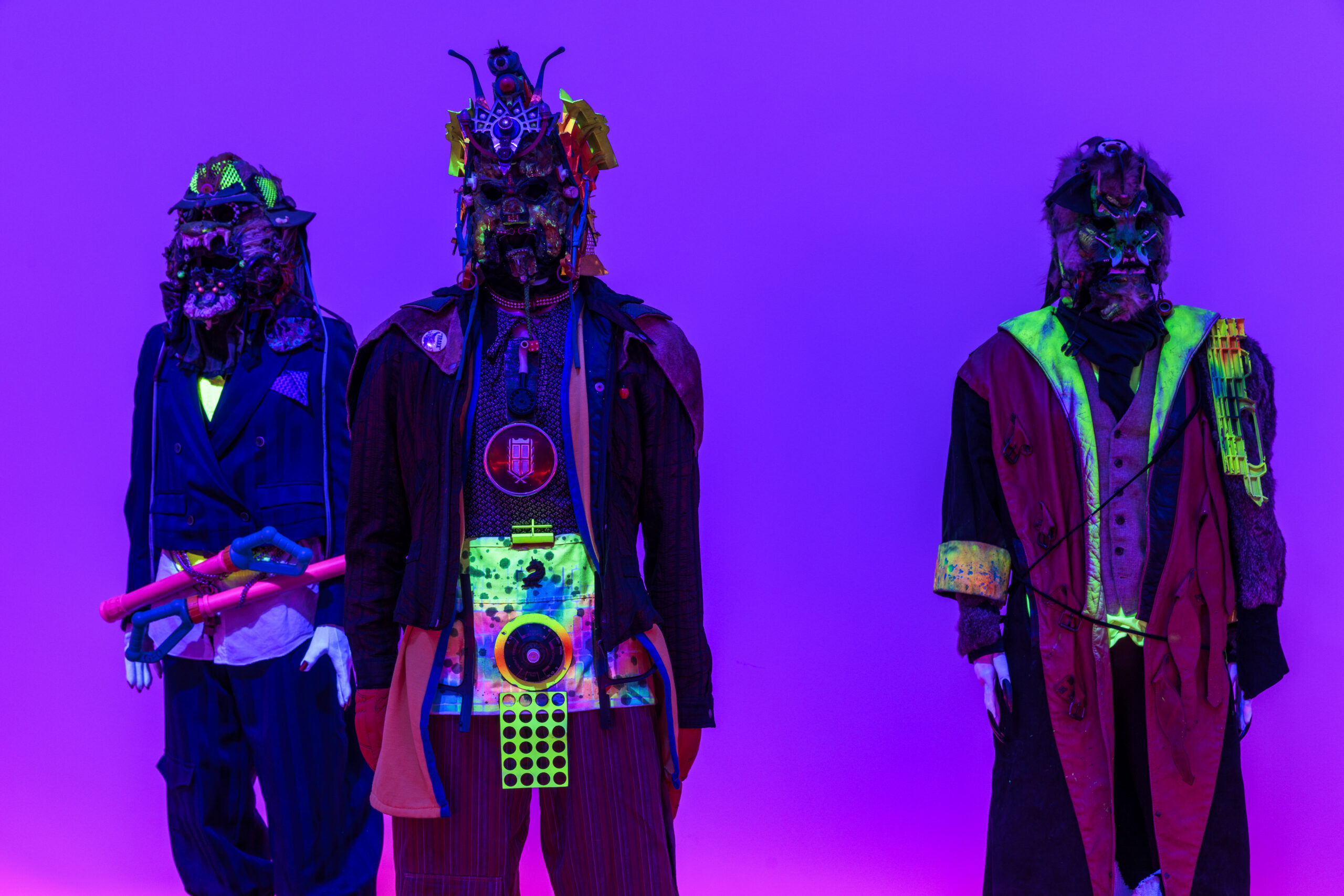
In a documentary called “Guerilla Art by Goetz Werner”, the New York City “graffiti-sprayer” Rammellzee proclaims he’s just an “average Joe.” However, your average Joe doesn’t quite look like a samurai Transformer made of multi-coloured space debris. He is, what he coined, a gothic-futuristic “Garbage God” – in other words, he’s an armoured, neon Shinobi, a katamari of hip-hop aesthetics which has rolled out from the ashes of a nuclear bomb set off in an alternate reality, leading to the artist becoming fused with the eclectic rubble of graffiti-tagged walls, litters of cosplay refuse, trinkets of a shattered New York City. “I am the equation known as the Rammellzee,” the artist says. “I am some 16 billion years old.”
He is a magpie in the form of a mecha – his low-fantasy alter egos were extensions of a self-created philosophy of Ikonoklast Panzerism, an aesthetic that borrows its name from the German Panzerkampfwagen, essentially meaning “armoured fighting vehicle.” Inspired by medieval manuscripts, Afrofuturism, and hip-hop culture, the wunderkind would be known by friends and family for filling molars if he hadn’t fallen in with eccentric crews of graffiti artists in the early 80s, founding groups such as Death Comet Crew and Tag Master Killers, the latter of which claimed A-One, the creator of “aerosol expressionism.”

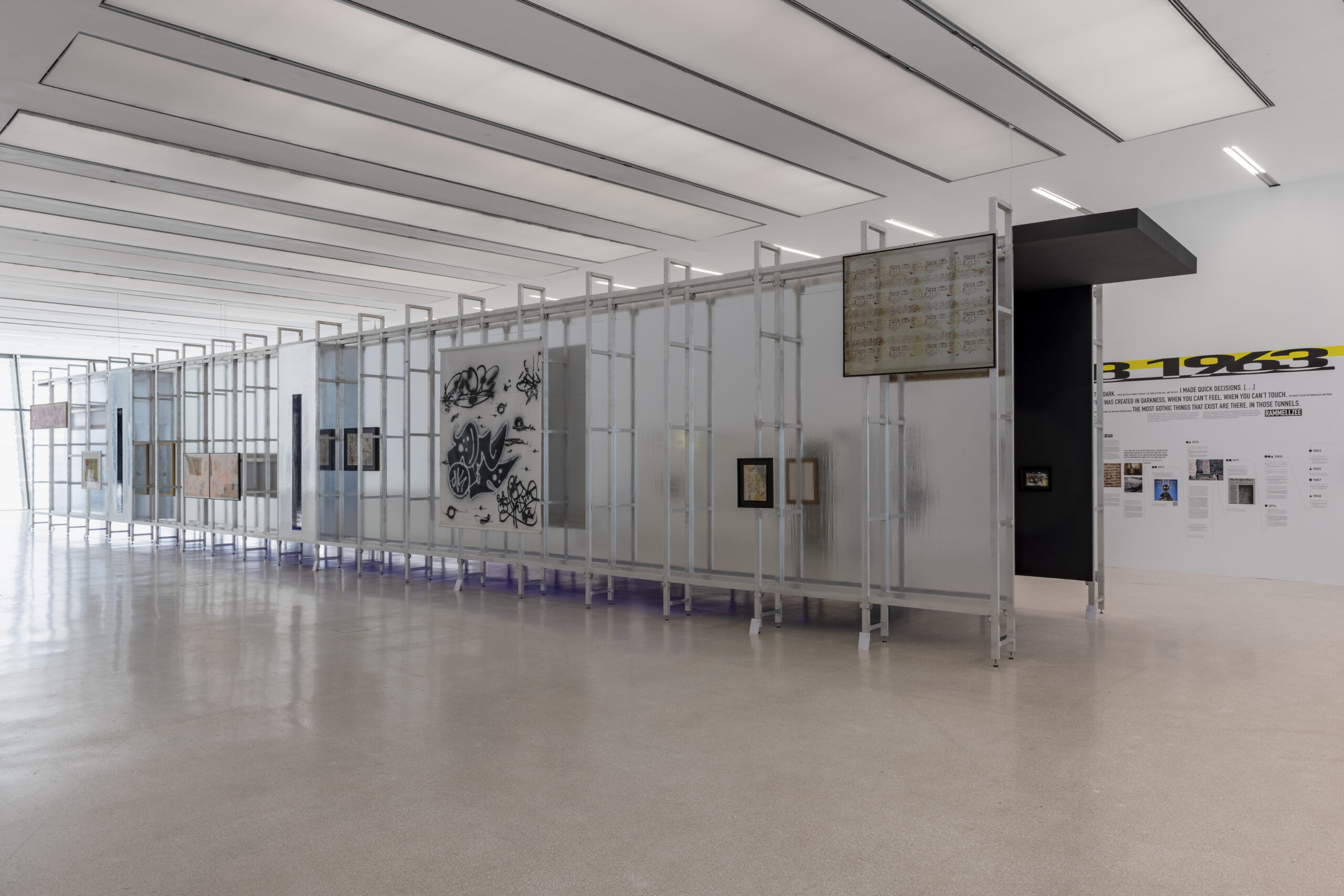
Expressionistic in a fashion we’ve hardly seen since his passing in 2010, Rammellzee once said he could “boomerang through time, making sure that a sledgehammer can cause a cosmic flush.” It doesn’t matter what that means, it’s just exactly the kind of prophecy that RAMM:ELL:ZEE TIME:LINE, a current exhibition at Bolzano’s Museion (17 October to 14 March 2027) is here to fulfil. It’s a testament to why exhibitions should display contemporary masters – we can make sure that gods, even those made of garbage, will never die.
Recently I’ve become aware of how culturally significant graffiti is. Prior to learning about Rammellzee’s theory of Gothic Futurism, which describes graffiti as “the weaponisation of letters in a battle to reclaim language from a diseased culture of social control,” I had perhaps ignorantly deemed graffiti as a visual nuisance. But then again, I live in London, and don’t kill me for saying this, but I’m exposed to a great deal of what graffiti artist Al Diaz calls “ego graffiti” – names of personas sprayed often haphazardly on any clean surface it can find, becoming a competitive game of style, territory-claiming, and catch-me-if-you-can with the Big Apple’s Vandal Squad. What Diaz and Basquiat did in the 80s with their iconic tag SAMO was create an experiment out of hype – injecting graffiti with strokes of satire, political commentary, and fine art. It wasn’t simply “I Wuz Here”, but a living concept that could die – and it literally did.
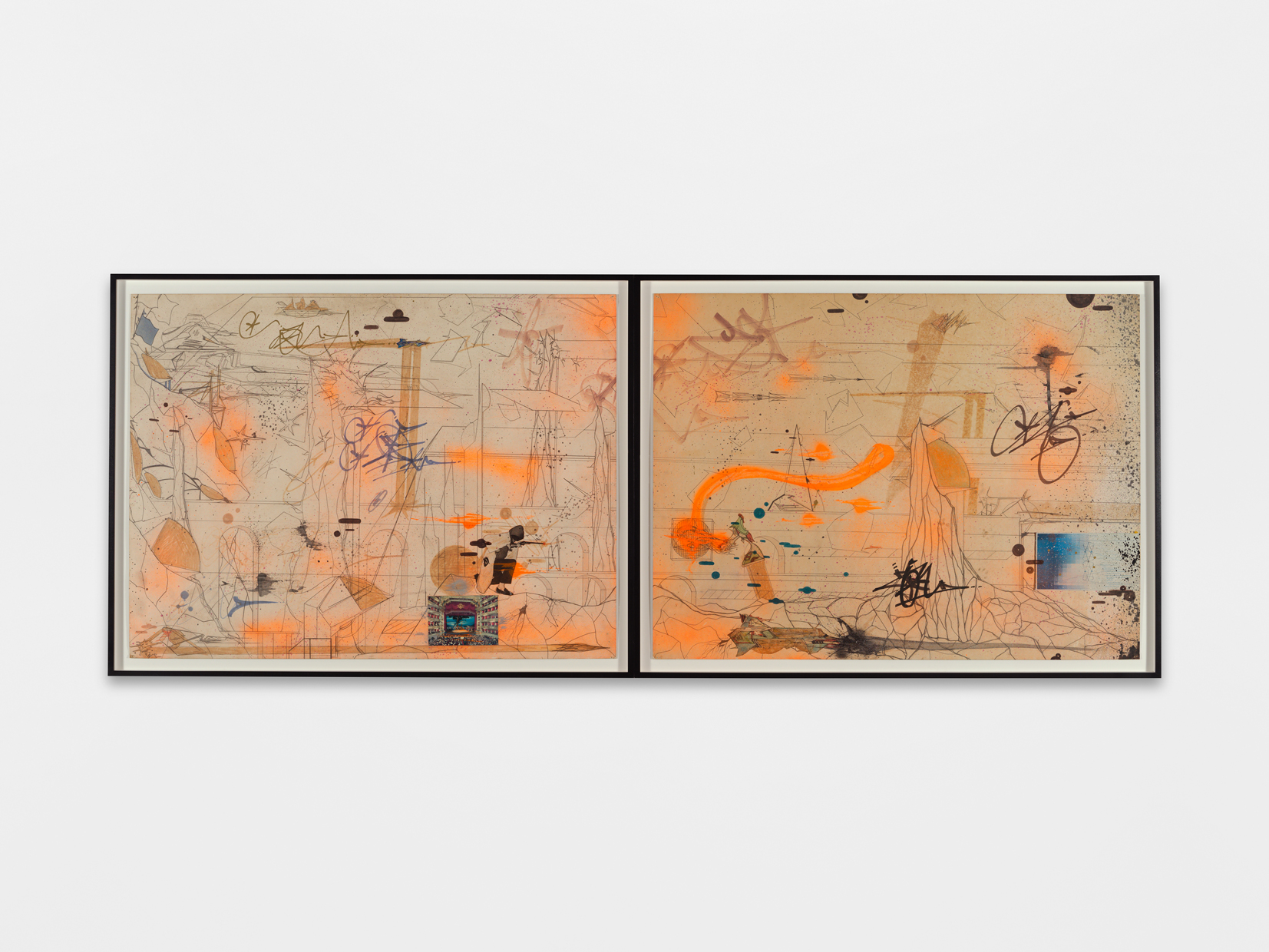
Expanding on the evolving concept of graffiti, the exhibition builds into its walls a literal timeline; charting births and deaths of aesthetic movements through pop cultural events. To understand Rammellzee, an artist who swallowed everything in his wake and spat it out as bombastic bricolages, you must understand the world in which he was reacting to, as well as the works of Richard Hambleton’s brilliant body graffiti works, and Cudelice Brazelton IV’s similar body-outline works, where he drew onto the exhibition walls using a soldering iron, creating a smouldering indigo drawing material out of melted denim abd reimagining the materials we use to create wall paintings. The timeline intelligently includes events such as the original airing of Neon Genesis Evangelion or the discovery of ultraviolet radiation, allowing graffiti to share the same cultural scale as groundbreaking media or major scientific breakthroughs, legitimising it as a watermark era in its own right.
At the beginning of the line, we see Étienne Léopold Trouvelot’s 1885 pathbreaking illustrations of astronomical events, and near the end, the first image of a supermassive black hole obtained by the Event Horizon telescope. It’s fitting: cosmic dust runs through Rammellzee’s combustible oeuvre, you can see it in the specks of paint that spit out of aerosol cans, you can see it the aural complexions of his canvases – you can see how language has travelled across the galaxy to arrive to us now. Perhaps it was too on-the-nose to include the publishing of the first ever English dictionary, but as exhibitiongoers can see, it has exploded onto the walls in these mutant forms.
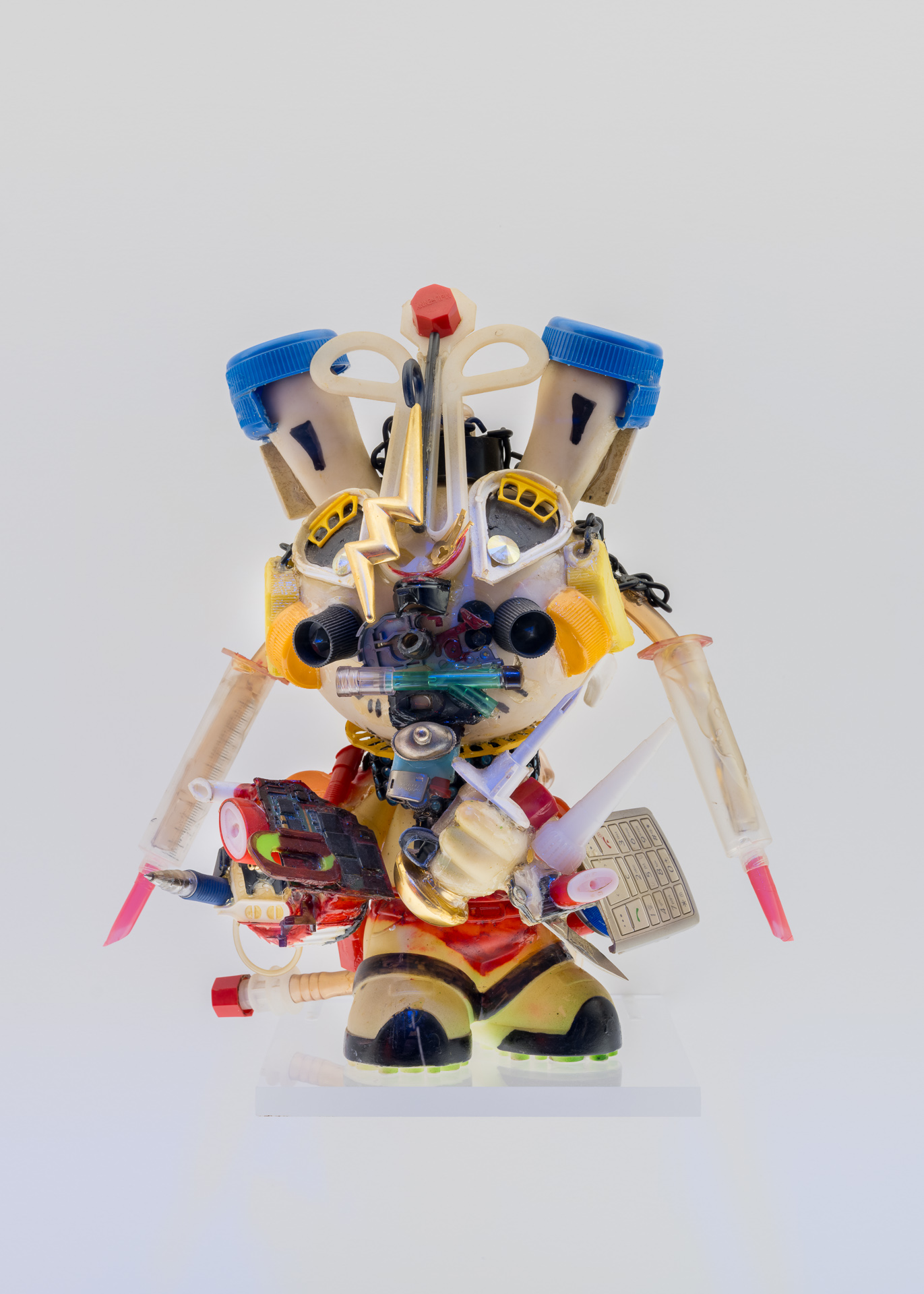
Travelling through time with the exhibition is above all an odyssey through language, in its primordial, ascended and invented forms. In the brilliant Dictionary of the Illegible by Laurenz Brunner, a book that looks at the dissolution of language across thousands of years of communication history, graffiti appears as one type of radical illegibility; transfigurations of conventional language which become the evidence of lives existing outside of traditional script. Rammellzee believed language – as we speak, read and write it – was institutionalised, standardised and designed to control the masses. Blending symbology, calligraphy, medieval script, pictograms and graffiti through self-directed painting ethoses – such as “Wild Style”, “Guerillaism”, “Snake Layups”, “Burnerism”, “Blood Technique” and “Intractulisation” – Rammellzee fashioned a type of bayoneted slanguage. Forhim, it was all about the “armament of the letter”, turning words into war machines. Rammellzee fashioned graphic harpoons onto M’s, designed to attack adjacent lettering, and turned B’s into “graffiti maps”, strategies that held within them the art of war. Words had velocity, they had teeth and rocket launchers, words became bullets, razors, iridium flares, an aurora borealis of spray-can technique. Graffiti often, and perhaps purposefully, appears illegible to the uninitiated, much like death metal band logos – but does that equate to unreadability? Better yet, is there such thing as unreadability? It’s difficult to escape the emotionality of Rammellzee’s geometric playfulness, never settling for anything less than shrapnel bombs of language, firing pieces of barbed wire, arrows, and aggressive directionality into your eyes.
Jim Jarmusch, who put Rammellzee in his film Stranger Than Paradise, once said of the artist: “There’s a legend that using the word ‘word’ as slang in hip-hop may have originated with Ramm, and just responding ‘word’ to almost anything is like the reduction of all slang to the essence of a small word. […] I don’t know if it really came from Rammellzee, but it might as well, because it sums up his ability to deconstruct and reduce things to an essence so you look at them differently.” Of every quote attributed to Rammellzee in the exhibition, this one rings the loudest – everything comes down back to ‘word’, the most beautifully simple communication break-down, one that leads everything in his practice, from painting, costume, video art, photography, toy-building and weapon-assembling all back to the gorgeous element of words. Rammellzee’s words were broken, mutated, censored, sawed-off, chewed up and spat out. These are the freaks of human nature, our unreliable, constantly glitching words.
Rammellzee seemed to avoid the word graffiti, instead choosing an invented term “signovertures”, a portmanteau of signage and overture, the latter of which expresses themes through music in orchestral concerts. Rammellzee obviously took huge glee in reclaiming the world through an esoteric lore of artistic gangsterisms – for example, train numbers that featured his paintings were reappropriated into page numbers – fitting, considering anything and everything became a canvas to him and his gangs of linguistic revolutionaries. His alter egos shared a visual and narrative universe, taking names such as Crux the Monk, Alpha Positive, Igniter the Master Alphabiter, Rip-cord Rex and Gangster Duck – a mish-mash of rejected Avengers, Transformers and Warhammer 40K characters. Allergic to the noumenon – things that are how they actually are, independent from human perception – what Rammellzee did best was create a personal mythology that turned private properties into intellectual ones, and made public property even more public.
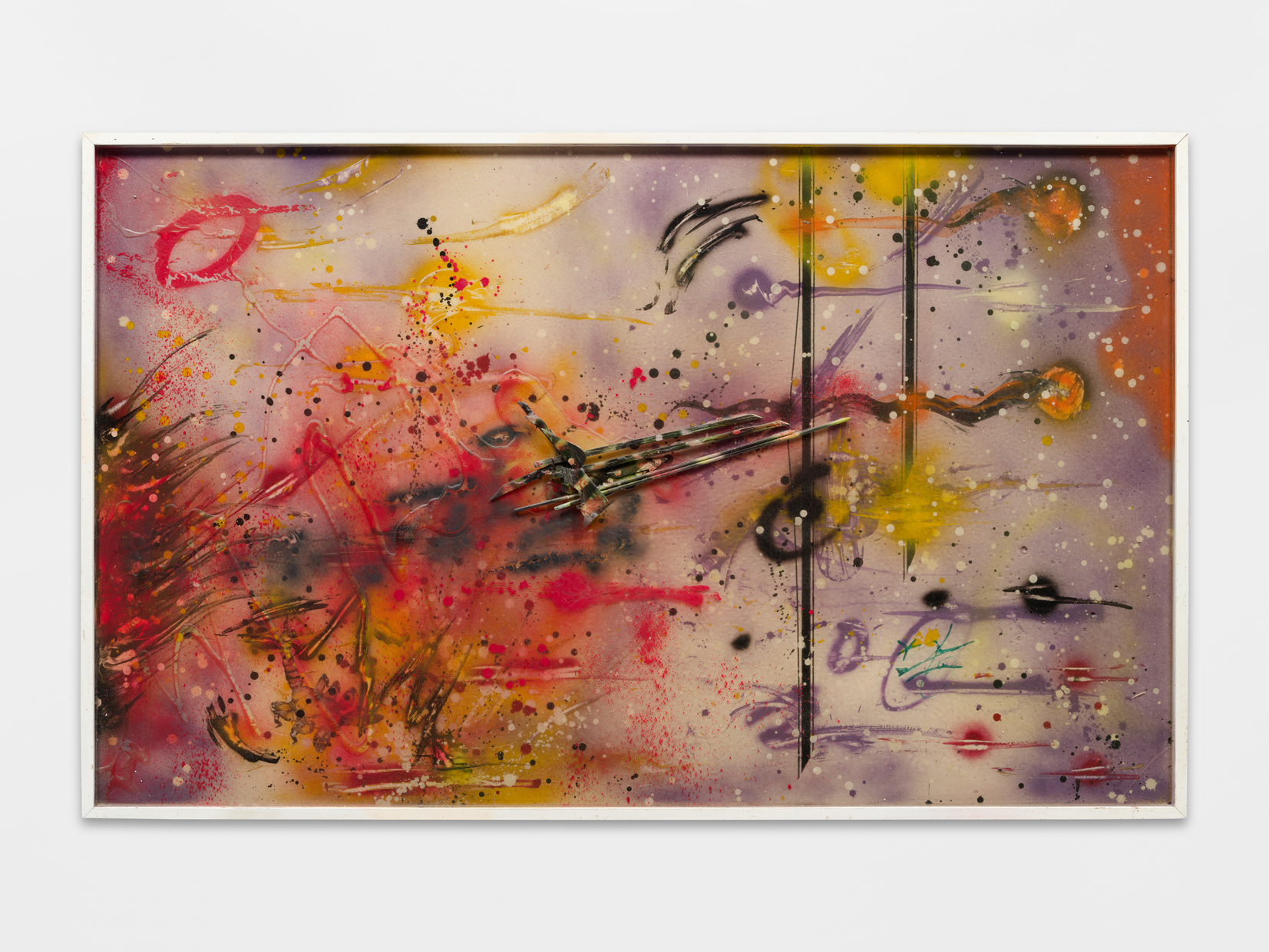
Today, we live in an age of usernames, aliases, personas – we increasingly invent our own identities, shed legal names, choose pen names, we play with self-fictionalisation, reject binaries, deny neat ordering into expected social roles. When travelling through the wormhole of RAMM:ELL:ZEE TIME:LINE, you feel like a new spangled person by the end, empowered by the way in which Rammellzee originated an entirely new world to exist in.
What is undeniable about Rammellzee is the human inside of the armour – I’ve been told by a friend of his that at parties Rammellzee would constantly be supergluing parts of his masks back on as elements fell off throughout the night. Tthe length to which Rammellzee committed to his characters without a single ounce of irony or prank-attitude is incredibly endearing. This was an artist who believed every word he said and gave every letter inside of those words the weapons it needs to survive the ages. How does one simply pay tribute to Rammellzee for ripping up the rule book, for laying down possibilities for such an eccentric self-reinvention? Perhaps we can look to the language we see being used all around us today. One must wonder about how the artist would feel about watermelon emojis being used to self-censor words like Palestine, how sex has become seggs and died has become unalived due to institutional suppression, how our neologisms become increasingly bizarre, how abbreviations like ‘iykyk’ and ‘afaik’ can collapse sentences and reject the uninitiated, how letterforms become garbled through generative imagery, how robots can’t read captchas or most of all: graffiti. Rammellzee’s work was like a vortex of glass shards which glitter attractively, but cut you when you reach for them. When we use our words today, do we draw blood? Or do we bandage something desperate to rise to the surface? To that, I say, give ‘em the knife.
Words by Casper Kelly.